September 29, 2026
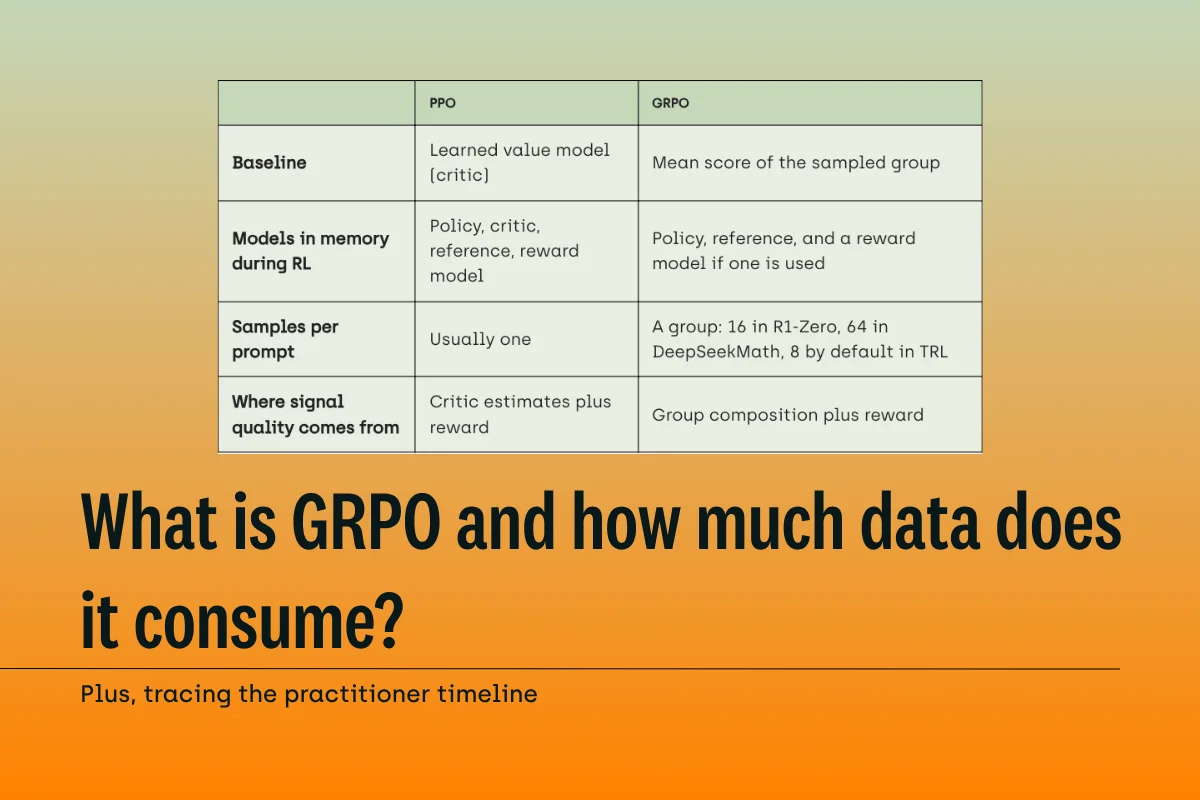
GRPO Explained: Group Relative Policy Optimization and the Data It Consumes
GRPO is the reinforcement learning algorithm behind DeepSeek-R1, Qwen3 and DeepSeek-V3.2. This guide explains how group relative policy optimization scores multiple responses against each other, and why your prompts and your reward model decide whether it learns.
.png)
![Fine-Tuning Audio Models Guide: What Annotation Quality Decides [2026]](https://cdn.prod.website-files.com/68da32b2041c593b0511a582/6a99841bb15b6bb3d7b4c083_Audio%20Fine-Tuning%20Guide.webp)
.webp)
![Best Computer Vision Annotation Tools for On-Premise Labeling [2026] Guide](https://cdn.prod.website-files.com/68da32b2041c593b0511a582/6a8ffe034889a4ba57aa64ba_Competitor%20Article%20-%20Listicle%203.webp)
![ASR Models Guide: Word Error Rate, Benchmarks and Failure Modes [2026]](https://cdn.prod.website-files.com/68da32b2041c593b0511a582/6a7d8d3743d1e7bbda9ae54e_ASR%20Models.webp)
![Speaker Diarization Models Guide: Benchmarks and Failure Modes [2026]](https://cdn.prod.website-files.com/68da32b2041c593b0511a582/6a7599f6a13b83298c74e35c_Speaker%20Diarization%20Models.webp)
![Best On-Premise Data Labeling Platforms for Regulated Industries [2026] Guide](https://cdn.prod.website-files.com/68da32b2041c593b0511a582/6a574849a90d08dc8b9b547d_Competitor%20Article%20-%20Listicle%201%20(2).webp)