Resources

/

Data Labeling

Data Labeling Hub

Guides on building labeled data that general annotators can’t: when to bring in domain experts, how to write guidelines and ontologies that hold up, where model pre-labels help, and how review, agreement checks and routing keep every label defensible.

Data Labeling Hub

The long read · 1 of 3

Data Annotation Guide: How to Achieve High Quality Data in Complex AI Data Operations

Data Annotation Guide: How to Achieve High Quality Data in Complex AI Data Operations

Data quality management is where most enterprise AI projects quietly fail. The teams that treat annotation as an engineering discipline, not an afterthought, are the ones shipping models that work. This guide breaks down the operational practices that produce high quality data at scale, drawing on recent research from Stanford, McKinsey, Google DeepMind, and peer-reviewed annotation science.

Read the guide

Key takeaways

  • 30% of NLP dataset papers apply subpar data quality management
  • Visual guideline examples improve data accuracy; longer text does not
  • Hybrid human-AI pipelines match full-human quality at 6–7% effort
  • EU AI Act mandates documented data quality standards by August 2026
  • AI high performers 3× likelier to define human validation triggers

‍

The long read · 2 of 3

Inter-Rater Reliability for AI Evaluation: Agreement, Gold Answers and Thresholds

Inter-Rater Reliability for AI Evaluation: Agreement, Gold Answers and Thresholds

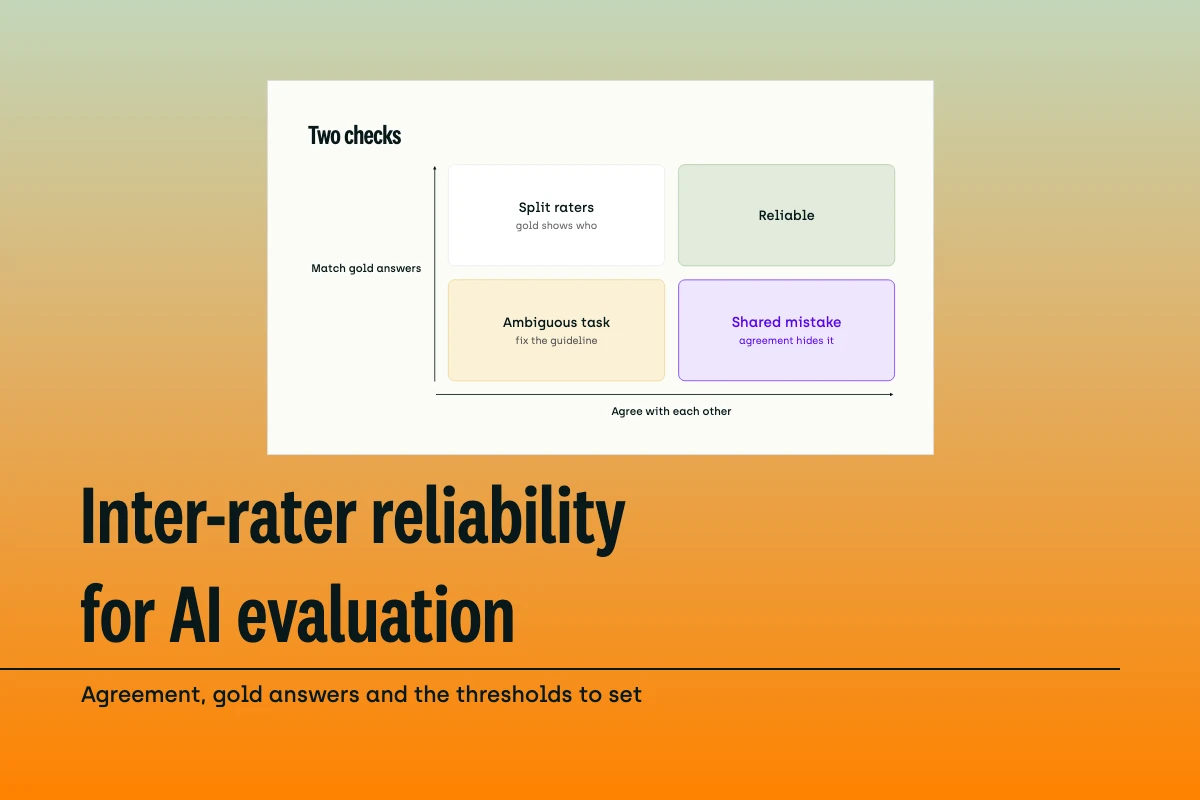
Inter-rater reliability tells you whether your experts' labels can be trusted before they grade a model or train one. This guide covers percent agreement, Cohen's kappa, Fleiss' kappa, Krippendorff's alpha, gold answers and the thresholds to set.

Read the guide

Key takeaways

  • Percent agreement counts lucky matches; kappa and alpha subtract them.
  • Agreement measures consistency between raters. Gold answers measure accuracy. Track both.
  • Two fixed raters: Cohen's kappa. More raters or missing ratings: Fleiss' kappa or Krippendorff's alpha.
  • Aim for 0.8. Treat 0.67 to 0.8 as tentative.

The long read · 3 of 3

Secure Data Labeling Guide: How to Protect Sensitive Data in AI Annotation Operations

Secure Data Labeling Guide: How to Protect Sensitive Data in AI Annotation Operations

Secure data labeling protects sensitive and regulated data during AI annotation without compromising compliance. Learn the deployment, certification, and access control requirements for annotating at scale.

Read the guide

Key takeaways

  • Annotation exposes raw data to more humans than any other pipeline phase
  • SOC 2 Type II and ISO 27001 are baseline; deployment mode determines actual data exposure
  • EU AI Act high-risk obligations (December 2027) mandate documented data governance for labeling
  • Defense, healthcare, and finance are driving demand for on-premise and hybrid annotation
  • On-premise platforms also need to perform well to avoid bottlenecks in building valuable and reliable AI models

More by data type

Quick answers

Short answers to the questions teams ask us most in this area.

What is expert data labeling, and when do you need domain experts instead of general annotators?

How do you label documents to train an intelligent document processing model?

How do you label multispectral satellite imagery?

What is the difference between consensus and honeypot, and when should I use each?

Report

2026 Data-Centric AI Adoption Whitepaper

Put your specialists on the labels only they can call