
Industries /
Financial Services and Insurance
Financial Services AI Evaluation and Post-Training, Held to Your Specialists' Standard
A model that reads claims, KYC files and contracts only earns its place once your specialists have checked it. Kili puts underwriters, claims handlers and compliance reviewers in charge of the verdict, measures how consistently they judge, and keeps the record your model validators will ask for.

ISO/IEC 27001:2022 certified · SOC 2 Type II
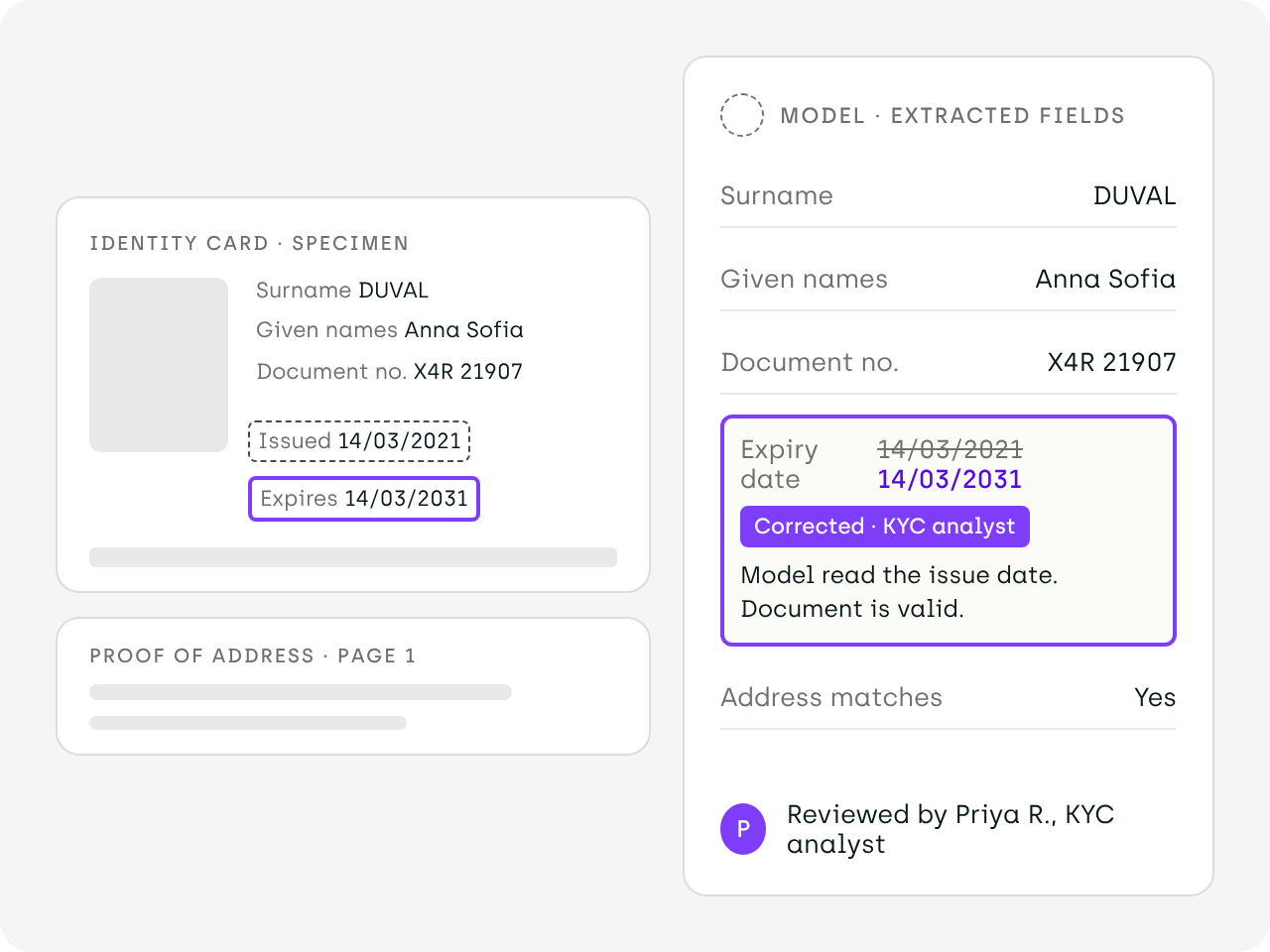
Who's in the loop
Each document type goes to the specialist who handles it, not to the next free annotator.
- Claims handlers
- Underwriters
- KYC and AML analysts
- Compliance officers
- Credit analysts
- Document operations leads
Use cases
Where banks and insurers use Kili
As LLMs read documents directly, the work has moved from labeling documents to reviewing what a model took from them. Kili covers both.
AI Evaluation
- LLM extractions reviewed before they reach a payment
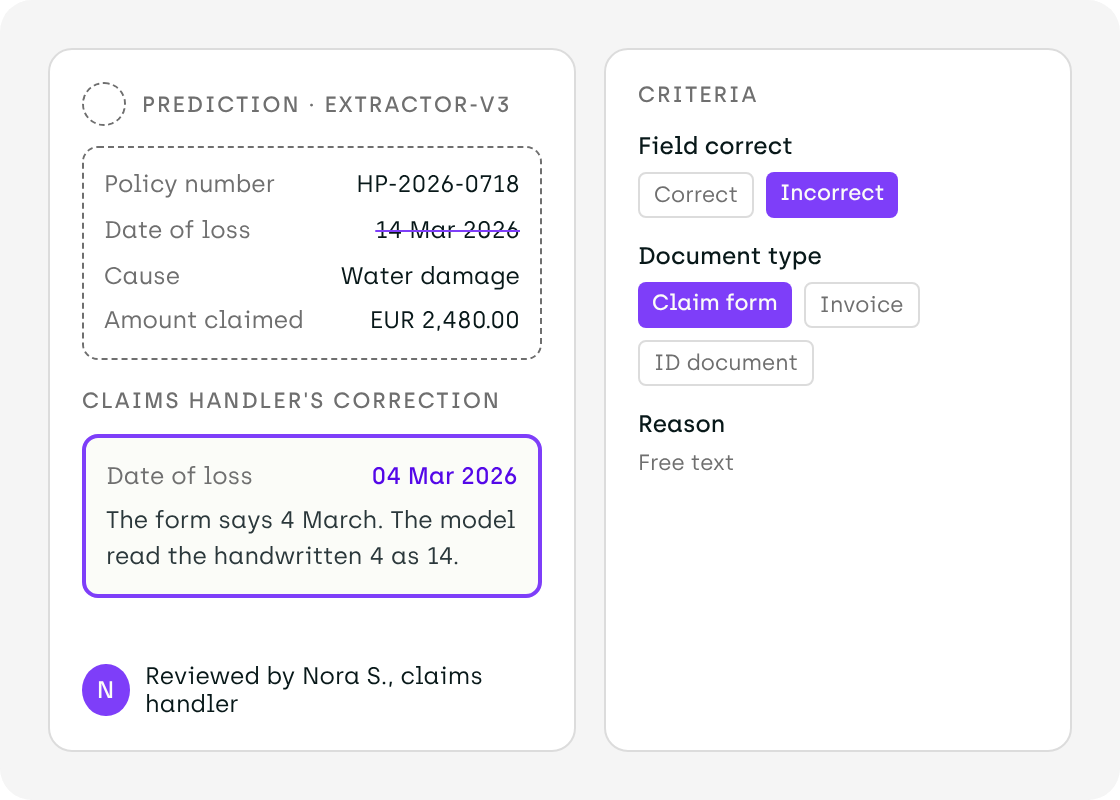
When a model pulls fields from claims files or ID documents, one wrong value can trigger a payment or a compliance breach. The extraction arrives pre-filled on the document and specialists confirm or correct each field. Predictions carry the model's name, so the model's values and the specialists' corrections can be pulled through the SDK and compared field by field.
PDF · Predictions
Learn More → - Policy and product assistants judged against the source
A retrieval-augmented assistant can quote the right policy and still answer the wrong question. Specialists see the retrieved passages, the question and the answer together, and judge retrieval and generation as separate criteria, so a failing score points at the step that went wrong.
RAG · Text
Learn More →
Post-Training
- Customer replies written to your standard
A model that drafts customer letters or adviser notes has to sound like your firm and stay inside your rules. Specialists correct its drafts or write the reply it should have given, a compliance reviewer checks each one, and the approved set becomes supervised fine-tuning data.
SFT · Text
Learn more → - Preferences from your underwriters
Two credit memos can both be correct and only one be useful. Underwriters rank the model's candidate answers and say why, producing RLHF preference data that reflects how your credit committee actually reasons, rather than a generic notion of a good answer.
RLHF · LLM (experimental)
Learn more →
Data Labeling
- KYC and onboarding documents
Identity documents, proofs of address and energy certificates come in every format. Pre-label them with your own OCR or extraction model, then have specialists correct fields, boxes and transcriptions, the way LCL built the training data behind more than 13 million documents processed in production.
OCR · PDF · Image
Learn more → - Customer feedback classified at scale
Comments from surveys, calls and claims carry the signal for product and service decisions. Specialists classify a sample by theme and sentiment, with consensus checking that they classify alike, and a model handles the rest. Covea analyzed 1.5 million comments this way.
Text · Classification
Learn more →
Working with a document type that isn't listed here?
Tell us about the model, the documents and who needs to judge them, and we'll show you how it runs in Kili.
Why Kili
Specialist judgment, measured and on record
Expert-in-the-Loop
Specialist time goes to the fields that need it
The underwriter or claims handler who knows the file makes the call, not a general annotator working from a guide. Kili removes the work around it: the extraction arrives pre-filled, and criteria and workflows are set up in the product, so nothing waits on engineering.
- Start from the model's extraction. Push predictions in with a single click, or programmatically through the SDK or API, so specialists confirm or correct instead of retyping.
- Criteria in your terms, without code. Field checks and document classes are set up as jobs in the ontology, with workflows and assignments configured in the interface.
- Custom logic, written once. Checks that need code run as Python plugins hosted by Kili, triggered on submit or review.
Quality, Built In
Consistency you can prove, field by field
Two claims handlers reading the same file should reach the same answer, and you should be able to prove it. Kili measures that while they work, and shows each reviewer the source page beside the extracted field, so corrections hold up the first time.
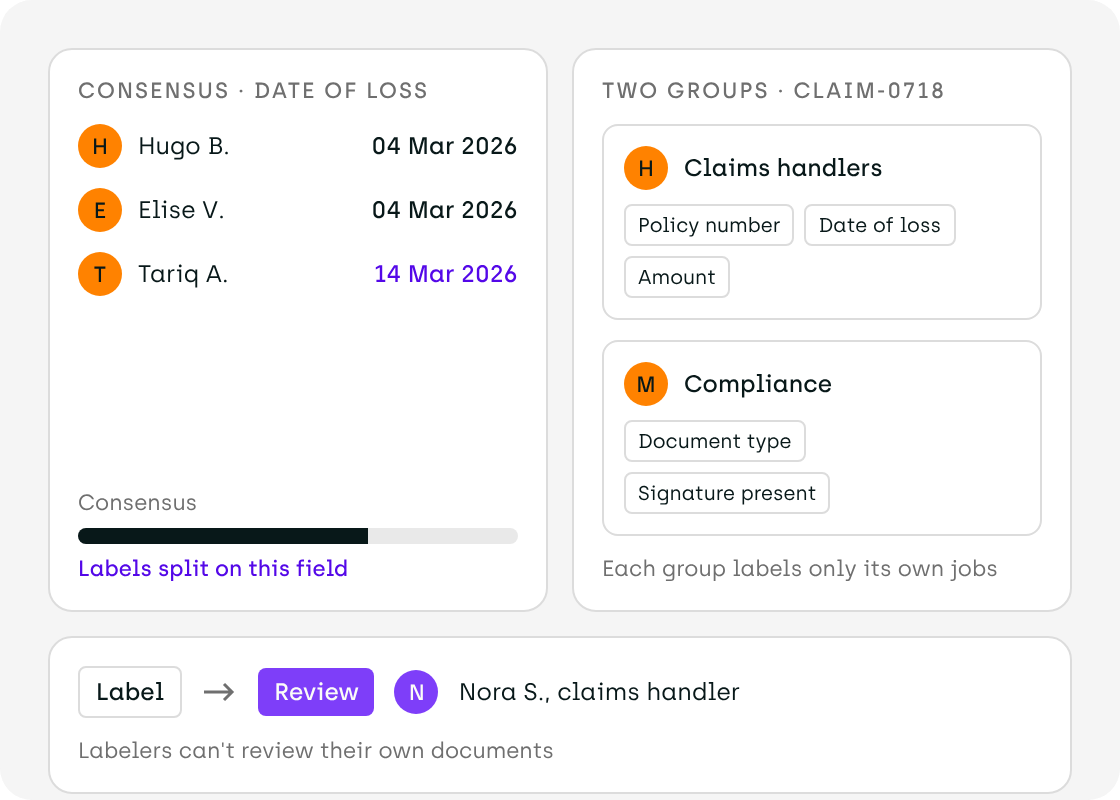
- Where specialists split. Consensus sends the same document to several specialists and scores how far their labels match, per field and per specialist.
- The right experts on the right calls. Multi-group workflows, in private beta, give each expert group its own part of the same asset, so the groups build on each other's work.
- Nobody approves their own work. Multi-step review keeps labeling and review in separate hands, with step separation built in.
Auditable from Day Zero
Real validation, not self-validation
Model risk teams expect validation to be independent of the people who built the model. Every quality check leaves a record in the same project that produced the labels, so the evidence your validators ask for already exists.
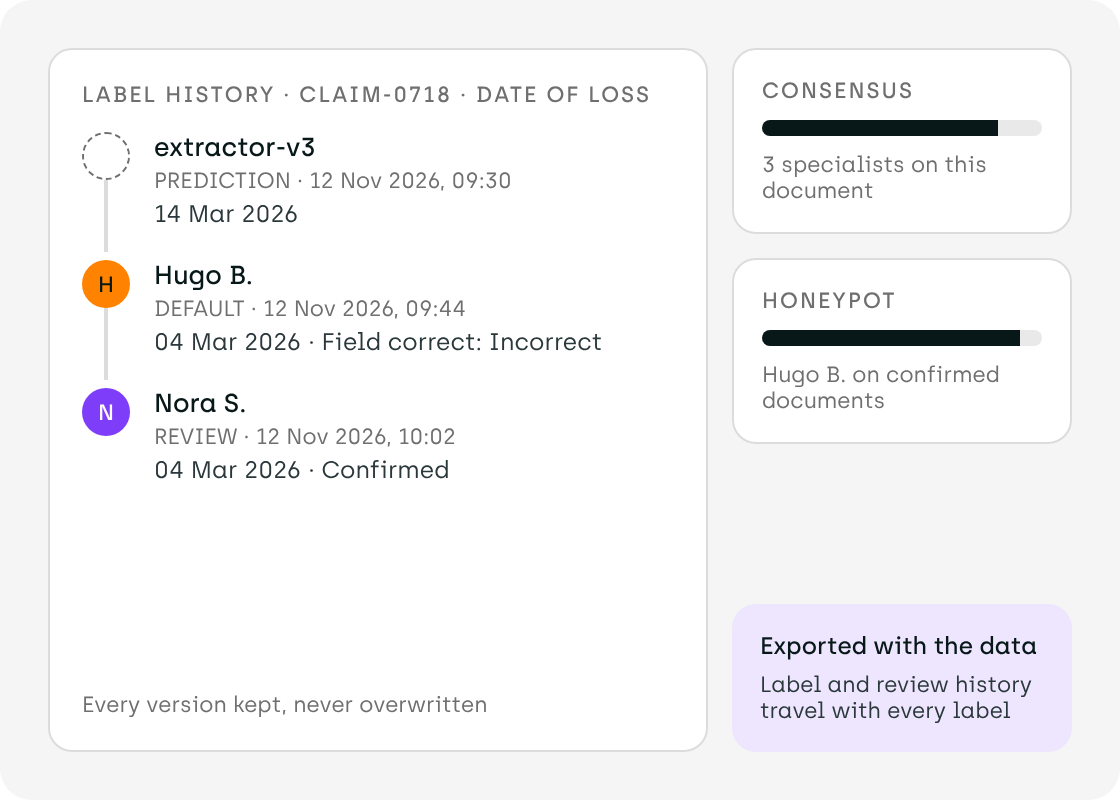
- Who made each call. Every label version records its author, label type and date.
- How good it was. Consensus and honeypot scores, per document and per specialist.
- Kept and exportable. Versions are never overwritten, and label and review history exports with the data.
Deploy Your Way
Customer data stays in your perimeter
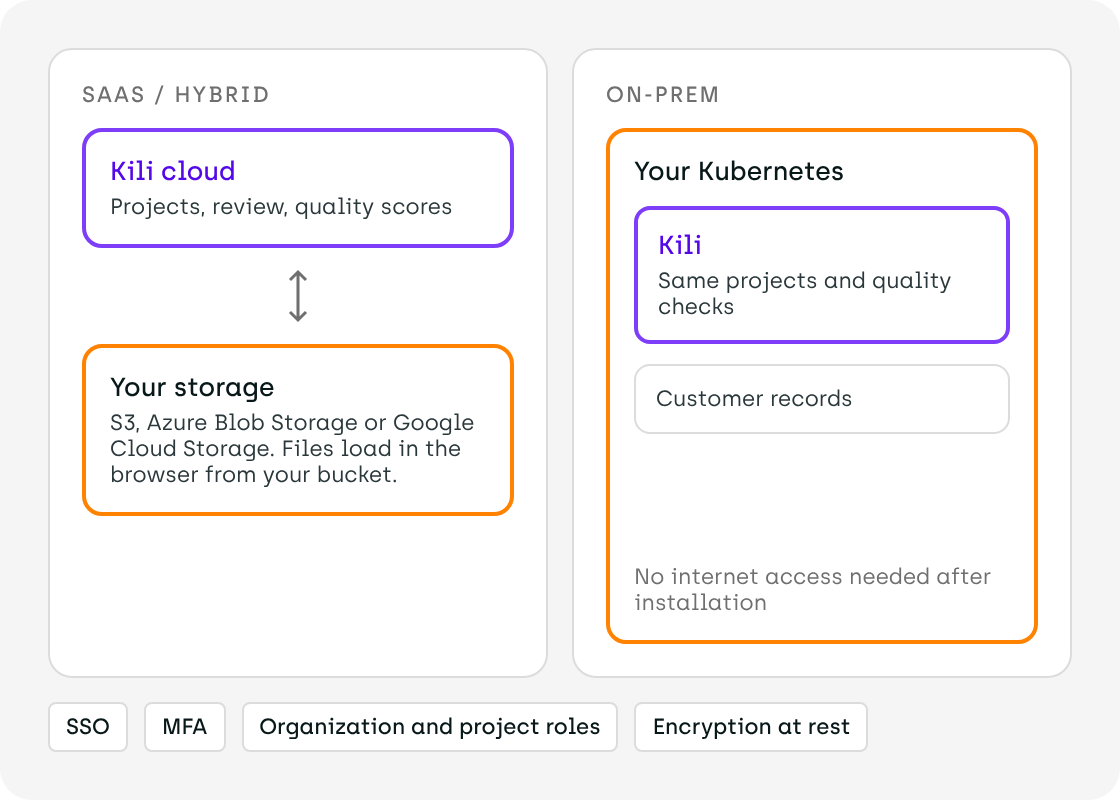
Customer records don't have to move to be labeled or evaluated. You choose where Kili runs and where the data lives, and your security team gets the controls and certifications it will ask for.
- SaaS / Hybrid. Use Kili's cloud while documents stay in your own S3, Azure Blob Storage or Google Cloud Storage bucket, loaded straight into the browser.
- On-Prem. Kili runs on your own Kubernetes, with no internet access needed after installation. LCL runs it this way for its KYC documents.
- Controls and certifications. SSO, MFA, organization- and project-level roles and encryption at rest. ISO/IEC 27001:2022 certified and SOC 2 Type II.
Data provenance your validators can trace
Kili goes beyond reviewing, correcting and labeling datasets. It keeps the record of how every document and field was judged, so your model risk team can trace the data's provenance and show the validation was independent.
- Was the review independent of the people who built the model?
Every label version names its author, and step separation stops anyone approving their own work. - What is the golden set, and who confirmed it?
Honeypot documents with confirmed answers, scored against every specialist. - How consistent are the specialists?
Consensus per job and per specialist, from the same project that produced the labels. - Where do people oversee the model?
In review steps you configure in the workflow, with the reviewer for each document type set by you. - What changed between releases?
Label version history today: author, label type and date, never overwritten. Version comparison is coming soon.
Customer stories
Banks and insurers on Kili
- LCL · KYC · On-PremLCL Bank automates KYC with AI document extraction"We cannot afford any mistakes given the importance of our two missions."
Axel Cypel, AI Expert at LCL - Covéa · Customer feedbackCovea turns 1.5M customer comments into insight"We decided to eliminate a large part of the technical debt by choosing a solution that will be perfectly mastered across a whole range of data science and AI projects."
Phileas Condemine, Data Science Lead at Covéa
Data types
The formats financial work comes in
- PDFs and scanned documents
Claims files, contracts and ID documents: entities on PDFs, OCR on boxes - Text and NLP
Emails, comments and notes classified, with entities and relations tagged - Image
Scanned forms and photos, labeled with boxes, polygons and Meta's SAM - Audio
Customer calls: segments, speakers and transcription on the waveform - LLM output
Model answers graded, ranked and rewritten by specialists, in the experimental LLM interface
AI Services Network
More claims, KYC and compliance specialists, through Kili's partners
Kili's AI Services Network connects bank and insurance AI teams with service providers whose claims, KYC and compliance specialists already work in the platform.
For financial services AI teams
Add specialists to your project, at your standard
When evaluation or post-training work outgrows your own underwriters and claims handlers, Kili introduces you to service providers whose financial document specialists already work in the platform. They join your project and back your experts' judgment, without changing how the work is checked.
- Matched to the work. Specialists who know your document types, your languages and your type of task.
- Your criteria, your review steps. They work inside the workflow and roles your team already set up, on the deployment you chose.
- Measured like your own team. Consensus and honeypot score every partner specialist, per document.
For service providers in finance and insurance
Move your banking and insurance client work onto one platform
If your claims handlers, KYC analysts or financial translators already deliver AI evaluation, post-training or data annotation for banks and insurers, run that work on Kili instead of a different tool for each client, with pricing set up for partners.
- Each client in its own project, with its own members, roles and guidelines.
- Quality you can show every client: review score, consensus and honeypot, from inside their project.
- Deployment to match each contract: SaaS, Hybrid or On-Prem, on a platform certified ISO/IEC 27001:2022 and SOC 2 Type II.
Questions from banks and insurers
How do you evaluate LLM document extraction for claims or KYC?
Evaluate LLM extraction by importing the model's extracted fields as predictions on the source documents and having specialists confirm or correct each one. In Kili, predictions carry the model's name, so the model's values and the specialists' corrections can be pulled through the SDK and compared, to compute error rates per field and per document type.
How does Kili support model risk management?
Kili doesn't validate models, but it produces the evidence a validation needs from the same workflow that produced the labels: who labeled and reviewed each item, how consistent the specialists were (consensus), how each scored on confirmed answers (honeypot), and the history of every label. Label and review history exports with the data.
Can Kili run on-premise for a bank?
Yes. Kili installs on your own Kubernetes cluster with no internet access needed after installation, which is how LCL runs it for its KYC documents. You can also use Kili's cloud while documents stay in your own AWS S3, Azure Blob Storage or Google Cloud Storage bucket.
Can each document type go to the specialist who handles it?
Yes. Select documents on the Queue page and assign them to named labelers, or set the assignment in bulk through the Python SDK, so motor claims, health claims and identity documents each go to the specialist who handles that type. Each document also carries a priority number, and the higher it is, the sooner it is served, which puts the most urgent files in front of your specialists first.
What's the difference between data labeling and AI evaluation for financial documents?
Data labeling builds the examples a model learns from; AI evaluation checks the answers a model gives. With LLMs reading documents directly, much of the work has moved from labeling documents to reviewing what a model extracted from them. Kili does both in the same kind of project, with the same review steps and quality scores.
Put Your Specialists' Judgment on Record
Run a full evaluation on your own documents, with your specialists, before you commit.