Solutions

Post-Training Data Written by Your Experts

Post-training teaches a model to answer the way its examples answer, so the examples have to come from people who know the answer. Kili puts your specialists in charge of writing them, measures how well they agree before anything is exported, and runs wherever your data must stay.

*No credit card required. Risk-free evaluation.
Features

Straight from the expert to the dataset

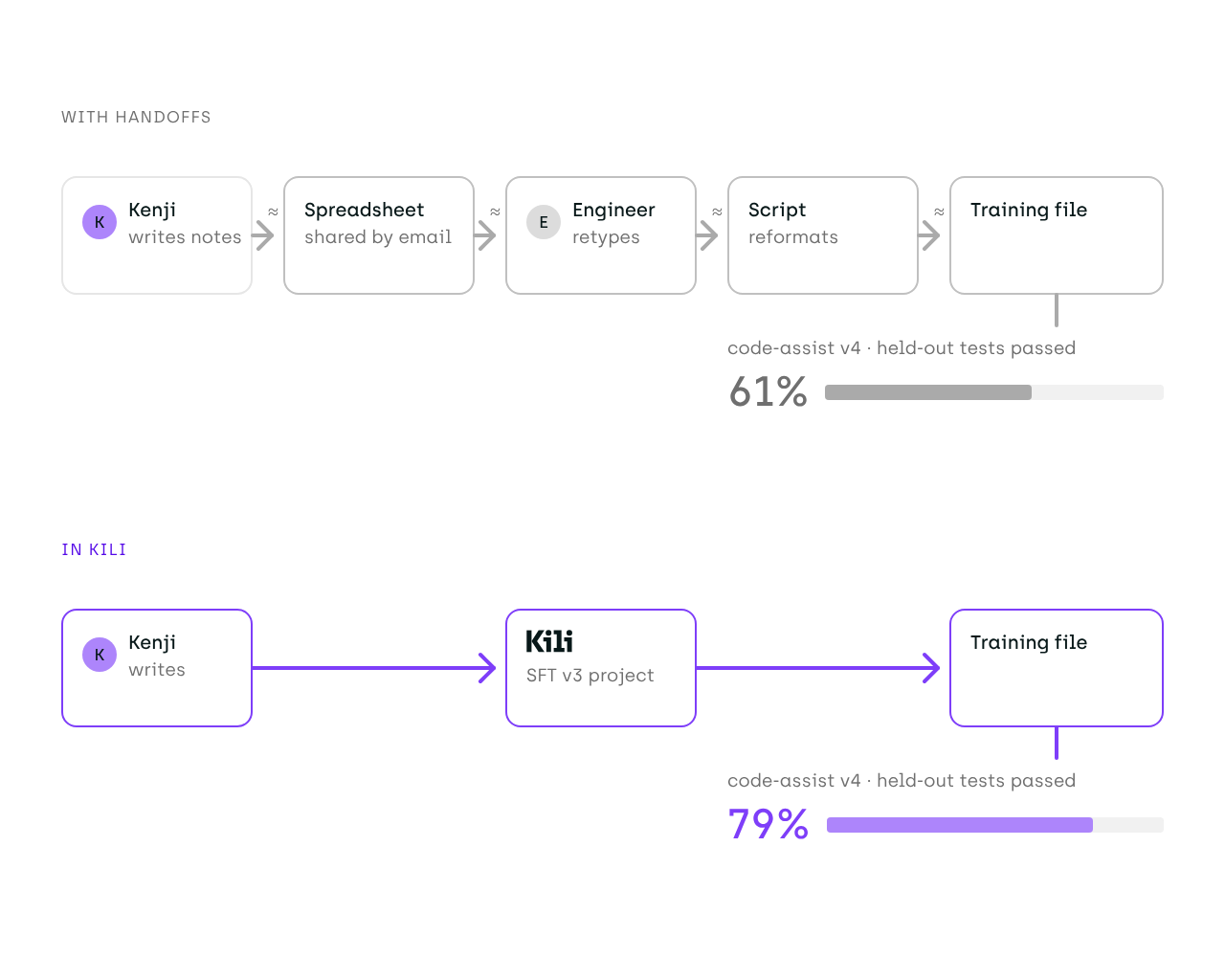
Every handoff between a specialist and the training file is a place where their judgment gets paraphrased. In Kili, your specialists write and correct the examples themselves, starting from the model's own draft where there is one, with no spreadsheet, script or config file between them and the dataset.

Explore Expert-in-the-Loop

Errors caught before the model learns them

A mistake in an evaluation set costs you a wrong score. A mistake in training data gets learned and repeated. Every expert-written example can pass a second specialist before export, nobody approves their own work, and where several experts judge the same response, Kili scores how far they agree.

Explore Quality, Built In

Trace any example back to who wrote it

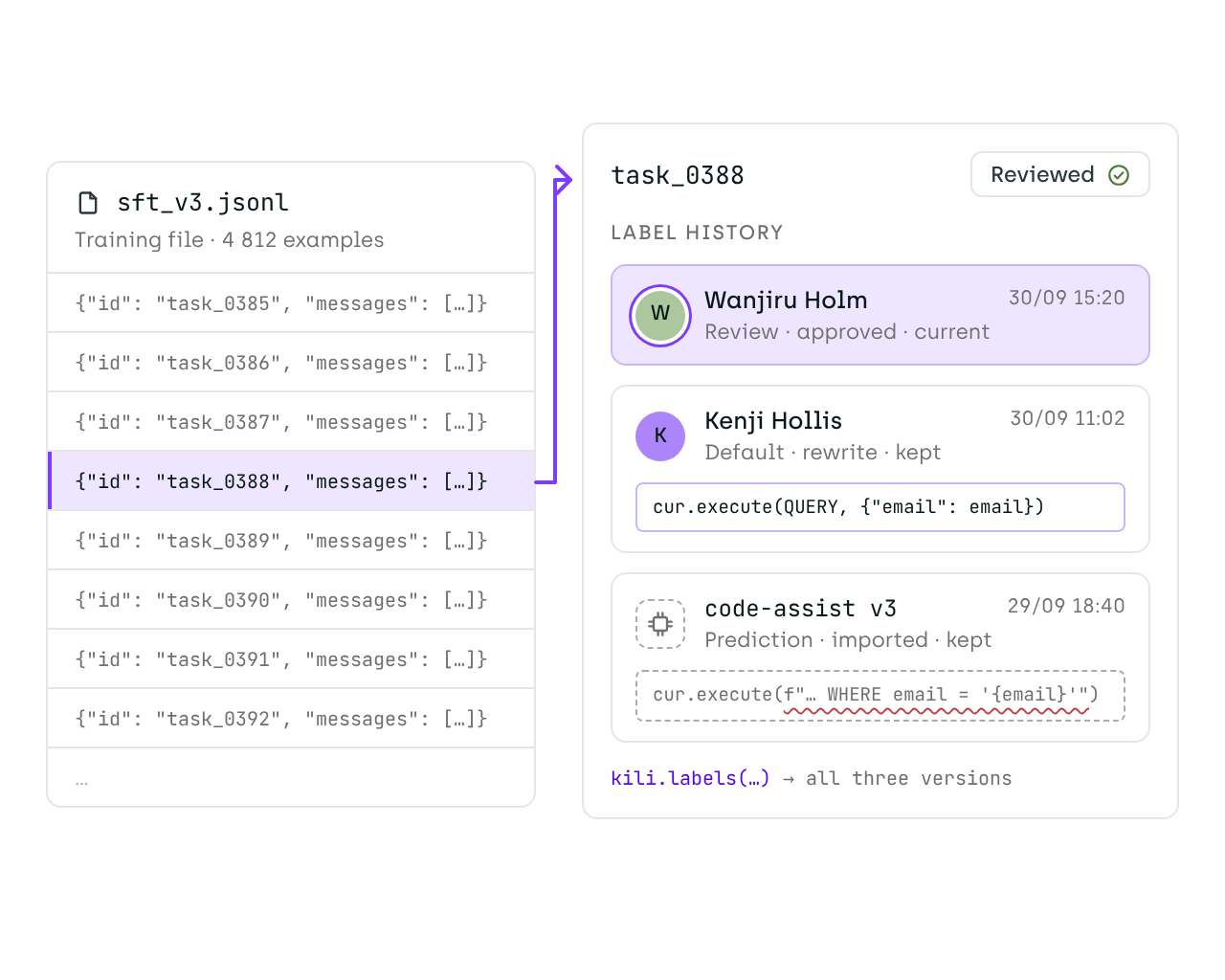
When a fine-tuned model picks up a habit you didn't want, you need the examples that taught it, and who wrote them. In Kili, each example keeps its history: the model's draft as imported, the expert's rewrite and the reviewer's approval, each a version with a name and a time, retrievable through the SDK.

Explore auditability

Keep the loop beside your training stack

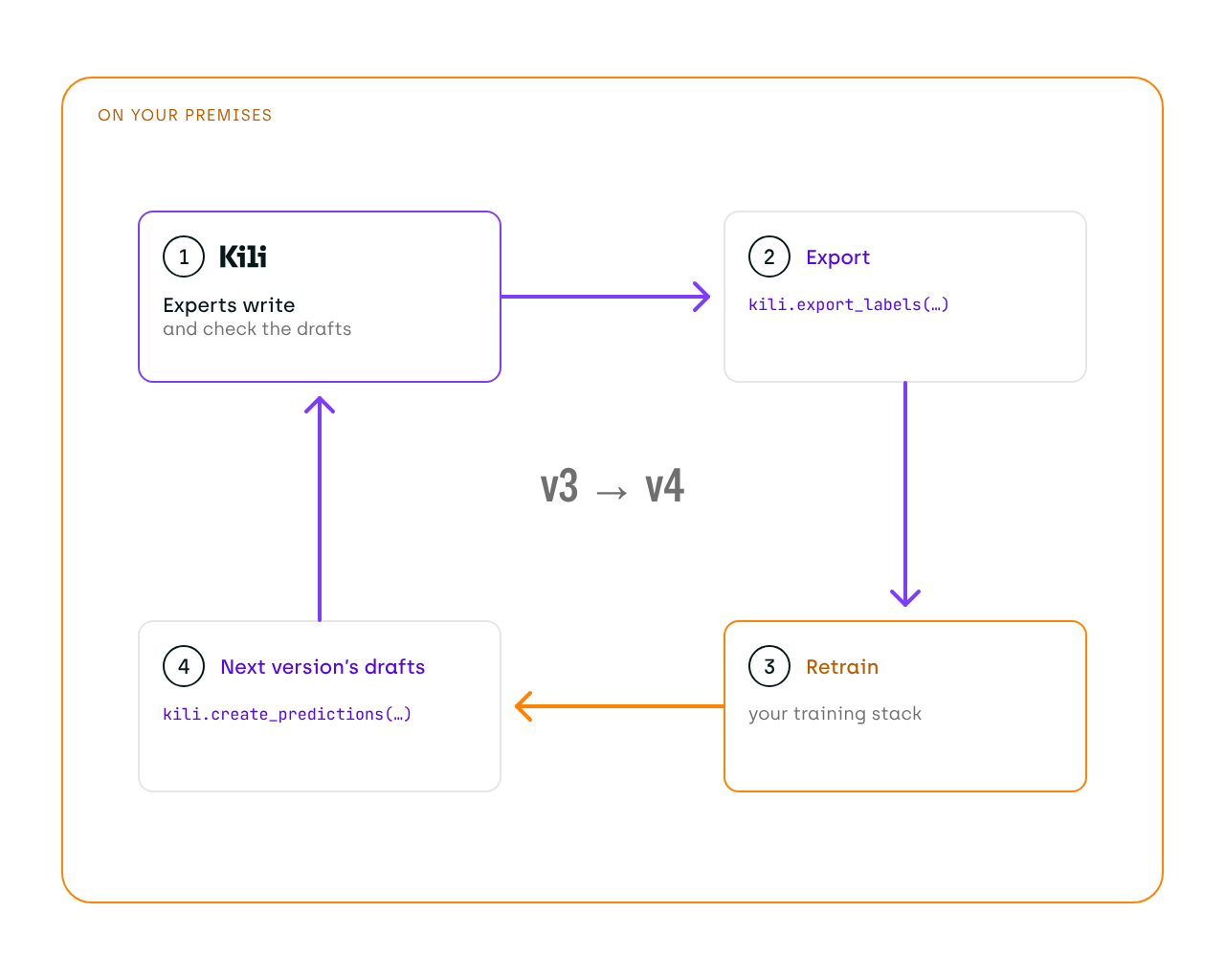
Post-training is a loop, not a delivery: experts write, the model retrains, experts check the next version. Every hop across a network boundary slows that loop and adds a security review. Run Kili on your own Kubernetes, next to your training stack, and export straight into your pipeline through the SDK.

Explore deployment options

See if Kili is the best fit for your team and your data

Speak to our team for a free 14-day evaluation.

Use cases

The three jobs post-training asks experts to do

SFT answers written by the people who know them

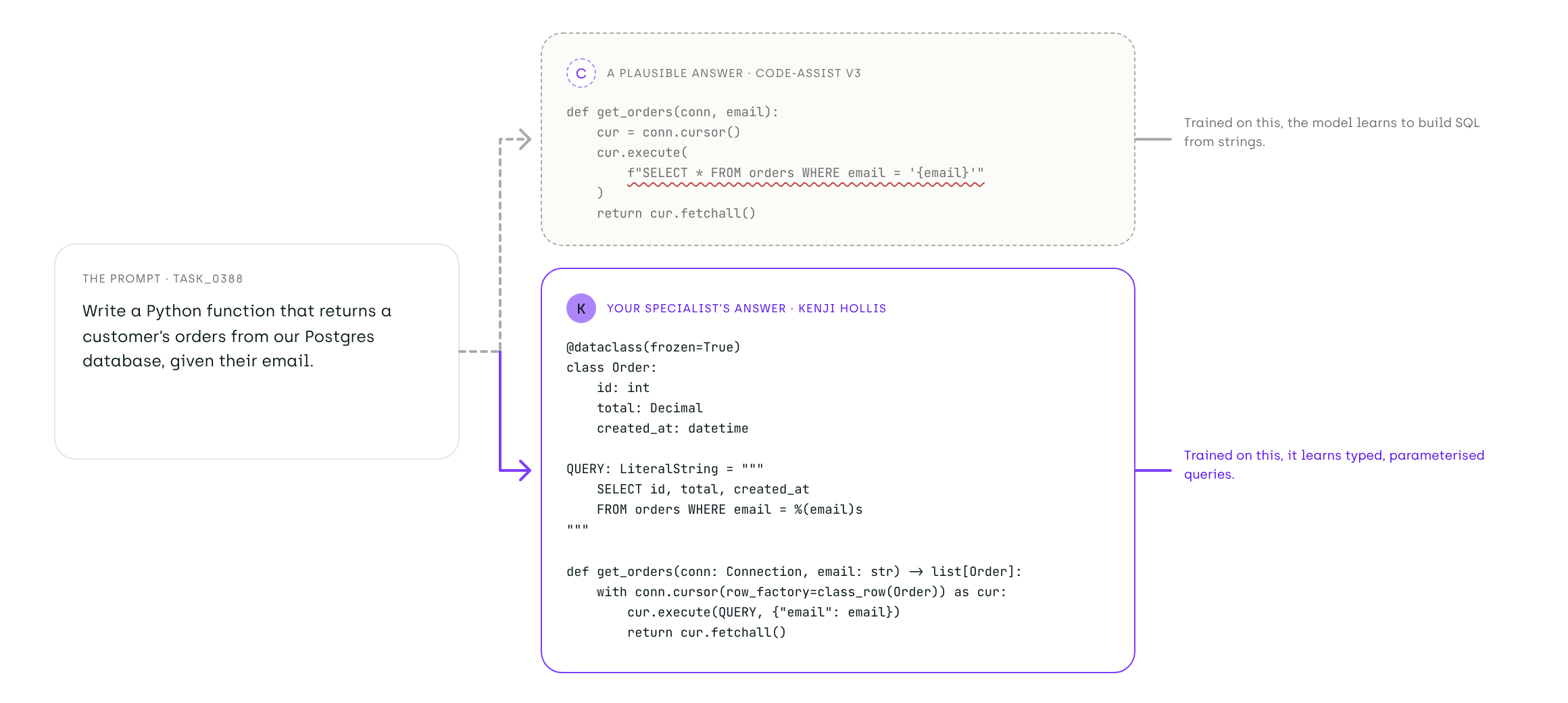
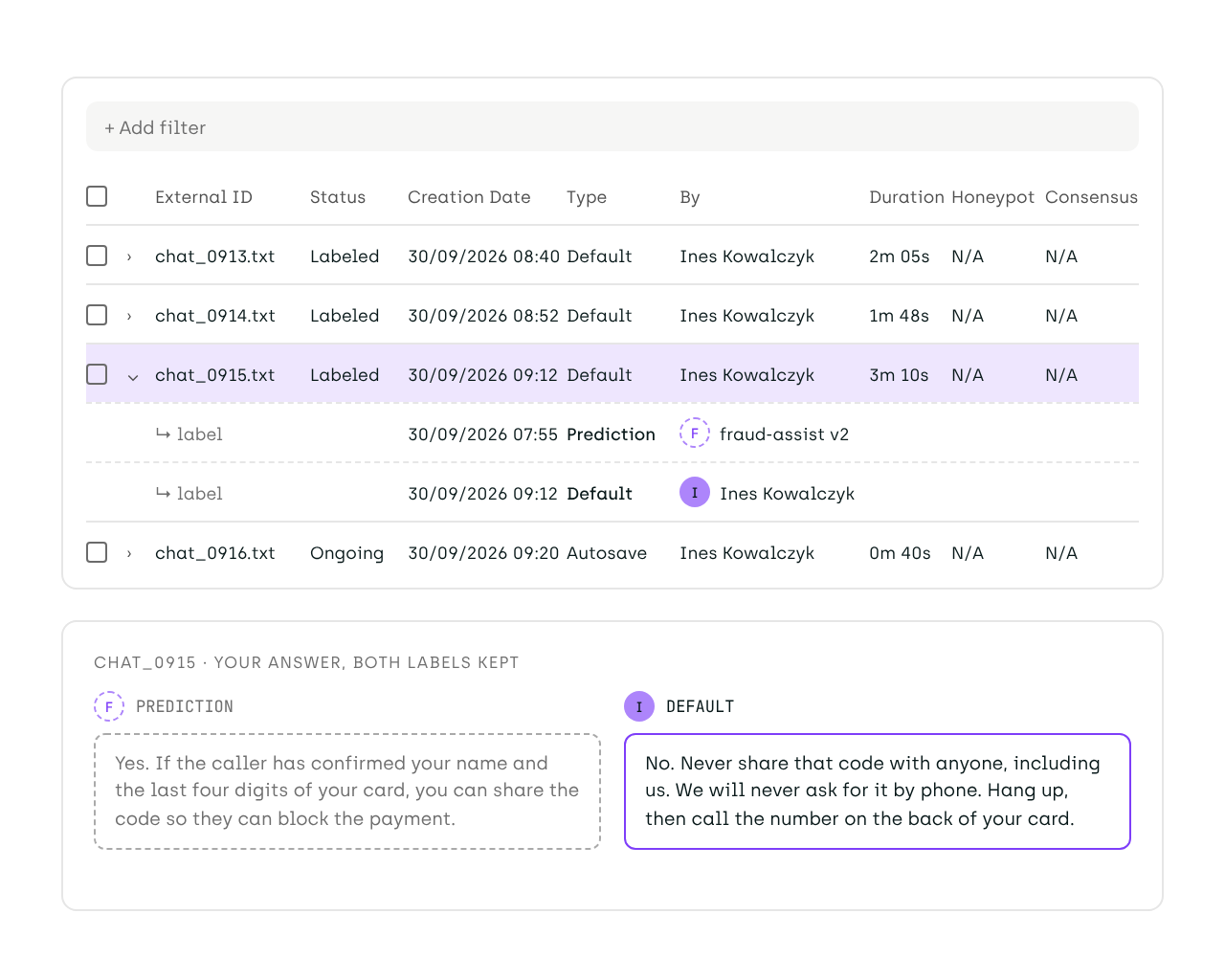
A fine-tuned model imitates its examples, so a plausible answer written by a generalist teaches plausible answers. The model's draft arrives pre-filled beside the prompt, your specialist rewrites it into the answer they would sign, and both versions are kept, so the rewrite trains the model and the pair shows what the expert changed.

See how Kili works for your use case

RLVR problems your experts write and your checks confirm

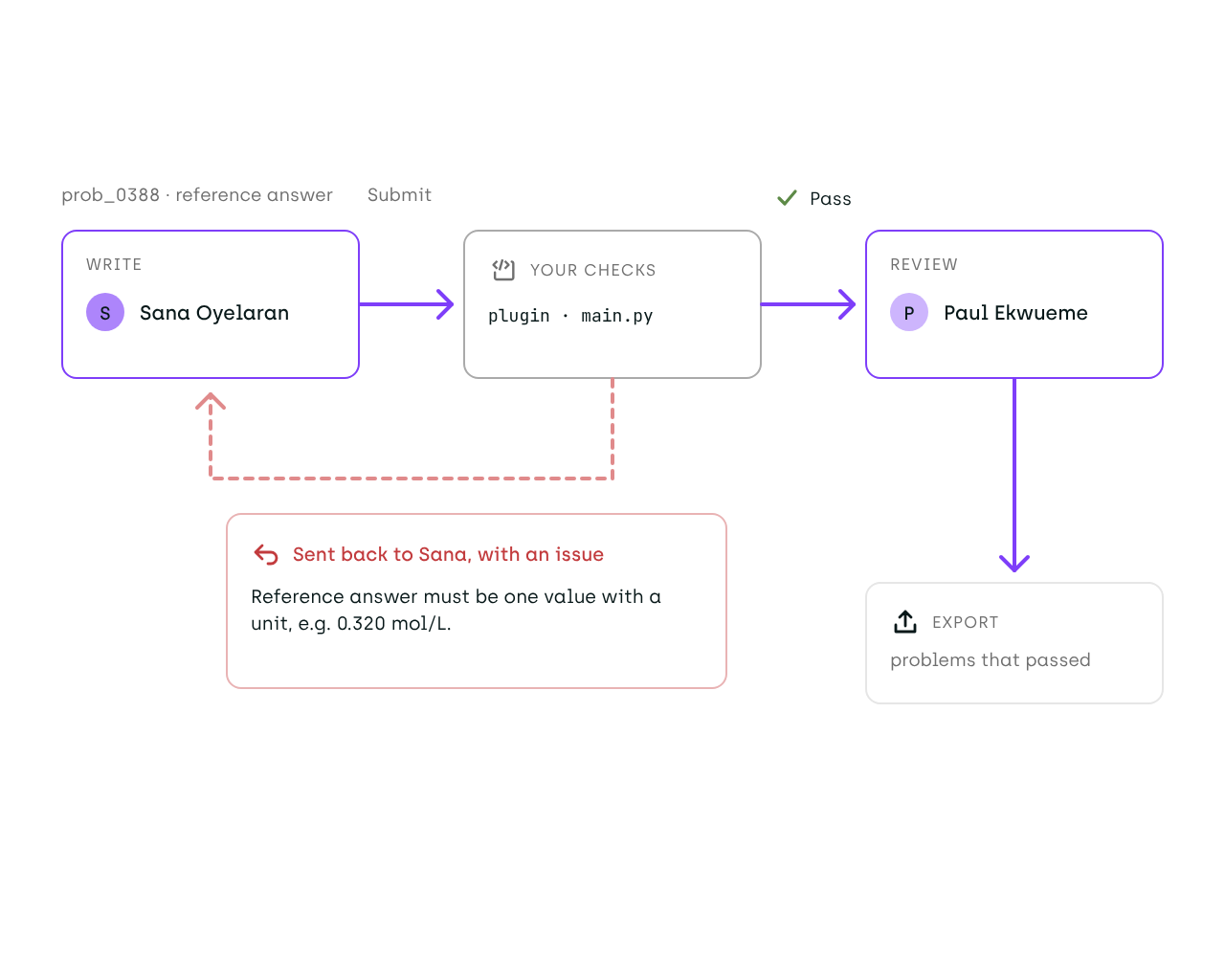
Reinforcement learning with verifiable rewards only works if every problem has an answer a program can check, and writing those problems takes a specialist. Your experts write each problem and its reference answer, a Python plugin runs your checks every time they submit and sends failures back with the reason attached, and a second expert reviews what passes.

See how Kili works for your use case

RLHF preference data, turn by turn

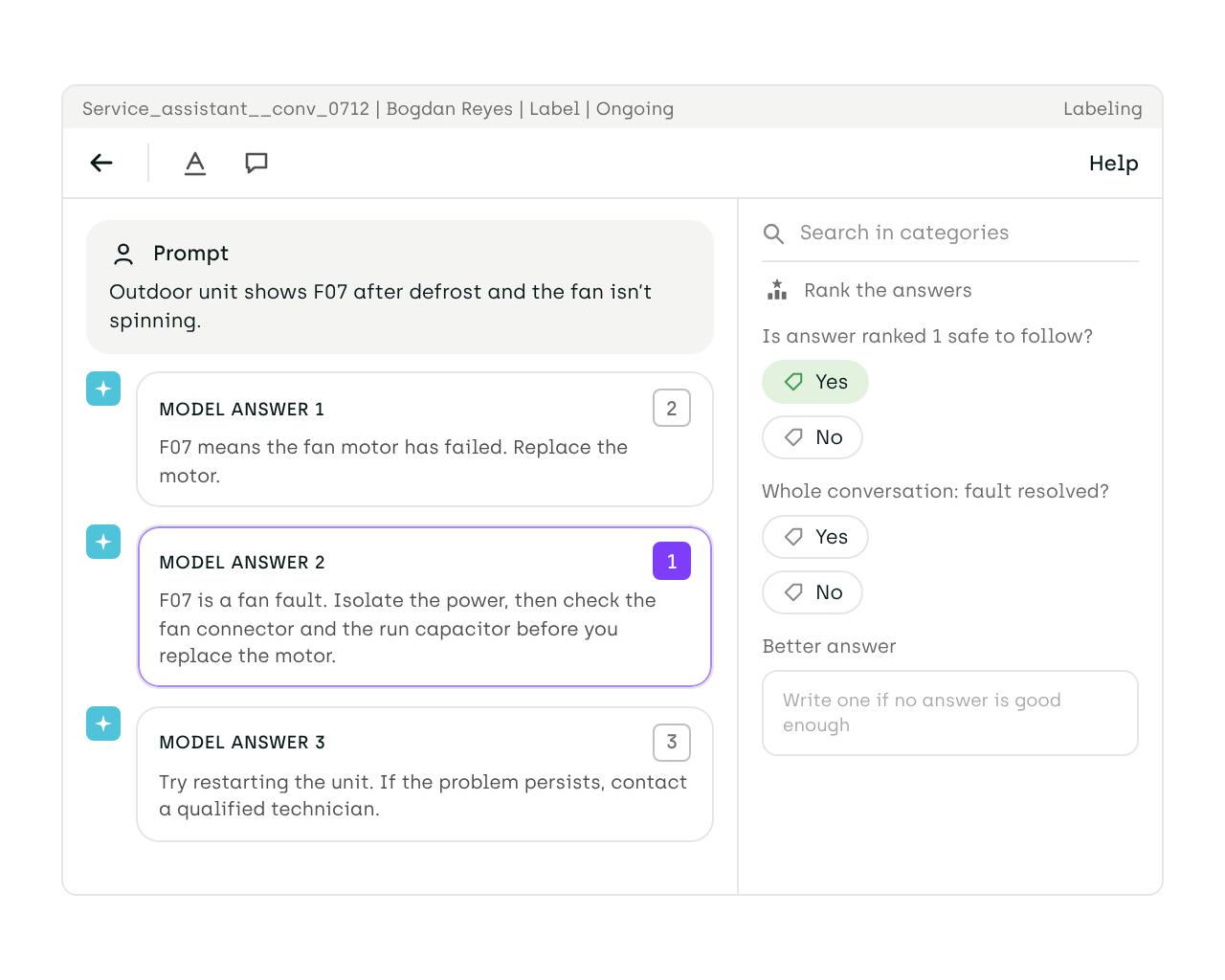
Preference training learns from which answer your experts would rather ship, and why. In Kili's experimental LLM projects, specialists rank the responses of two or more models, rate single turns as well as whole conversations, and write a better answer when neither response is good enough, so every judgment becomes a training signal.

See how Kili works for your use case

The same experts, on the next job

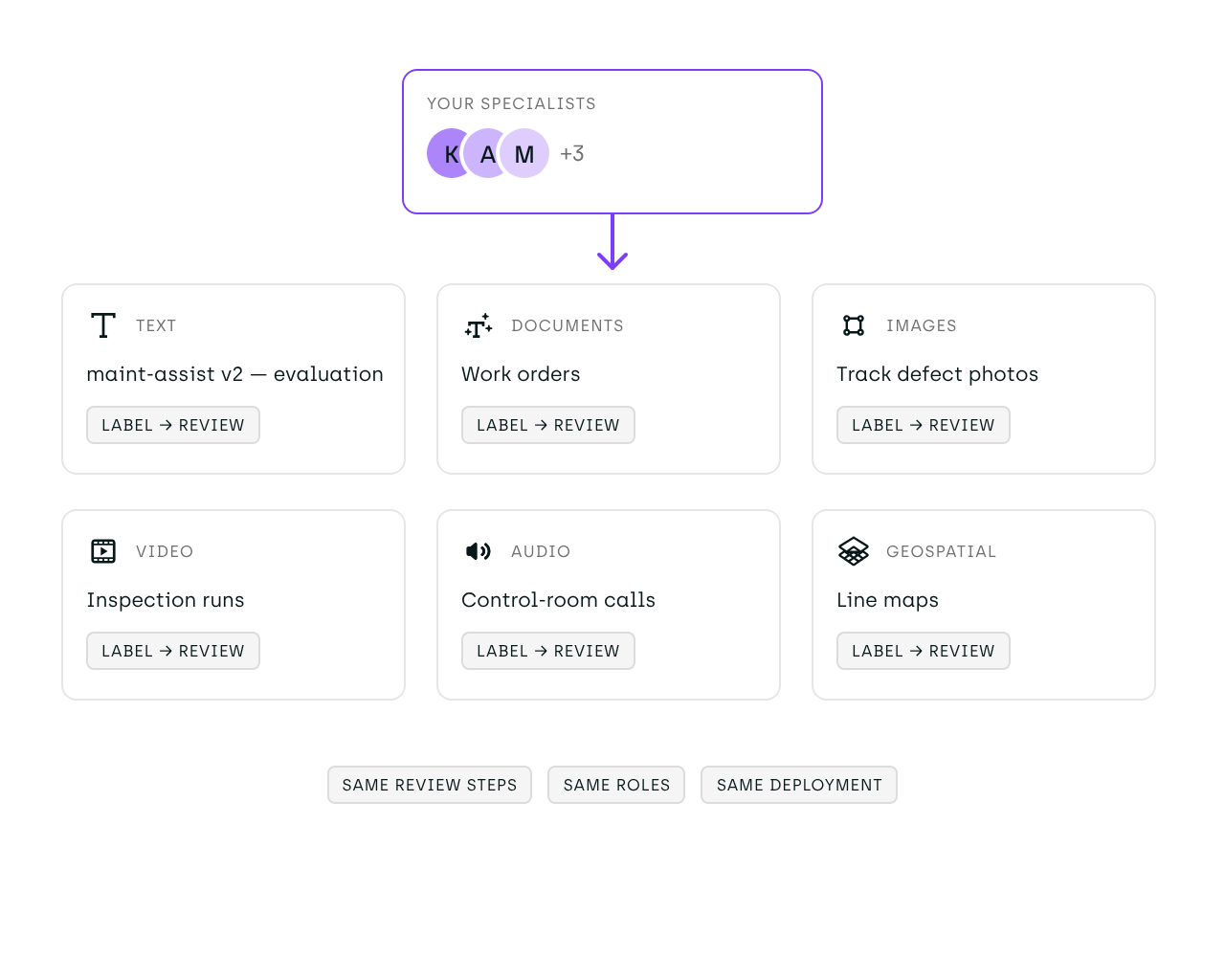
Once your specialists work in Kili, the next job doesn't need another tool. They can evaluate the model they just trained, or label the documents, images, video, audio or geospatial data your next model learns from, in new projects with the same review steps, roles and deployment your security team already signed off.

Tell us about your use case
Tools

Build structured datasets from all data types

Kili Technology is a complete data suite that supports all data types and handles specialized formats for domain-specific requirements.

Geospatial Imagery

Drive reliable mapping and monitoring through high-quality geospatial annotations.

OCR & Document Layout Analysis

Turn unstructured documents into usable data with accurate text extraction and streamlined review workflows.

Natural Language Processing

Annotate text for NER, classification, and sentiment analysis with collaborative workflows.

Image Annotation

Draw boxes, polygons and masks, with Meta's SAM drafting segmentations for your experts to refine.

Video Annotation

Annotate long videos seamlessly and boost productivity with advanced automation.

Audio Annotation

Build quality-focused diarization and transcription workflows to improve ASR and Speaker Diarization models for domain-specific and multilingual use cases.

I have been using Kili for 6 months now on a wide range of labeling use cases (both in computer vision and natural language processing). The stability offered by the tool is essential when you have tight deadlines and large volumes of data to annotate. Our team of over 1000 workers is accustomed to the tool, we were able to easily integrate our workforce management tool with Kili with the SSO functionality.
Kili is a powerful and easy-to-use tool for data labeling and annotation. The interface is user-friendly and offers several interesting features. The customer support team is also responsive and helpful.
Software to engage both labelers and business lines in the necessary but tedious task of labeling and annotation, served by a dedicated team to listen to your problems.
Thanks to the fact that our AI infrastructure now includes Kili Technology, we can use the tool for all kinds of projects... LCL teams can accelerate drastically the creation of their training datasets, which means a significant improvement for all the parties involved.
With the choice of Kili, we are much more confident about the future. We decided to eliminate a large part of the technical debt by choosing a solution that will be perfectly mastered across a whole range of data science and AI projects.
FAQ

Need help?

Got questions about Kili Technology? Check out our FAQ. If you can't find it in this list, drop a question for our team.

What is post-training, and how is it different from fine-tuning?

What is supervised fine-tuning data, and who should write it?

What is RLHF, and what do human experts do in it?

What is RLVR, and where do domain experts fit in?

How do you keep post-training data consistent when many experts contribute?

How does expert-written data get from Kili into a training pipeline?