.png)
.webp)

_logo%201.svg)


AI Summary
- LLM-as-a-Judge and HITL are complementary control layers — automated speed plus human nuance — not competing approaches.
- LLM judges exhibit systematic biases including order effects and verbosity preferences; human-defined rubrics are the corrective.
- Effective HITL workflows match review intensity to decision risk — dense oversight for high-stakes, sampling for routine outputs.
- A layered routing architecture — rules, then LLM judge scoring, then human escalation — conserves expert time while protecting critical decisions.
- Governance frameworks like NIST AI RMF and the EU AI Act formalize the monitoring and escalation that hybrid workflows already practice.
- Kili Technology provides configurable annotation workflows and managed labeling services to operationalize LLM-as-a-Judge and HITL at enterprise scale.
Teams building large language models and AI systems now face a practical governance problem rather than a purely modeling problem. They can use an LLM-as-a-judge pipeline to score AI outputs at speed, and they can use human-in-the-loop (HITL) review to enforce quality and human oversight. Each pattern is useful. Each also fails in predictable ways when deployed alone.
The integration of human input into AI workflows is essential for navigating the complexities and nuances that often challenge purely algorithmic approaches. This is not a theoretical claim. The academic literature consistently supports it:
- Judging LLM-as-a-Judge with MT-Bench and Chatbot Arena and Chatbot Arena: An Open Platform for Evaluating LLMs by Human Preference demonstrate that large language models can approximate human preference rankings under certain controlled conditions.
- Large Language Models are not Fair Evaluators reveals that these AI systems are sensitive to formatting, position, and verbosity, introducing systematic evaluator biases.
- Governance frameworks such as the NIST AI Risk Management Framework (AI RMF 1.0), the NIST Generative AI Profile (AI 600-1), the EU AI Act (Regulation 2024/1689), Article 14, and the OECD AI Principles explicitly require lifecycle human oversight and risk-proportionate controls.
None of these sources claim that LLM judges are universally reliable or that human review is optional. Instead, they consistently point toward structured oversight, calibration, and layered control.
LLM-as-a-judge scales faster than expert review. It can evaluate thousands of model outputs, track regressions, and provide a consistent scoring interface. But consistency is not the same as correctness. Research shows systematic evaluator biases: order effects, verbosity preferences, and formatting artifacts can alter rankings even when answer quality is unchanged.
Pure human-in-the-loop has the opposite problem. It is usually stronger on nuanced, high-stakes correctness because human experts can reason about context, evidence quality, policy constraints, and downstream harm. Human intelligence and contextual understanding are irreplaceable for these judgments. But if every output requires full expert adjudication, throughput collapses and costs rise. Human review without structured measurement often becomes anecdotal.
The core failure mode is automation without accountability—or accountability without scalable measurement.
Understanding the Governance Frameworks
Before diving deeper, it helps to understand the frameworks that increasingly shape how AI systems must be governed:
- NIST AI RMF (AI RMF 1.0) is a voluntary U.S. framework that helps organizations identify, assess, manage, and monitor AI risks across the system lifecycle. It is structured around four core functions: Govern, Map, Measure, and Manage. The emphasis is on building measurable, documented risk controls into design, deployment, and real time monitoring processes.
- NIST Generative AI Profile (AI 600-1) extends the RMF specifically to generative AI. It highlights risks such as hallucination, content authenticity, misuse, and downstream amplification. Importantly, it treats gen AI as requiring continuous post-deployment monitoring rather than one-time validation.
- EU AI Act (Regulation 2024/1689), Article 14 is binding legislation within the European Union. It requires that high-risk AI systems include human oversight mechanisms capable of human intervention, override, and safe shutdown. Oversight must be proportionate to the system's autonomy and potential harm.
- OECD AI Principles are internationally endorsed policy principles emphasizing transparency, accountability, robustness, and human values. They serve as high-level governance guidance adopted by many countries and reinforce the ethical considerations that must underpin AI development.
Why does following these frameworks make practical sense? Because production systems drift. Prompts change. Data distributions shift. New use cases appear. Without lifecycle controls, quality degradation becomes visible only after damage occurs. These frameworks formalize something engineering teams already know: monitoring, documentation, and escalation reduce long-term system risk.
From that perspective, LLM-as-a-judge and HITL are not alternatives. They are complementary control layers — and choosing the right AI model evaluation service determines how effectively both layers perform in practice:
- LLM judges provide broad, fast, low-cost sensing across AI outputs.
- Human reviewers provide high-fidelity adjudication where stakes and ambiguity are highest, bringing human expertise and human judgment that machine intelligence alone cannot replicate.
- Governance frameworks define when one hands off to the other.
The most reliable pattern is hybrid by design.
1. Keys to a Successful LLM-as-a-Judge Setup
Start with Human-Defined Rubrics, Not Model Defaults
A judge model optimizes whatever scoring frame it is given—including implicit ones. Work such as G-Eval: NLG Evaluation using GPT-4 with Better Human Alignment shows that structured criteria improve alignment with human judgment. The HELM evaluation framework reinforces the need for multi-metric evaluation rather than single-score optimization.
A practical example in healthcare: If a model generates discharge instructions, a fluency-based rubric may reward clarity but miss medical omissions. A structured rubric would explicitly check for medication accuracy, contraindications, follow-up timing, and patient safety warnings. Without a human-defined rubric, the judge may favor readability over safety.
In finance: An investment summary that is articulate but omits regulatory disclosures should fail. Only a rubric that encodes regulatory compliance requirements will detect that omission.
Operationally, a rubric should define the task objective, acceptable evidence behavior, disallowed failure modes, severity tiers, and tie-breaking rules. This shifts evaluation from "Which answer sounds better?" to "Which answer satisfies policy and domain constraints?"
How This Connects to Data Quality: Rubric design is fundamentally a data quality problem. In supervised learning, human input is essential for correctly labeling data, which is then used to train machine learning algorithms. When evaluation criteria are poorly defined, even the most sophisticated ML models produce unreliable outputs. Platforms like Kili Technology address this by enabling domain experts—radiologists, underwriters, compliance officers—to embed their technical expertise directly into annotation rubrics and labeling workflows from the first annotation, ensuring AI models are built on domain expertise rather than technical assumptions alone.
Calibrate the Judge Against Expert Labels Before Deploying
Before production use, judge outputs should be compared against trusted human labels. Research from MT-Bench and Chatbot Arena shows high correlation is possible—but only under specific setups. The literature does not claim universal reliability.
Example in legal services: Suppose a model drafts contract clauses. Experts review 500 examples and label them as acceptable or risky. The judge is run on the same set. If agreement is 92% overall but only 60% on indemnity clauses, calibration reveals a domain-specific blind spot. That informs threshold tuning and escalation design.
Calibration typically involves creating an expert-labeled validation set, measuring agreement and disagreement patterns, adjusting rubric language and thresholds, and re-testing before deployment. Calibration must be repeated as use cases expand. This aligns with risk frameworks because proportional oversight depends on measurable reliability.
Reinforcement learning from human feedback (RLHF) uses a reward model trained with direct human feedback to optimize AI performance—but even RLHF depends on the quality of the initial expert labels that calibrate the reward signal. Without calibrated ground truth, the feedback loop amplifies errors rather than correcting them.
Use Judges for Triage and Measurement—Not Final Decisions
Judge outputs work best as decision support tools, not autonomous authorities. Human-in-the-loop design strategies can improve the performance of the system compared to fully automated systems or fully manual approaches.
Example in customer support: An LLM drafts 10,000 support replies per day. The judge scores them for policy compliance and tone. 85% low-risk replies are auto-approved. 10% medium-risk replies are sampled for human review. 5% high-risk replies escalate to supervisors. The judge acts as a filter, not an authority.
In insurance underwriting: If an LLM generates claim summaries, a judge can flag anomalies or inconsistencies, but a licensed underwriter signs off on approvals. HITL can be used in high-stakes applications to impose alerts, human reviews, and failsafes to help ensure accuracy in autonomous decisions.
This layered model satisfies governance principles because automation improves throughput while human operators retain accountability where harm is material.
Monitor for Judge Drift and Bias
Research in Large Language Models are not Fair Evaluators documents evaluator bias. This is not theoretical. The broader concept of technical debt in machine learning systems is outlined in Hidden Technical Debt in Machine Learning Systems.
Example in HR screening: If a judge systematically scores longer answers higher, applicants coached to write longer responses may be advantaged independent of skill. Permutation tests can detect position bias. Severity distribution monitoring can reveal drift.
HITL systems require continuous monitoring and adjustment to maintain accuracy, which can be time-consuming—but the alternative is undetected degradation. Drift monitoring aligns with NIST's lifecycle approach because controls must persist beyond initial deployment. Active learning involves the model identifying uncertain predictions and requesting human input only where needed, leading to faster and more accurate detection of drift patterns.
2. Keys to Successful Human-in-the-Loop Workflows
Match Human Effort to Decision Risk
Oversight intensity should scale with risk. Human-in-the-loop systems are particularly valuable in high-stakes applications like healthcare and finance, where accuracy and ethical considerations are critical. Human intervention in these high-stakes areas prevents errors and mitigates risks to individuals.
Example in medical diagnostics support:
- Low risk: grammar correction of patient letters → automated.
- Medium risk: symptom triage suggestions → sampled physician review.
- High risk: treatment recommendations → mandatory physician approval.
This approach conserves expert time while protecting patients. In financial compliance, routine reporting summaries may require audit sampling, while high-risk anti-money-laundering alerts require direct human review. Risk-tiering makes operational and ethical sense. HITL can be used to ensure regulatory compliance in heavily regulated industries by providing human oversight in decision making processes.
Design for the Expert, Not the Engineer
Human-AI interaction research such as Guidelines for Human-AI Interaction (CHI 2019) emphasizes calibration and override mechanisms. Effective human-in-the-loop professionals must possess a combination of technical knowledge, domain-specific expertise, cognitive skills, and interpersonal skills.
Example in aviation maintenance: If an LLM summarizes maintenance logs, engineers reviewing outputs should see original log excerpts, highlighted inferred risks, confidence indicators, and quick correction tools. If experts must copy-paste between systems, review quality drops.
In pharmaceutical research, a reviewer validating literature synthesis should see linked citations and contradiction flags, not just a summary paragraph. User interface design determines whether HITL improves quality or becomes procedural overhead.
Platform Example—Expert-Centered Review Design: Kili Technology's platform is purpose-built for this pattern. Its configurable annotation interfaces allow domain experts—from data scientists to subject matter specialists—to review, validate, and correct AI outputs directly within the labeling environment. Multi-step review workflows can be configured to match existing QA processes, with dedicated review queues, issue tracking at the object level, and consensus measurement. This means human reviewers work in an interface designed for their expertise, not one that forces them to adapt to engineering tooling. For organizations needing additional support, Kili also offers managed data labeling services that handle the entire annotation lifecycle—from sourcing and training annotators with domain expertise across hundreds of specializations and 30+ languages, to delivering high-quality labeled data with 95%+ accuracy guarantees, zero management overhead, and enterprise-grade security.
Build Feedback Loops That Feed Back Into the Model
Alignment research shows structured human feedback improves behavior. Key work includes Training language models to follow instructions with human feedback (InstructGPT), Training a Helpful and Harmless Assistant with RLHF, Direct Language Model Alignment from Online AI Feedback, and Constitutional AI.
Example in enterprise coding assistants: If developers repeatedly correct unsafe SQL queries, those corrections can be logged as preference pairs, policy violation examples, and new regression tests. Over time, the system learns not just what was wrong, but why. Human-in-the-loop systems enable continuous learning and model adaptation by incorporating human feedback into the AI training process.
In education technology, if teachers revise generated lesson plans for age-appropriateness, those edits become fine-tuning data through a continuous cycle of improvement. HITL allows humans to fix incorrect inputs, giving the model the opportunity to improve over time. Human feedback can help both improve ML models and serve as a safeguard for when AI systems perform at insufficient levels. The human-in-the-loop approach integrates humans directly into the AI process to refine results continuously, while the human-on-the-loop approach uses human oversight to correct results after they are produced.
HITL becomes a data engine rather than a cost center.
Keep Traceability From Annotation to Production
Documentation frameworks such as Datasheets for Datasets and Model Cards for Model Reporting support transparency, reproducibility, and auditability.
Example in government procurement: If a decision support tool influences funding allocation, traceability allows auditors to see who labeled evaluation data, which rubric version applied, and when thresholds changed. The human-in-the-loop approach can provide a record of why a decision was overturned with an audit trail that supports transparency and external reviews.
Without traceability, post-incident analysis becomes speculative. In healthcare AI audits, lineage records can demonstrate whether a harmful output reflects model behavior, rubric gaps, or annotation inconsistencies. Traceability reduces regulatory exposure and improves learning speed.
Transparency and Auditability in Practice: AI model failures often trace back to training data quality issues—but without documentation, diagnosis is impossible. Kili Technology provides complete traceability for every data decision: who labeled each asset, who reviewed it, what consensus was reached, and how quality evolved over time. When a model behaves unexpectedly in production, teams can trace it back to the training data and understand whether the issue was labeling inconsistency, reviewer disagreement, or insufficient domain expert involvement. This complete visibility from first label to model output satisfies the auditability requirements embedded in frameworks like the NIST AI RMF and EU AI Act.
3. Making LLM-as-a-Judge and HITL Work Together
Layered Routing Architecture
A practical layered design for AI workflows involves multiple control layers operating in sequence:
- Rule-based and programmatic checks (pattern recognition for known failure modes).
- LLM judge scoring and tagging (broad, fast, low-cost evaluation).
- Human escalation queue (expert review for complex scenarios and edge cases).
- Periodic audit and drift review (continuous improvement through data collection and analysis).
Example in banking chatbots: Layer 1 detects prohibited financial advice. Layer 2 judges compliance and clarity. Layer 3 routes flagged outputs to a licensed advisor. Layer 4 runs monthly audit of random samples.
Research on judge panels such as Replacing Judges with Juries: Evaluating LLM Generations with a Panel of Diverse Models suggests ensembles may reduce single-model bias, but operational complexity increases. The tradeoff must be measured against better outcomes. Thresholds should reflect cost of error—a false negative in medical triage carries far greater consequences than one in marketing copy.
HITL approaches help to mitigate the 'black box' effect where the reasoning behind AI outputs is unclear. Incorporating human oversight in AI systems ensures ethical alignment, reduces bias, increases the model's accuracy, and builds public trust. Active oversight boosts public confidence in AI-driven decisions and provides accountability when AI systems make mistakes.
This same score-filter-verify logic is visible at frontier model scale. Our analysis of the GLM model family's data pipeline traces how labs apply analogous admission control and human anchoring across billions of training samples. For a deeper look at the specific operational challenges that emerge when scaling these workflows across large reviewer pools, see our guide on scaling HITL AI evaluation.
Expert Corrections Become Better Rubrics
When experts override judge decisions, structured reason codes should be captured. This transforms human intervention from a cost into a data asset.
Example in regulatory reporting: If compliance officers frequently override because of missing disclosures, the rubric can be updated to explicitly weight disclosure presence. In autonomous vehicle simulation, if safety engineers flag edge-case misinterpretations, those scenarios become targeted evaluation tests.
Over time: better corrections → better rubrics → better triage → better expert time allocation. The right human-in-the-loop professional enhances system performance by providing feedback that enables continuous learning and model adaptation.
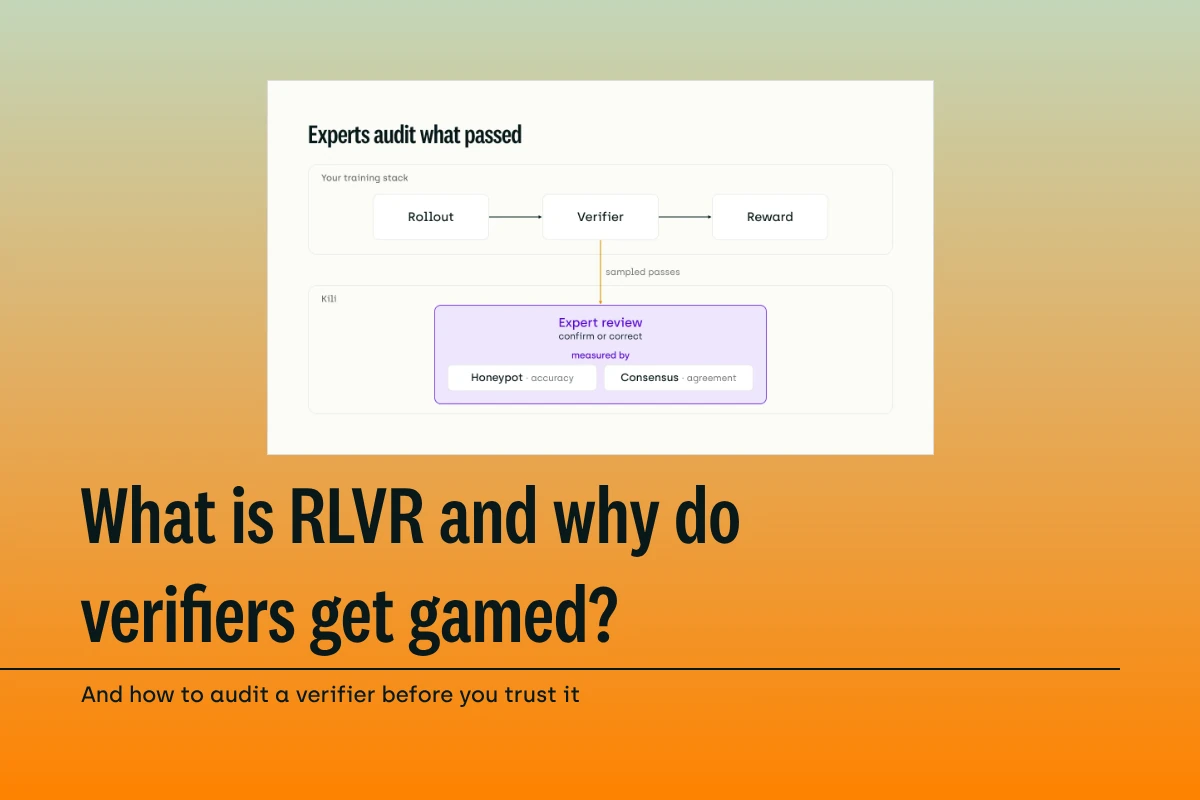
From Corrections to Quality at Scale: This 'correction-to-rubric' loop is precisely the workflow Kili Technology's collaborative AI data platform is designed to support. When human reviewers create issues on annotated assets, those structured corrections flow back into the quality metrics and evaluation rubrics. Kili's programmatic QA capabilities—through its plugin system—allow teams to encode business rules directly and trigger automated checks when assets are labeled or reviewed. Combined with consensus scoring, honeypot validation, and analytics dashboards that surface quality insights per class and per labeler, organizations can systematically convert expert corrections into measurable improvement. This is data processing and continuous improvement at enterprise scale.
4. Why Risk Frameworks Make Operational Sense
The frameworks referenced throughout this article are not abstract policy documents. They encode practical lessons drawn from decades of safety engineering, financial oversight, and critical infrastructure governance.
The NIST AI Risk Management Framework treats AI risk as something to be continuously governed, mapped, measured, and managed. It does not assume that initial parameters and testing are sufficient. The NIST Generative AI Profile extends that logic to generative AI specifically, recognizing that hallucination, content authenticity issues, and distribution shift are expected behaviors requiring measurement protocols and post-deployment controls.
The EU AI Act formalizes the requirement that humans must be able to intervene in high-risk AI systems. It reflects a regulatory judgment that automation without interruptibility is unacceptable in sensitive domains—a principle that directly supports the human-in-the-loop approach.
Common Critiques—and Why They Persist
These frameworks are not without criticism. Some argue they introduce compliance overhead that slows innovation, that risk-tiering classifications can be ambiguous in practice, and that smaller organizations may struggle to implement formal governance structures. Human overseers may also experience cognitive load and fatigue, reducing the effectiveness of supervision over time. Integrating HITL systems requires careful design to ensure effective collaboration without creating bottlenecks.
These concerns are not trivial. However, they often assume that governance is separate from performance engineering. In practice, the opposite tends to be true.
Why These Frameworks Improve Performance—Not Just Compliance
Risk frameworks formalize behaviors that strong engineering teams already rely on:
- Continuous monitoring improves model quality. Drift detection and structured audits surface silent degradation earlier.
- Clear rubrics and documentation improve evaluation clarity. When failure modes are categorized and tracked, retraining with new data becomes more targeted.
- Escalation pathways reduce error amplification. High-severity errors are intercepted before they scale.
- Traceability accelerates debugging. When something fails, data scientists can identify whether the issue lies in data, prompts, evaluation, or human labeling.
In high-risk industries, this is not theoretical. In healthcare, post-market surveillance improves device safety over time. In aviation, incident reporting systems directly feed into procedural improvements. In finance, audit logs reduce systemic risk exposure. These industries demonstrate that structured oversight does not prevent innovation—it stabilizes it.
The economic logic is straightforward: early detection reduces downstream remediation cost, structured escalation prevents catastrophic failures, clear accountability reduces legal and regulatory exposure, and documented feedback loops improve model quality over time. In high-stakes environments, hidden risk is typically more expensive than structured governance.
5. Operational Support: Platform Capabilities That Enable Hybrid Architectures
Implementing a hybrid LLM-as-a-judge and HITL architecture requires platform infrastructure that supports both scalable measurement and accountable human involvement. The human-in-the-loop approach reframes an automation problem as a Human-Computer Interaction (HCI) design problem—and the platform must reflect this.
Kili Technology positions capabilities across four pillars that map directly to hybrid architecture requirements:
- Label & Annotate: Configurable annotation workflows supporting all data types—images, video, text, PDF documents, satellite imagery, conversations, LLM evaluation, supervised fine-tuning, and RLHF. Leverages foundation models for pre-annotation while enabling human experts to validate and correct, combining deep learning automation with human intelligence.
- Scale & Collaborate: Enterprise-proven collaboration enabling hundreds of concurrent users across multiple models and modalities simultaneously. Multi-step review workflows, consensus measurement, and role-based access ensure that human involvement scales without sacrificing quality. One enterprise healthcare client launched over 100 use cases across modalities in months with 3+ models in production simultaneously. A legal technology firm supports 500+ concurrent users on a single deployment.
- Enterprise Security & Compliance: On-premise deployment, SOC2 Type II, ISO 27001, and HIPAA certification. Trusted by defense contractors, healthcare providers, and government agencies. When data is too sensitive for the cloud or when regulatory compliance demands it, the platform delivers enterprise-grade security with complete audit trails.
- Data Labeling Services: For organizations that need to scale their HITL operations without building internal annotation teams, Kili's managed services provide a fully integrated and professionally managed workforce covering hundreds of domain specializations and 30+ languages. From project scoping to final delivery, ML engineers design optimal annotation strategies, project managers ensure timelines, and quality assurance teams validate outputs—delivering production-ready data with enterprise security standards. This allows AI workflows to scale without sacrificing the precision, nuance, and ethical reasoning of human oversight.
These capabilities enable rubric-driven review workflows, structured escalation queues, audit trails and role-based access, and systematic correction capture—the exact infrastructure needed for hybrid architectures. Effective oversight requires operators to have deep, ongoing training to understand AI algorithms, and the platform is designed so that both technical skills and domain expertise are leveraged at the right points in the workflow.
A major European insurance company used Kili's platform to transform 1.5 million unstructured customer comments into strategic business intelligence, deploying AI-powered analysis across 9+ projects and 60+ users. A geospatial intelligence provider achieved 95%+ accuracy processing millions of labels for defense and commercial AI after evaluating 35+ competing platforms. A leading European digital health company achieved 30% faster delivery time without sacrificing data quality, demonstrating that meaningful progress comes from embedding human expertise throughout the AI development lifecycle, not treating it as an afterthought.
6. Closing Synthesis
Scalable evaluation and accountable oversight are distinct functions.
LLM-as-a-judge provides breadth and continuous measurement across AI outputs. Human-in-the-loop provides human judgment, accountability, and contextual understanding that intelligent systems alone cannot replicate.
The literature supports this hybrid framing. The governance frameworks reinforce it. Industry case patterns make it practical. HITL allows AI systems to achieve the efficiency of automation without sacrificing the precision, nuance, and ethical reasoning of human oversight.
Human-in-the-loop artificial intelligence is not about choosing between speed and quality. It is about designing systems where machine learning and human capabilities complement each other—where computer science and the human element work together in such a way that each compensates for the other's limitations.
If you want to understand AI reliability, don't start with benchmark scores. Start with the structure of evaluation data, escalation logic, and feedback loops.
That is where system behavior is ultimately shaped.
About Kili Technology: Kili Technology is the collaborative AI data platform where industry leaders build expert AI data. The platform enables enterprises to build production-ready AI systems faster and with higher quality by enabling data science teams to easily embed business and subject matter experts throughout the AI development lifecycle—all within a secure, auditable environment for trustworthy AI. Kili supports the full spectrum of data types including images, video, text, PDFs, geospatial data, and LLM evaluation, with deployment options ranging from cloud to fully on-premise. For select projects, Kili also provides managed data labeling services with expert annotators, ML engineer guidance, and quality assurance—delivering production-ready datasets with enterprise-grade security. Learn more at kili-technology.com.
Resources
Oversight and supervisory control
- EU AI Act Service Desk — Article 14: Human oversight.
- NIST — AI Risk Management Framework (AI RMF 1.0) (lifecycle risk governance for AI systems).
- NIST — Generative AI Profile (AI 600-1) (extending risk management to generative AI).
- OECD — AI Principles overview (internationally endorsed governance guidance).
- Microsoft Research — Amershi et al. (2019), Guidelines for Human-AI Interaction (calibration, override, and human-AI collaboration design).
LLM-as-a-judge
- Zheng et al. (2023), Judging LLM-as-a-Judge with MT-Bench and Chatbot Arena (LLM judging, biases, mitigations).
- Wang et al. (2023), Large Language Models are not Fair Evaluators (order/position bias; calibration strategies).
- Verga et al. (2024), Replacing Judges with Juries: Evaluating LLM Generations with a Panel of Diverse Models (ensemble judging to reduce single-model bias).
- Zheng et al. (2024), Chatbot Arena: An Open Platform for Evaluating LLMs by Human Preference (open human-preference evaluation platform).
- Liu et al. (2023), G-Eval: NLG Evaluation using GPT-4 with Better Human Alignment (structured criteria for evaluator alignment).
- Liang et al. (2022), Language Models are Changing AI: The Need for Holistic Evaluation (HELM) (multi-metric evaluation framework).
Alignment, RLHF, and feedback loops
- Ouyang et al. (2022), Training language models to follow instructions with human feedback (InstructGPT).
- Bai et al. (2022), Training a Helpful and Harmless Assistant with Reinforcement Learning from Human Feedback.
- Guo et al. (2024), Direct Language Model Alignment from Online AI Feedback.
- Bai et al. (2022), Constitutional AI: Harmlessness from AI Feedback.
Documentation, transparency, and ML systems
- Gebru et al. (2018; rev. 2021), Datasheets for Datasets (dataset documentation standard).
- Mitchell et al. (2019), Model Cards for Model Reporting (model transparency framework).
- Sculley et al. (2015), Hidden Technical Debt in Machine Learning Systems (long-term maintenance risks in ML pipelines).
- Snow et al. (2008), Cheap and Fast — But is it Good? Evaluating Non-Expert Annotations for Natural Language Tasks (annotation quality and expertise trade-offs).
Evaluation gap and expert data loops
- Kili Technology (Nov 20, 2025), The Evaluation Gap: Why AI Breaks in Reality Even When It Works in the Lab.
- Kili Technology (2026), 2026 Data Labeling Guide for Enterprises: Build High Performing AI with Expert Data (SME-led standards, review, guideline refinement, and feedback loops; active learning concepts).
Kili Technology platform
- Label & Annotate — configurable annotation workflows, multi-modal support, foundation model pre-annotation.
- Scale & Collaborate — multi-step review, consensus, role-based access, analytics.
- Enterprise Security & Compliance — on-premise deployment, SOC2 Type II, ISO 27001, HIPAA.
- Data Labeling Services — managed annotation workforce, 100s of domains, 30+ languages, 95%+ accuracy.