Are you affected by the EU AI Act? Do you know what your obligations and timelines look like? Download our skill to find out.

Download the Skill File →
Product

Quality, Built In

Bad labels get caught at the step that produced them, not in a cleanup pass three weeks later. Quality is constructed while the work happens, and the reviewer has enough context to make the correction right the first time.

*No credit card required. Risk-free evaluation.

Trusted by the world leaders

Features

Disagreement surfaces early

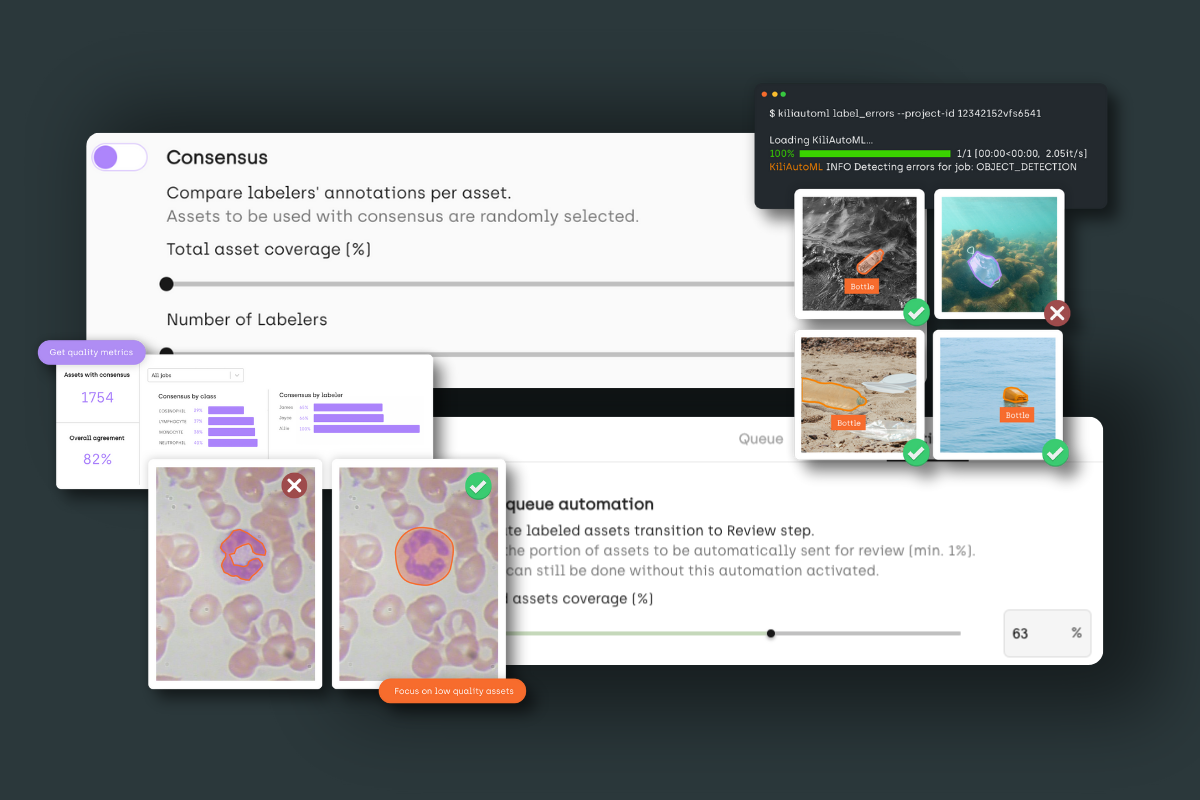
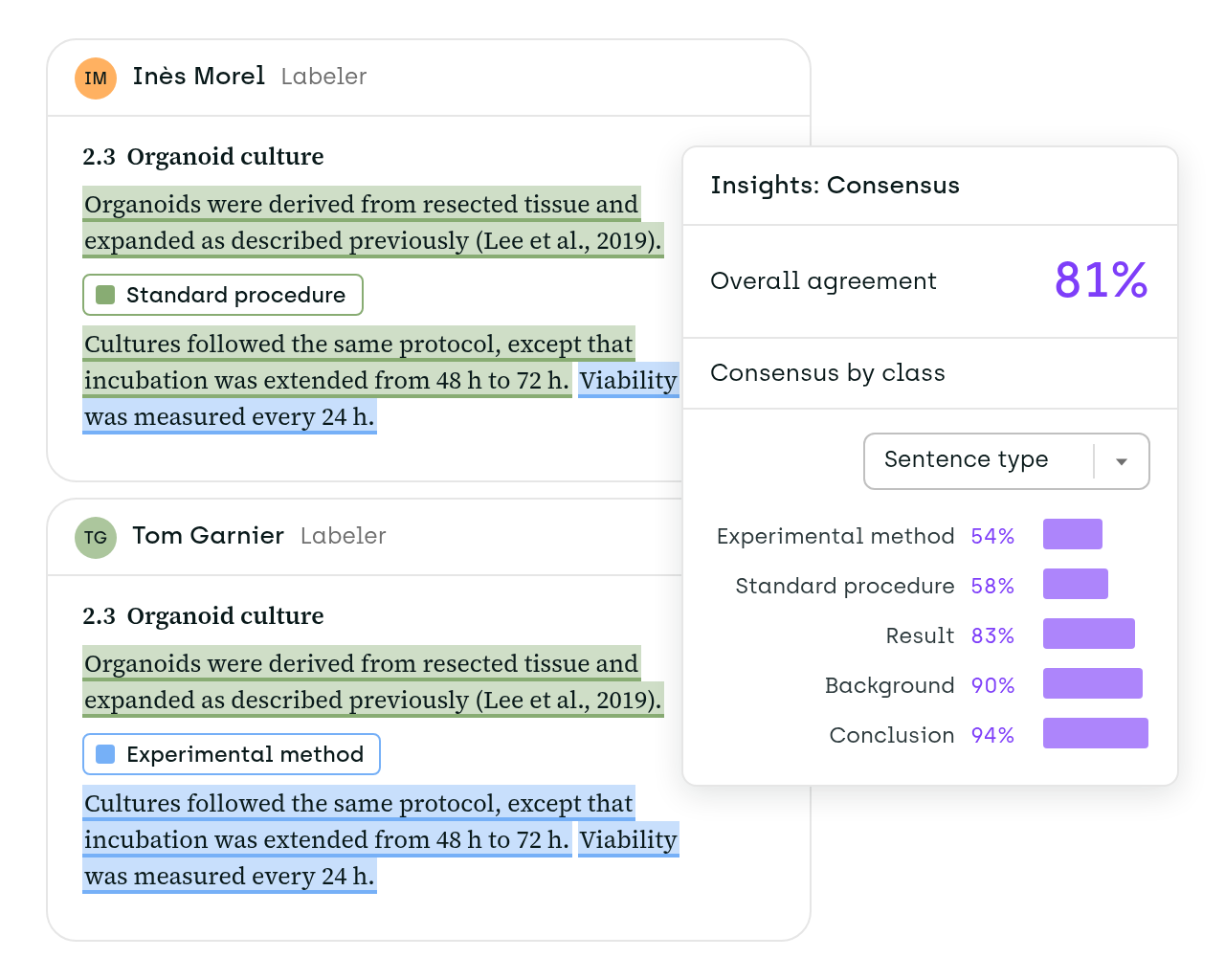
Two specialists looking at the same asset will disagree wherever your criteria are unclear, and that is worth knowing in week one rather than at delivery. Kili puts a number on the gap and breaks it down by class and by person, so you fix the instruction rather than the batch.

See how consensus is scored

Held to your standard

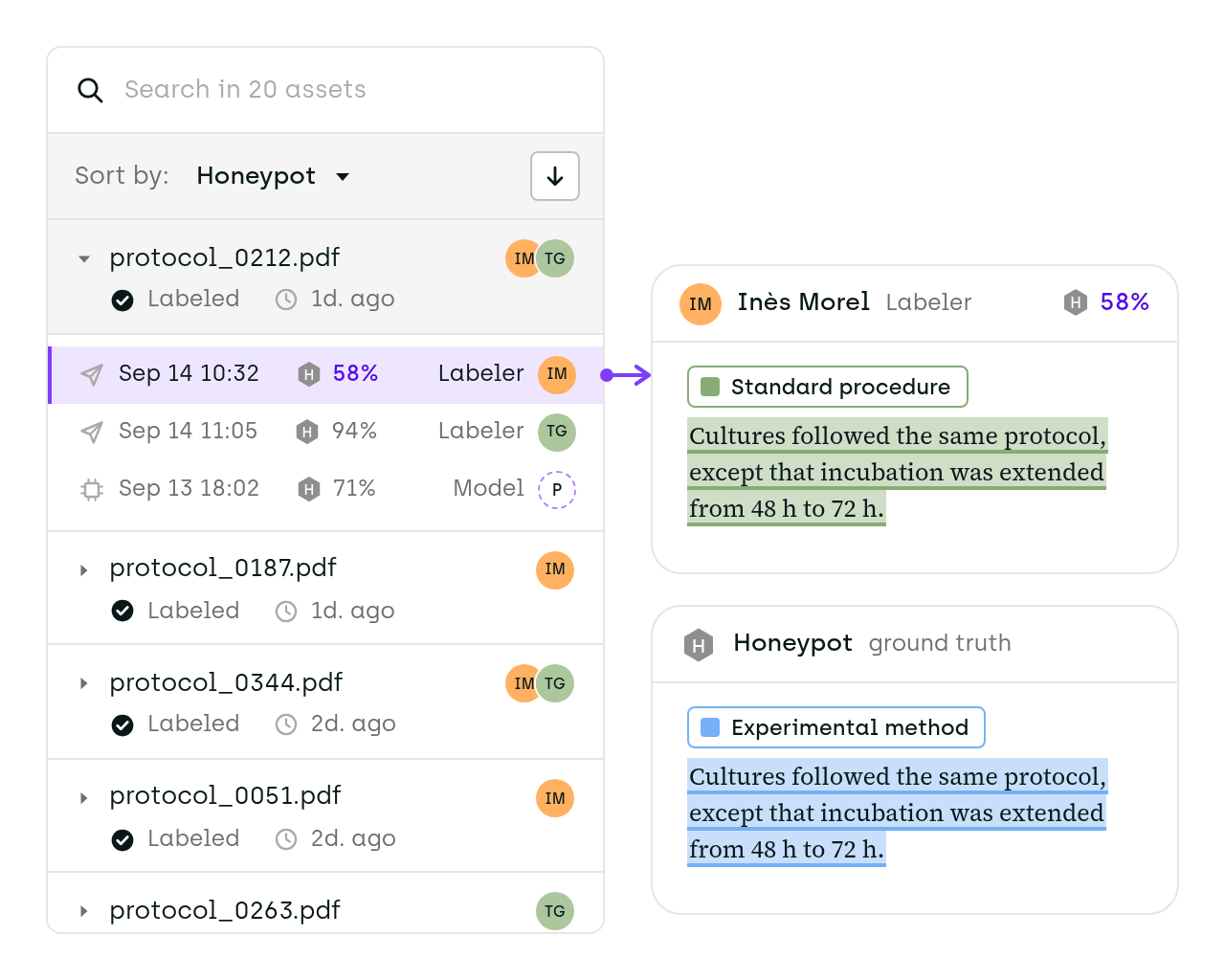
Measure every labeler against work you already know is right, and a contributor drifting from your standard shows up as a score instead of a complaint from a downstream team. You find out while it is still one person's calibration.

Learn how honeypot scoring works

Corrections that hold

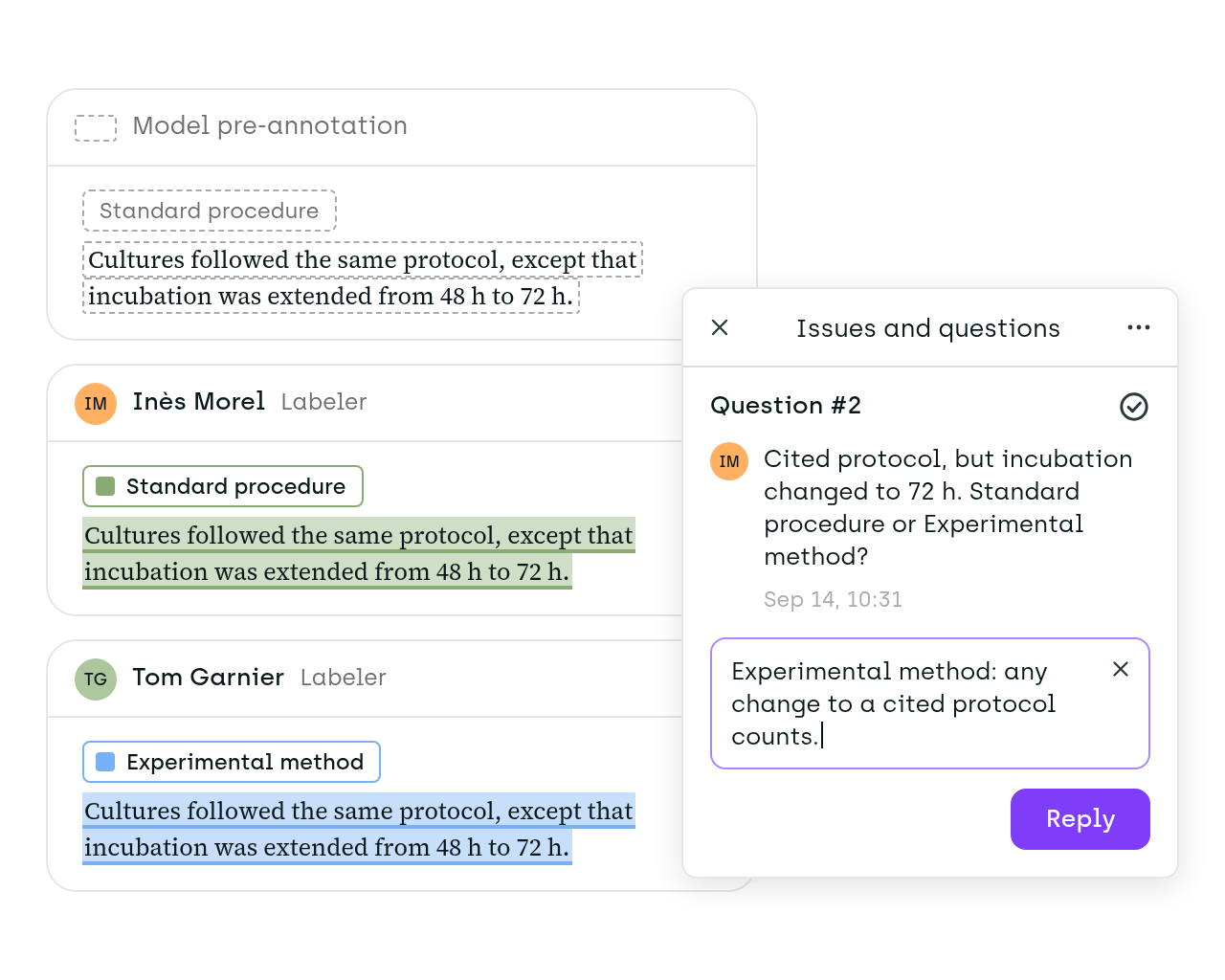
A reviewer guessing at why a label is wrong produces a second wrong label. Kili puts the model's prediction, the class definition and the labeler's own question in the same frame, so the person making the correction knows what the disagreement was actually about.

Read how issues and questions work

See if Kili is the best fit for your team and your data

Speak to our team for a free 14-day evaluation.

Product photo of breast cell segmentation on Kili Technology's platform
Solutions

How each one gets checked

Evaluation sets your team can defend

An evaluation set is only as good as the agreement behind it. Run the same assets past several specialists, watch where they diverge per class, and fix the criteria before the benchmark is frozen. Honeypot holds the set against labels you already trust, so drift in the judges shows up as clearly as drift in the model.

Explore AI Evaluation
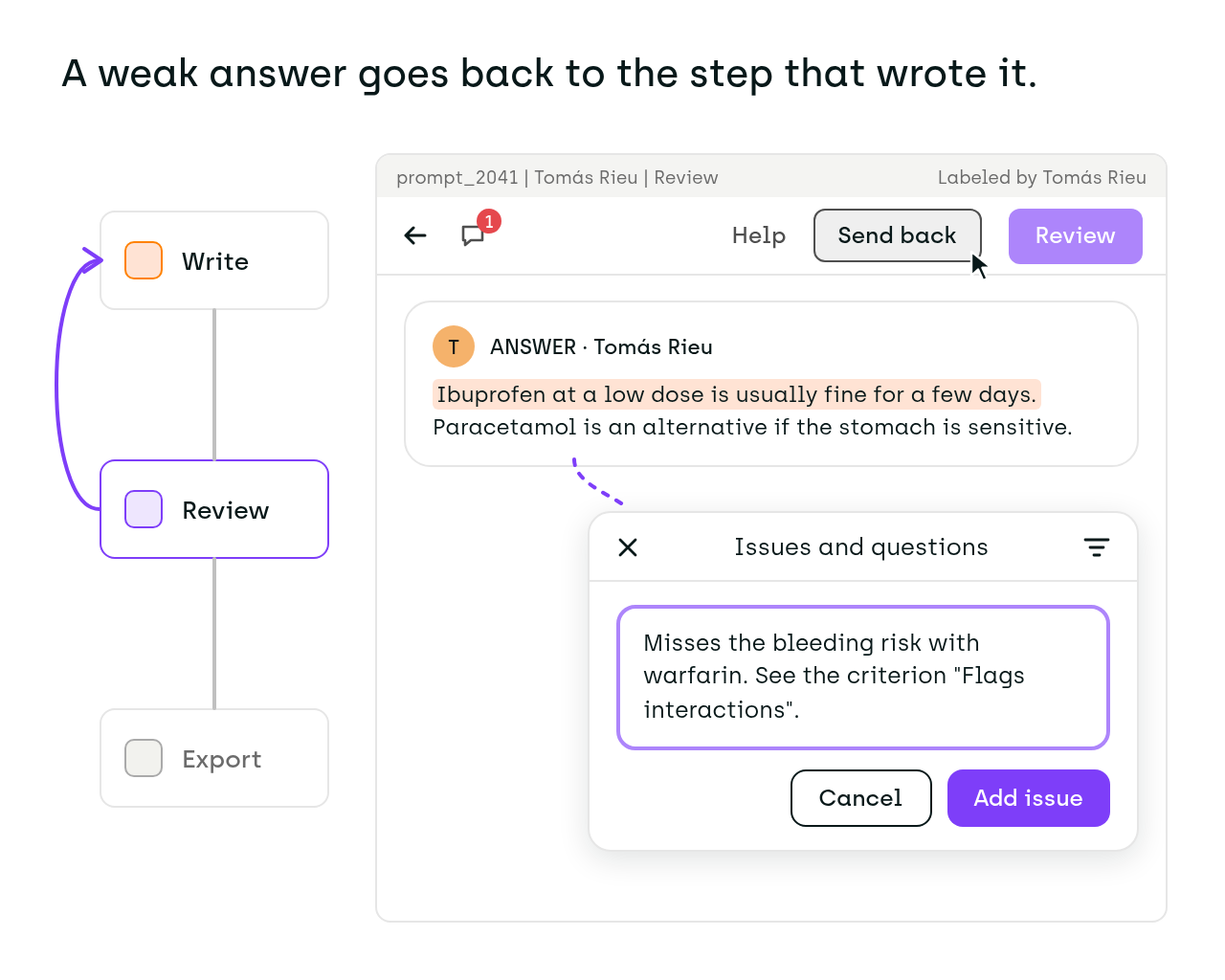
A weak answer goes back to the step that wrote it. A reviewer flags that an answer about ibuprofen misses the bleeding risk with warfarin and sends it back to the Write step.

Where your own experts disagree

Post-training data is an argument about what a good answer looks like, and the argument is usually inside your own team. Consensus makes it visible: two specialists write against the same ontology, and the gap between them is a number you can act on. Tighten the criteria, re-run the step, and the disagreement closes.

Explore Post-Training
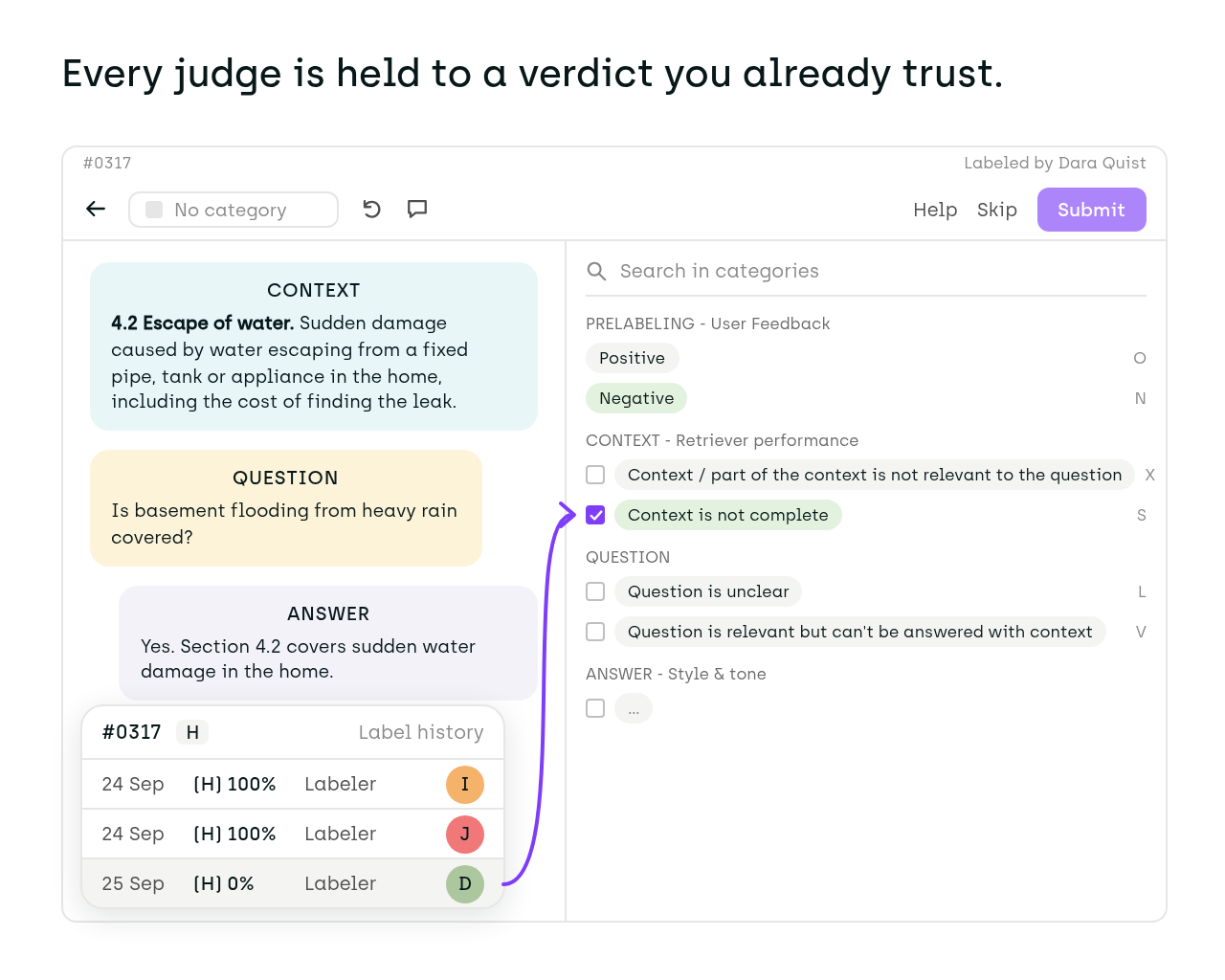
Every judge is held to a verdict you already trust. On a RAG review with a known answer, two judges score 100% on the honeypot and a third scores 0%.

Ground truth that holds at volume

When the class is a domain call, volume is where quality quietly slips. Set the share of assets that go to more than one labeler and keep honeypots on the step that matters. The review step catches what those two miss. Per-person scores point at the contributor who needs the criteria explained, which a project-level average never does.

Explore Data Labeling
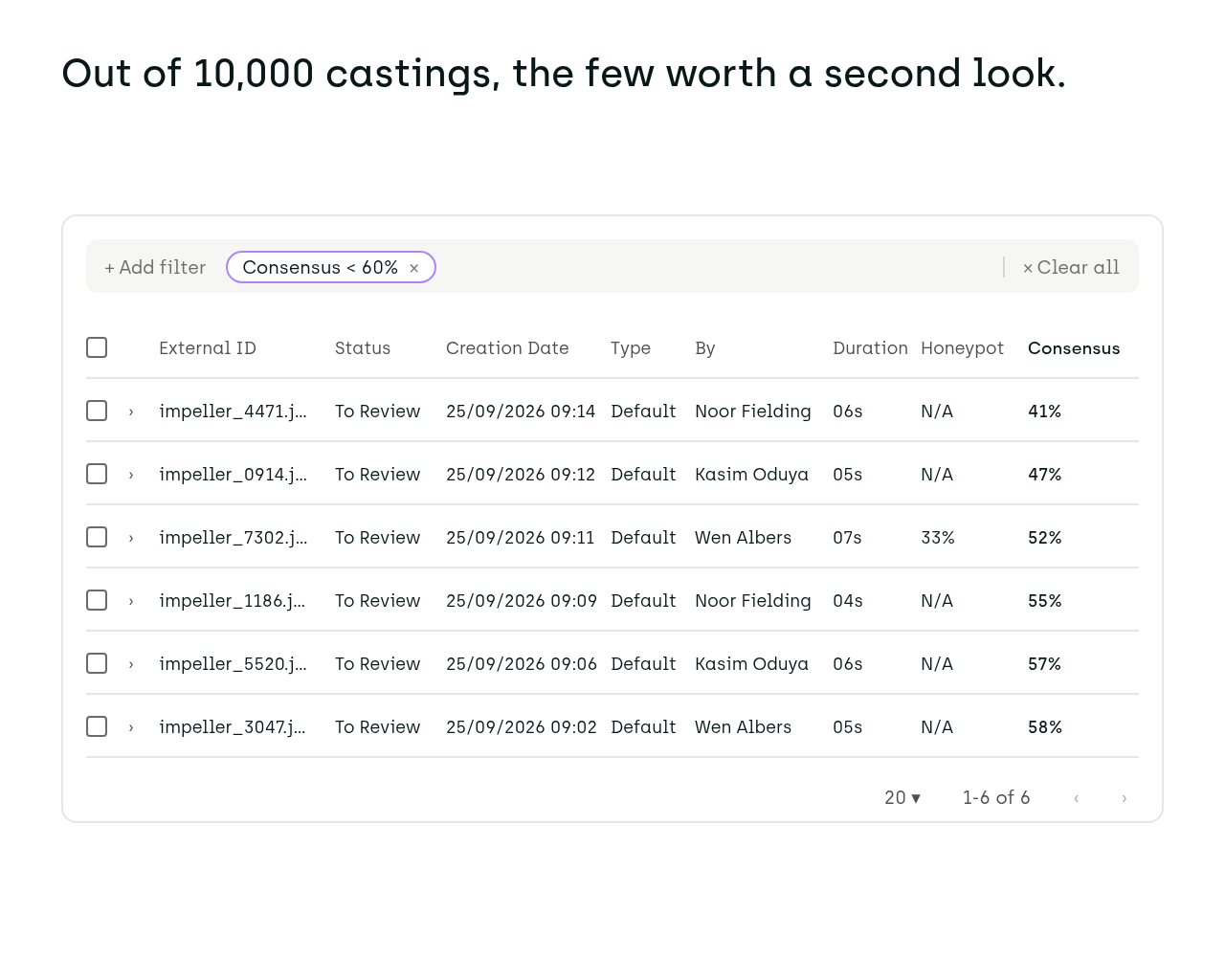
Out of 10,000 castings, the few worth a second look. Impeller images filtered to consensus below 60%, leaving six assets to review.
Tools

Build structured datasets from all data types

Kili Technology is a complete data suite that supports all data types and handles specialized formats for domain-specific requirements.

Geospatial Imagery

Drive reliable mapping and monitoring through high-quality geospatial annotations.

OCR & Document Layout Analysis

Turn unstructured documents into usable data with accurate text extraction and streamlined review workflows.

Natural Language Processing

Annotate text for NER, classification, and sentiment analysis with collaborative workflows.

Image Annotation

Annotate images 10x faster with SAM 2 integration and automated quality controls.

Video Annotation

Annotate long videos seamlessly and boost productivity with advanced automation.

Audio Annotation

Build quality-focused diarization and transcription workflows to improve ASR and Speaker Diarization models for domain-specific and multilingual use cases.

I have been using Kili for 6 months now on a wide range of labeling use cases (both in computer vision and natural language processing). The stability offered by the tool is essential when you have tight deadlines and large volumes of data to annotate. Our team of over 1000 workers is accustomed to the tool, we were able to easily integrate our workforce management tool with Kili with the SSO functionality.
Kili is a powerful and easy-to-use tool for data labeling and annotation. The interface is user-friendly and offers several interesting features. The customer support team is also responsive and helpful.
Software to engage both labelers and business lines in the necessary but tedious task of labeling and annotation, served by a dedicated team to listen to your problems.
Thanks to the fact that our AI infrastructure now includes Kili Technology, we can use the tool for all kinds of projects... LCL teams can accelerate drastically the creation of their training datasets, which means a significant improvement for all the parties involved.
With the choice of Kili, we are much more confident about the future. We decided to eliminate a large part of the technical debt by choosing a solution that will be perfectly mastered across a whole range of data science and AI projects.
FAQ

Need help?

Got questions about Kili Technology? Check out our FAQ. If you can't find it in this list, drop a question for our team.

What is consensus in data labeling, and how does Kili measure it?
What is a honeypot in data labeling and AI evaluation?
What is the difference between consensus and honeypot, and when should I use each?
How do you know whether expert evaluators agree when judging model outputs?
How can I track annotator quality per person instead of per project?
Can I run multi-step review workflows without consensus enabled?
How does Kili stop someone from reviewing their own work?
How do reviewers compare model predictions with human labels during quality review?