.png)

_logo%201.svg)


AI Summary
- The annotation services market is projected to grow from $18.6B in 2024 to $57.6B by 2030, driven by GenAI's demand for domain-specific, expert-created data over generic crowdsourced labels.
- Internal teams suit sensitive data, deep proprietary expertise, and small consistent volumes — but organizations underestimate true total cost by 40–60% when factoring in hiring, infrastructure, and management overhead.
- External workforces unlock access to scarce specialists like Lean 4 programmers, math-olympiad annotators, and native-speaker linguists that are practically impossible to hire as full-time employees.
- Using an external workforce specifically to build gold-standard evaluation data eliminates internal bias and gives independent benchmarks against which internally-annotated training data can be validated.
- Modality matters: autonomous-vehicle volume favors external scale, medical imaging demands clinical expertise, and document IDP often benefits from hybrid models with internal SMEs handling edge cases.
- Kili Technology delivers both platform infrastructure and expert workforce — including specialized talent networks across 40+ languages and technical domains — so teams can pick the operating model that fits their project.
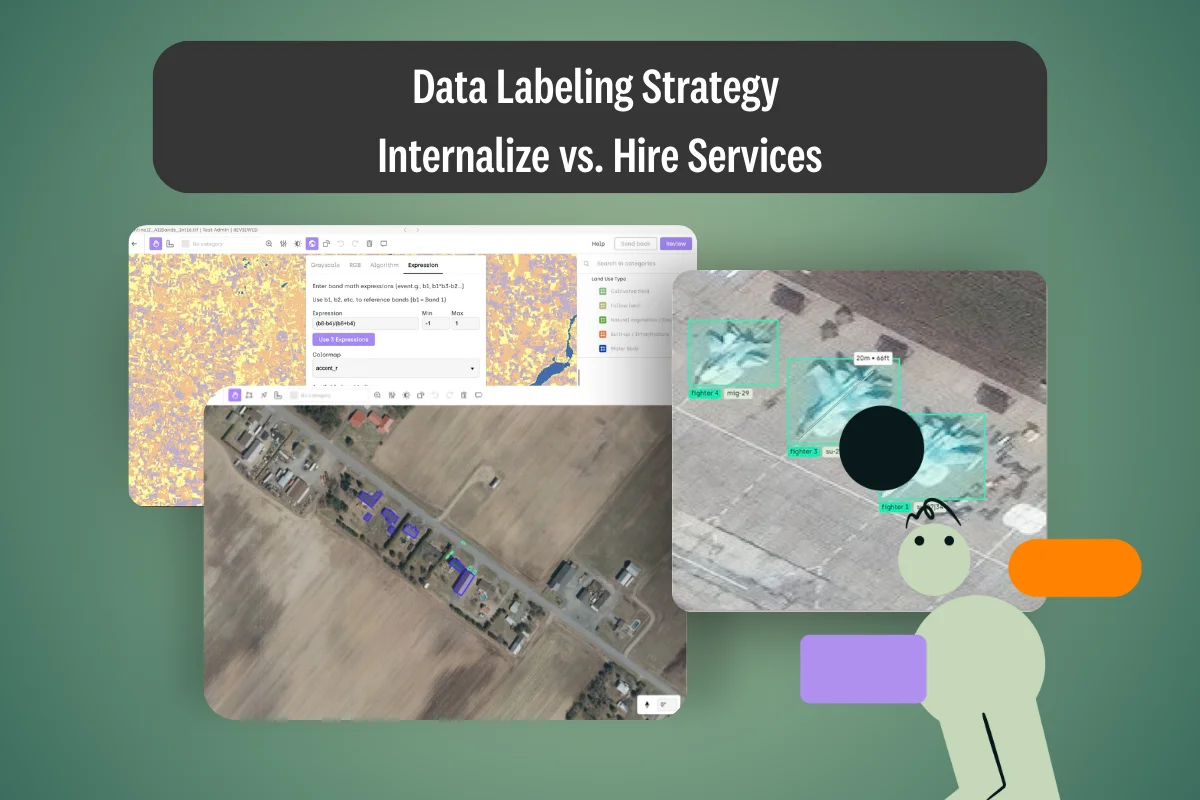
The quality of your AI model is only as good as the data behind it. This is not a cliché—it's the hard-won lesson that AI teams learn after months of frustrating iteration cycles, disappointing model performance, and missed deadlines. Whether you're building a foundation model, fine-tuning an LLM for a specialized domain, or creating evaluation benchmarks for your enterprise AI, one question looms large: Should you use a data annotation platform with your internal team, hire an external annotation workforce, or pursue a hybrid approach?
This decision has profound implications for your project timeline, budget, data quality, and ultimately, your model's performance in production. The wrong choice can mean months of delays, ballooning costs, and training data that introduces more problems than it solves. The right choice accelerates your path from prototype to production while delivering high quality data that genuinely improves model accuracy.
In this guide, we'll explore the three primary approaches to data annotation, examine the real-world factors that should influence your decision, and help you identify the strategy that aligns with your specific data annotation project requirements. We'll also introduce a fourth consideration that many AI teams overlook: using an external workforce to produce gold standard evaluation data that validates and improves the quality of your internally-annotated datasets.
The Stakes Have Never Been Higher
Before diving into the tactical comparison, it's worth understanding why this decision matters more today than ever before.
The data annotation market has exploded, with industry analysts valuing the global annotation services sector at approximately $18.6 billion in 2024 and projecting growth to $57.6 billion by 2030. This growth reflects a fundamental shift in how organizations approach artificial intelligence development: data quality has moved from an afterthought to a strategic priority.
For generative AI projects specifically, the requirements have intensified. Supervised fine-tuning (SFT) datasets for large language models demand specialized, domain-specific knowledge that goes far beyond basic annotation tasks. The data must be original, unique, and created by experts who bring real-world industry experience to the labeling process. Without properly labeled data, AI models cannot learn effectively—and generic crowdsourced data simply won't cut it for training models that need to perform with professional-grade accuracy and reliability.
According to Gartner, by 2027, more than 50% of the GenAI models used by large businesses will be designed specifically for focused industry or business process functions—up from approximately 1% in 2023. This dramatic shift means organizations need ai data annotation capabilities that can match the complexity and specificity of their AI ambitions.
Option 1: Data Annotation Platform with Internal Teams
How It Works
In this approach, your organization licenses or builds a data annotation platform and assigns internal team members to handle annotation tasks. These could be dedicated data annotators you've hired, or existing employees—such as domain experts, business analysts, or quality assurance specialists—who take on annotation responsibilities alongside their primary roles.
Modern data annotation platforms provide sophisticated interfaces designed for efficiency, including AI-assisted pre-labeling, quality management workflows, consensus algorithms, and integration capabilities with your existing ML infrastructure. Most platforms support custom workflows to enhance team collaboration, along with basic annotation tools like bounding boxes and polygons for tasks ranging from object detection to semantic annotation. Your annotation team uses these tools to annotate datasets according to guidelines you've developed in-house.
When This Approach Makes Sense
Your project involves highly sensitive or classified data. When datasets contain proprietary information, trade secrets, patient health records, financial data, or national security materials, keeping the annotation process entirely in-house eliminates third-party data exposure risks. End-to-end control over who touches the data becomes paramount—especially critical for complex projects in regulated industries.
You have deep domain expertise that's difficult to transfer. Some annotation tasks require such specialized knowledge that training external annotators would take longer than completing the work internally. If your team includes subject matter experts who understand the nuances of your industry—and those nuances are essential for accurate annotation—internal execution may be faster.
Your data volumes are manageable and consistent. If you need to annotate a relatively small dataset for a proof of concept or pilot project, building out external workforce relationships may be overkill. Internal teams can handle modest volumes efficiently, especially when combined with platform automation features and cloud storage integration.
You're building ongoing annotation capabilities as a core competency. Some organizations, particularly tech companies with continuous AI development needs, view annotation expertise as a strategic capability worth developing internally. They're willing to invest in building infrastructure, training teams, and refining workflows over the long term.
The Challenges You'll Face
Scalability hits a wall quickly. Most internal data annotation teams are designed to meet a specific, limited requirement. When project demands fluctuate—requiring significantly more annotated data one month and less the next—internal teams struggle to adapt. You can't quickly hire, train, and onboard new annotators, nor can you easily reduce headcount during slower periods without losing institutional knowledge.
Hidden costs accumulate rapidly. The visible cost of internal annotation—salaries for annotators—represents only a fraction of the true expense. Factor in recruiting and hiring costs, benefits and overhead, training and onboarding time, annotation platform licensing or development, IT infrastructure and data management, quality assurance workflows, and management overhead. Organizations frequently underestimate these costs by 40-60% when comparing internal versus external options.
Quality consistency is harder than it looks. Maintaining annotation quality across a team requires sophisticated training programs, clear guidelines, calibration exercises, and ongoing performance monitoring. Quality assurance is critical in data annotation—all platforms provide manual review functionality, but implementing effective quality control techniques like consensus labeling and audit checks requires expertise. Internal teams, especially when annotation isn't their primary job function, often struggle to maintain the consistency that machine learning models require. Without established quality workflows, inter-annotator agreement suffers, and your datasets become unreliable.
Expertise gaps emerge in specialized domains. Even if your internal team includes domain experts, they may lack experience with specific annotation methodologies, AI training data requirements, or the iterative feedback loops that optimize datasets for model performance. The gap between domain expertise and annotation expertise is often larger than organizations anticipate—particularly when handling diverse data types from images and video to audio data and text annotation.
Opportunity cost is significant. Every hour your data scientists, ML engineers, or domain experts spend on annotation tasks is an hour not spent on model development, algorithm refinement, or strategic initiatives. The majority of data scientists' work already involves working with training data—adding annotation responsibilities on top compounds this problem.
Option 2: Hiring an External Annotation Workforce
How It Works
In this approach, you partner with a specialized data annotation service provider who supplies trained annotators, quality management processes, and often their own annotation platform. A data annotation service prepares your raw data—whether images, audio recordings, documents, or other data types—into labeled, machine-readable training sets essential for AI models. You define the requirements, provide guidelines, and receive annotated datasets that meet your specifications.
The best service providers go beyond basic labor arbitrage. They offer a dedicated project manager with AI/ML expertise to oversee the annotation process and quality assurance, quality workflows built specifically for generative AI, access to specialized talent networks, and the ability to scale annotation operations rapidly based on your needs.
When This Approach Makes Sense
Your project demands specialized expertise you can't source internally. Consider this scenario: you're building a model that requires Lean 4 programmers to translate natural language math problems into formal proofs. Or you need native speakers across multiple languages to create culturally-nuanced instruction-following datasets. Or you require math olympiad-level annotators to ensure quality training data for advanced reasoning capabilities. These experts are extremely difficult to hire as full-time employees, but specialized providers maintain networks of vetted professionals across technical domains.
Speed-to-market is a competitive advantage. Outsourcing accelerates the timeline from raw data to training data by eliminating hiring delays, onboarding periods, and the learning curve of building internal annotation capabilities. Providers with established workforces and workflows can begin production immediately, often delivering results in weeks rather than months. Properly annotated datasets enable models to learn faster and more effectively, reducing the time and resources needed for training and development.
Scale requirements exceed your internal capacity. When you need to annotate large datasets at scale—hundreds of thousands or millions of samples—external workforces become not just preferable but necessary. Providers can quickly ramp from a handful of annotators to hundreds, then scale back down without the organizational burden of managing fluctuating headcount. This scalability is essential for projects ranging from computer vision applications to autonomous driving systems that require massive volumes of labeled data.
You need quality guarantees backed by SLAs. Reputable service providers offer contractual quality and volume commitments. They have skin in the game: if they don't meet your specifications, they bear the cost of rework. Quality assurance often involves multiple reviewers checking the consistency and accuracy of labels, with quality assurance reports that include accuracy metrics and confusion matrices for performance analysis. This shifts risk away from your organization and creates accountability that's difficult to replicate with internal teams.
You want to free internal resources for higher-value work. By outsourcing annotation projects, your data scientists and ML engineers can focus on what they do best: developing models, refining algorithms, and driving innovation. The operational burden of managing annotation workflows shifts to specialists who excel at it.
The Challenges You'll Face
Finding a provider who can handle GenAI complexity. The traditional data annotation market was built for simpler tasks: drawing bounding boxes for object detection, classifying images for computer vision, transcribing audio. Many providers struggle when confronted with the sophisticated requirements of GenAI projects—instruction-following datasets, RLHF preference data, domain-specific benchmark creation, or technical coding tasks. You need a partner with genuine AI expertise and the ability to handle projects across diverse use cases, not just annotation volume.
Communication and feedback loops require attention. Effective outsourcing demands clear project requirements, responsive communication, and iterative feedback. If your requirements are ambiguous or your feedback cycles are slow, annotation quality suffers. The best providers mitigate this with dedicated project managers and agile methodologies, but you still need to invest time in the relationship.
Data security becomes a shared responsibility. Sharing data with an external provider requires trust and verification. You need to assess their security infrastructure, compliance certifications (SOC2, ISO 27001, HIPAA), data handling practices, and access controls. For highly sensitive projects, this due diligence is essential—and some providers offer on-premise, hybrid, or air-gapped deployment options to address these concerns.
Dependency on vendor execution. Your project timeline becomes partially dependent on your provider's ability to deliver. Reputable providers mitigate this with SLA guarantees and transparent progress tracking, but the dependency remains. Choose partners with demonstrated ability to meet commitments and handle edge cases that inevitably arise in complex annotation projects.
Option 3: The Hybrid Approach
How It Works
The hybrid approach combines elements of internal annotation and external workforce engagement. Rather than viewing these as mutually exclusive options, organizations design workflows that leverage the strengths of each.
Common hybrid configurations include keeping a small internal team for sensitive or domain-specific data while outsourcing larger-scale or more routine annotation tasks; using internal subject matter experts for guideline development, quality review, and edge case resolution while external annotators handle volume production; maintaining internal annotation capabilities for ongoing needs while engaging external providers for surge capacity during intensive project phases; or using an external workforce specifically to create gold standard evaluation datasets that benchmark and validate internally-annotated data.
When This Approach Makes Sense
You have both sensitive and non-sensitive data requirements. Many organizations work with datasets that span a spectrum of sensitivity levels. Highly confidential data can be annotated internally while less sensitive portions are handled externally, optimizing both security and efficiency.
You want quality control through independent validation. Here's a powerful use case that many AI teams overlook: engaging an external workforce to create evaluation and benchmark datasets that serve as gold standards for measuring the quality of your internally-annotated training data.
Golden datasets—meticulously curated collections of high quality training data verified by experts—serve as ground truth benchmarks against which your model's performance is measured. They provide ground truth labeling, accuracy and precision assessment, bias and fairness checks, and standardized performance comparison across model iterations for comprehensive model evaluation.
By having an independent external team create these evaluation datasets, you gain several advantages. First, you eliminate internal bias: when the same team that creates training data also creates evaluation data, blind spots carry over. External annotators bring fresh perspectives and catch errors that internal teams miss. Second, you access domain expertise for validation: specialized providers can supply subject matter experts—doctors, lawyers, mathematicians, linguists—who verify that your annotations meet professional standards. Third, you establish rigorous benchmarking: golden datasets created by external experts give you confidence that your evaluation metrics reflect genuine model performance, not artifacts of your annotation process.
You need to balance cost optimization with quality requirements. Different annotation tasks have different quality thresholds. External workforces may be more cost-effective for high-volume tasks with clear guidelines, while internal experts handle lower-volume work requiring deep institutional knowledge. The hybrid approach lets you allocate resources efficiently based on project requirements.
Your annotation needs fluctuate significantly over time. If your annotation requirements vary with project phases—intensive during initial training data creation, lighter during maintenance—a hybrid approach provides flexibility. Maintain core internal capabilities while using external providers to absorb demand spikes.
The Challenges You'll Face
Coordination complexity increases. Managing two annotation streams requires more sophisticated project management. You need clear boundaries defining which data goes where, consistent guidelines across both teams, and integration points for quality assurance. Without careful orchestration, the hybrid approach creates fragmentation rather than synergy.
Consistency across teams demands attention. If internal and external annotators are labeling similar data types, maintaining inter-team consistency becomes critical. Regular calibration exercises, shared training materials, and unified quality metrics help ensure your datasets are coherent regardless of their source. Automated QA techniques can help catch and fix frequent errors across both annotation streams.
You may need platform interoperability. If your internal team uses one annotation platform and your external provider uses another, data handoffs and format conversions add friction. Seek providers who can work within your existing infrastructure or provide API-first integration capabilities to manage data collection and delivery seamlessly.
Key Factors for Your Decision
As you evaluate which approach—or combination of approaches—fits your situation, consider these factors systematically.
Data Sensitivity and Security Requirements
How sensitive is your data? If you're working with classified information, patient health records, or proprietary trade secrets, internal handling or carefully vetted providers with appropriate certifications become non-negotiable. Assess not just the sensitivity of the data itself, but the regulatory and compliance requirements governing it.
Domain Expertise Requirements
How specialized is the knowledge required for accurate annotation? Technical domains like theorem proving, medical imaging, legal document processing, or advanced mathematics require annotators with genuine expertise—not just training. Evaluate whether you can source this expertise internally, whether providers in your domain have access to qualified talent, and the realistic time and cost to develop expertise from scratch.
Scale and Volume Needs
How much data do you need to annotate, and over what timeframe? Small pilots and proofs of concept may be efficiently handled internally. Large-scale training data creation typically benefits from external workforce engagement. Be realistic about your volumes and consider how they may change as your project evolves—from initial model training through ongoing model evaluation and refinement.
Timeline Pressures
When do you need annotated data delivered? If speed matters, external providers with established workforces can begin production immediately. Building internal capabilities takes months—time you may not have if competitors are moving fast with their ai and machine learning initiatives.
Budget Constraints and Total Cost of Ownership
What's your budget, and how are you calculating costs? Compare true total cost of ownership for each approach, including all the hidden costs of internal operations (hiring, training, infrastructure, management) against the visible costs of external services. Many platforms offer free trials to help evaluate their capabilities, but organizations that focus only on per-annotation costs often make suboptimal decisions.
Quality Requirements and Accountability
What quality levels do your ml models require, and how will you enforce them? Quality assurance involves defining measurable KPIs like accuracy or precision. Consider whether you have the expertise to implement rigorous quality workflows internally, whether you need SLA-backed quality guarantees, and how you'll measure and maintain annotation consistency over time to ensure top quality training data.
Long-term Strategic Intent
Is annotation a core competency you want to build, or an operational function you'd prefer to outsource? Your answer shapes whether internal capability building is a strategic investment or an unnecessary distraction from your primary mission of advancing AI technology.
Modality-Specific Considerations: How Project Type Shapes Your Decision
The platform-versus-workforce decision plays out differently depending on the type of AI you're building. Each modality—computer vision, NLP and LLMs, OCR and intelligent document processing—presents unique annotation challenges that influence which approach delivers the best results.
Computer Vision
Computer vision projects span a wide spectrum, from relatively straightforward object detection to complex multi-frame video annotation requiring object tracking and action recognition. The right approach depends heavily on where your project falls on this spectrum.
Autonomous vehicles and robotics represent the high end of complexity. These projects require annotators to label images, videos, and 3D LiDAR point clouds with extreme precision—drawing bounding boxes around pedestrians, vehicles, and obstacles; creating pixel-perfect semantic segmentation masks; and tracking objects across thousands of video frames. The volume requirements are massive (often millions of labeled images), the accuracy requirements are safety-critical, and the annotation types are technically demanding.
For autonomous driving and similar projects, external workforce engagement is typically essential. The scale alone makes internal-only approaches impractical, and the technical complexity of 3D cuboid annotation and motion tracking requires specialized training that dedicated providers have already invested in developing. However, a hybrid approach often works best: internal teams handle edge cases and validation, while external annotators manage volume production.
Medical imaging presents a different challenge. Annotating X-rays, CT scans, MRIs, and pathology slides requires genuine clinical expertise—radiologists, pathologists, and other medical professionals who can identify anomalies with diagnostic accuracy. This is not work that can be performed by general-purpose annotators with brief training.
Organizations working on medical AI often benefit from a hybrid model: licensed medical professionals (either internal or contracted through specialized providers) perform primary annotation, while platform-based workflows manage quality control, consensus measurement, and audit trails required for regulatory compliance. The sensitivity of patient health data also favors internal handling or providers with HIPAA certification and healthcare-specific security protocols.
Retail and e-commerce applications—product recognition, visual search, shelf monitoring—typically involve high volumes of relatively standardized annotation tasks. Image annotation with classification labels, bounding boxes around products, and attribute tagging can be performed efficiently by trained annotators without deep domain expertise. External workforces excel here, delivering the scale and cost efficiency these projects require. Internal teams may focus on developing guidelines, handling brand-specific edge cases, and validating quality.
Security and surveillance systems require person detection, facial landmark annotation for gesture recognition, crowd analysis, and anomaly identification. The sensitivity of this data—often involving identifiable individuals—creates security requirements that influence provider selection. Organizations in this space frequently opt for on-premise or air-gapped deployments, whether using internal teams or carefully vetted external partners.
Natural Language Processing and Large Language Models
NLP and LLM projects have evolved dramatically, and with that evolution, the annotation requirements have become far more sophisticated than traditional text annotation.
Instruction-following datasets for post-training represent one of the most demanding annotation challenges in modern AI. These datasets teach models how to respond helpfully, accurately, and safely to user prompts across diverse tasks—from creative writing to technical explanation to multi-step reasoning.
Creating high-quality instruction-following data requires annotators who can write fluently, think critically, and understand what constitutes a genuinely helpful response. For multilingual datasets, native-speaker professionals with strong writing skills are essential—not just for grammatical accuracy, but for cultural nuance and natural expression. Traditional crowdsourcing approaches fail here because the bar for quality is simply too high. Data annotation can help AI systems detect sentiment, prioritize assistance, and direct customer interactions effectively—but only when the underlying training data meets exacting standards.
This is where specialized workforce providers demonstrate their value. Building an internal team of professional writers across multiple languages is prohibitively expensive and slow. Providers with established networks of linguists, professional writers, and native-speaker experts can deliver multilingual instruction-following datasets at quality levels that internal teams struggle to match.
RLHF (Reinforcement Learning from Human Feedback) and preference data require annotators to compare model outputs and judge which response is better—and why. This demands sophisticated reasoning about helpfulness, accuracy, safety, and alignment with user intent. Annotators need training not just in the task mechanics, but in the principles that define good AI behavior.
The iterative nature of RLHF—where model outputs change as training progresses—benefits from agile workforce arrangements that can adapt quickly to evolving requirements. External providers with dedicated project managers and rapid feedback loops outperform internal teams that must context-switch between annotation and other responsibilities.
Domain-specific fine-tuning for legal, medical, financial, or technical applications requires subject matter experts who understand professional terminology, regulatory requirements, and industry-specific conventions. A legal AI needs training data created by lawyers; a medical AI needs input from clinicians; a financial AI needs expertise from analysts and compliance professionals.
For these projects, the hybrid approach often delivers the best results. Internal domain experts develop guidelines and handle the most sensitive or complex examples, while external providers supply additional SME capacity and manage the operational complexity of coordinating specialized talent. Some organizations also use external expert annotators specifically to create gold standard evaluation datasets—providing an independent benchmark against which internally-created training data can be validated.
Sentiment analysis, entity recognition, and text classification represent more traditional NLP tasks with established annotation methodologies. While still requiring careful attention to guidelines and quality, these tasks can be performed effectively by trained annotators without deep domain expertise. Annotated data from these services can be used for various applications, including sentiment analysis and customer service automation. External workforce providers offer scale and cost advantages for these higher-volume, more standardized annotation types.
OCR and Intelligent Document Processing (IDP)
Document understanding has emerged as a critical AI application across industries—from invoice processing and contract analysis to form extraction and records digitization. These projects combine visual understanding (recognizing document layouts, tables, and handwriting) with semantic comprehension (understanding what the extracted text means).
Structured document extraction—processing invoices, receipts, purchase orders, and standardized forms—involves labeling key fields (vendor name, date, line items, totals) across large volumes of documents. The annotation process transforms this unstructured data into structured data for training machine learning models. The task is relatively well-defined: identify specific fields, draw bounding boxes around them, and transcribe or classify the content.
For document processing projects, external workforce providers offer compelling advantages. The volume requirements for training robust extraction models are substantial, and the annotation task can be performed effectively by trained annotators following clear guidelines. Human annotators use specialized software to add metadata during the labeling process, with final annotated datasets exported in machine-readable formats like JSON, COCO, or XML. Platform-based quality workflows ensure consistency across annotators, and specialized providers have developed efficient processes for document annotation at scale.
Unstructured document analysis—extracting information from contracts, legal filings, medical records, or technical manuals—presents greater challenges. These documents vary widely in format and structure, and accurate extraction requires understanding context, resolving ambiguities, and handling domain-specific terminology.
Internal teams with domain expertise may be better positioned for initial guideline development and edge case resolution, while external annotators handle volume production for more standardized document types. The hybrid model lets organizations leverage internal knowledge while achieving the scale that document processing projects typically require.
Handwritten text recognition adds another layer of complexity. Training models to read handwritten forms, historical documents, or notes requires annotators who can accurately transcribe often-difficult handwriting. Audio annotation includes similar challenges—transcription and timestamping of speech data requires careful attention to detail and domain-specific vocabulary. Quality control is critical—transcription errors directly degrade model performance—and consensus workflows help identify and resolve ambiguous cases.
Table extraction and document layout analysis require annotators to identify and label complex document structures: tables with merged cells, multi-column layouts, headers and footers, and hierarchical relationships between document elements. These tasks benefit from annotation platforms with specialized interfaces for document structure labeling, combined with annotators trained in the specific conventions of the documents being processed.
Compliance and audit requirements frequently accompany IDP projects, particularly in regulated industries. Financial services, healthcare, and legal organizations need complete audit trails documenting how training data was created, who performed annotations, and what quality controls were applied. This favors platforms and providers with robust documentation capabilities and security certifications appropriate to the industry.
The Case for Working with Kili Technology
At Kili Technology, we've built our services around a simple recognition: different organizations have different needs, and the best partner is one who can adapt to your specific situation rather than forcing you into a one-size-fits-all solution.
Platform + Services: The Complete Solution
Unlike providers who offer only workforce services or only platform tools, Kili delivers both. Our enterprise-grade collaborative AI data platform enables organizations to manage the entire AI data workflow—from annotation and labeling to validation and model feedback—whether you're working with internal teams, our expert annotation services, or a combination of both.
For organizations building internal capabilities, our API-first annotation interfaces integrate seamlessly with your existing ML infrastructure. LLM-specific interfaces, quality management at scale, and simple annotation ops integration mean your team can work efficiently without building tools from scratch. The platform supports diverse data types and annotation tasks—from image and video annotation to text and audio—with the flexibility to create custom workflows tailored to your specific needs.
For organizations seeking workforce services, our dedicated project manager and ML engineers own your data pipeline from kickoff to delivery—handling workforce coordination, quality workflows, and iteration cycles so you can focus on model development.
Access to Specialized Talent Networks
The current data services market struggles to source niche technical experts. We've invested in building relationships with specialized talent across domains that traditional providers can't access—giving our clients the expertise and capabilities needed to train models for cutting-edge applications.
Consider our work developing high-quality Lean 4 datasets for mathematical theorem proving. Our talent acquisition team contacted 600 experts via GitHub, onboarded 15 experts within one week, scaled to 150 active experts within one month, and now maintains connections with over 2,000 Lean 4 experts on reserve. This isn't commodity labor—these are math olympiad-level annotators and specialized programmers who ensure training data quality for advanced reasoning capabilities.
For multilingual instruction-following datasets, our in-house language experts—linguists, professional writers, native speakers—guide and monitor highly-educated native language professionals across 40+ languages. We've delivered datasets in Simplified Chinese, French, Italian, Portuguese, Russian, and dozens of other languages with the cultural nuance intact that models need to perform consistently across linguistic boundaries.
Quality Without Compromise
Traditional providers force a choice: speed or quality. We eliminate that trade-off with comprehensive data quality workflows tailored to GenAI requirements, ensuring high-quality annotations at every stage.
Our approach includes multi-step validation processes where every dataset undergoes rigorous quality control to ensure precision and alignment with project specifications. We use inter-annotator agreement metrics with strict quality control guidelines that promote or demote annotators as needed based on performance. In-house AI tutors—our ML experts—guide and monitor annotators, instructing them when diversity or quality needs improvement. We take an agile, iterative approach with efficient workflows that allow our AI and language teams to quickly gather feedback and adapt to fast-changing requirements.
The result: highly curated datasets usable for training next-generation ai models, with diversity fine-tuned to the exact needs of each customer. Our quality assurance reports provide detailed accuracy metrics and performance analysis, giving you confidence in your training data quality.
Enterprise-Grade Security and Support
Trusted by the defense industry, foundation model builders, and research labs, our infrastructure meets the highest security standards. We hold SOC2, ISO 27001, and HIPAA certifications. We provide on-premise, hybrid, and air-gapped deployment options. We implement role-based access controls and complete audit trails. We deliver full documentation for compliance requirements.
Whether your data is classified, regulated, or simply confidential, we have deployment options that match your security posture. Our support team provides comprehensive assistance throughout your annotation projects, ensuring smooth execution from kickoff to delivery.
End-to-End Project Orchestration
Stop managing spreadsheets and start shipping models. Our agile approach means fast feedback loops and quick pivots when requirements change, real-time progress tracking and SLA-guaranteed quality and volume commitments, seamless handoffs through API-first delivery in your preferred format, and automation strategy tailored to your workflow that combines human expertise with ML-assisted efficiency.
For organizations seeking flexibility, we offer custom quotes tailored to specific project requirements, scale needs, and timeline constraints—ensuring you get the right balance of capabilities, quality, and cost for your unique situation.
Making Your Decision
The choice between internal annotation, external workforce, or hybrid approach isn't about finding the objectively "best" option—it's about finding the right fit for your specific situation and project requirements.
If you're a startup with limited resources and straightforward annotation needs, an external provider may let you move faster without building infrastructure. If you're an enterprise with classified data and ongoing annotation requirements, internal capabilities supported by carefully selected external partners may offer the best balance. If you're a foundation model builder pushing the boundaries of AI capability, you likely need access to specialized experts that only dedicated providers can source.
Whatever your situation, remember that your annotated data is often the most durable asset in your AI stack. Models come and go—new architectures emerge every few years—but high quality training data retains value across model generations. Your data annotation strategy deserves strategic attention commensurate with its importance.
The annotation process—whether manual or automated, with human oversight preferred for complex tasks—directly impacts your model's ability to learn and perform. As AI technology continues to advance, the organizations that succeed will be those who recognize that quality training data isn't just a requirement for model training—it's the foundation upon which breakthrough AI capabilities are built.
Ready to Start?
Kili Technology offers the flexibility to support whatever approach matches your needs. Whether you're looking for a platform to empower your internal team, expert data labeling services to deliver production-ready datasets, or a hybrid solution that combines both capabilities, we're prepared to help.
Talk to our team about your dataset requirements. We'll scope the project, match the right approach to your situation, and deliver the high-quality data that powers AI models breaking new ground. Our research-backed methodologies and proven track record across diverse use cases—from image segmentation and video object detection to NLP and document processing—ensure your annotation projects succeed.
[Talk to Our Team] | [View Case Studies] | [Explore Our Platform]
Kili Technology is the premier partner for AI data annotation—trusted by foundation model builders, research labs, defense industry organizations, and AI startups and scale-ups worldwide. We combine a niche expert workforce handling different languages and domains, experienced data scientists and project managers, and a platform built for enterprise scale and security.
Frequently Asked Questions
What is a data annotation platform?
A data annotation platform is software that provides the tools, workflows, and quality controls for labeling training data. It typically includes annotation interfaces for multiple data types, project management features, workforce collaboration tools, and analytics dashboards. Teams bring their own annotators or hire externally.
What is an annotation workforce service?
An annotation workforce service provides trained human annotators who label your data for you. The provider manages recruitment, training, quality control, and capacity scaling. You define the task requirements; the service delivers labeled datasets. Some services also provide their own tooling.
Which approach is better: platform or workforce?
Neither is universally better. Platforms give you control and flexibility — ideal when you have domain experts internally or need to iterate quickly on labeling guidelines. Workforce services reduce operational burden — ideal when you need scale fast or lack internal annotation capacity. Many teams use both: a platform for tooling and quality control, with external workforce for volume.
How do I decide between using internal teams or outsourcing annotation?
Consider three factors: domain expertise required, volume and timeline, and data sensitivity. If your data requires specialized knowledge (medical imaging, legal documents), internal experts or carefully vetted external specialists are essential. If you need high volume with straightforward tasks, outsourced workforce scales faster. If data is sensitive or regulated, platform-based internal workflows with access controls may be required for compliance.
Can I use a platform and an external workforce together?
Yes. The hybrid approach is increasingly common for enterprise AI projects. You run your annotation workflows on a platform you control while onboarding external annotators into that platform. This gives you the scale of outsourced labor with the quality oversight and data security of a managed platform.
What should I look for in a data annotation platform?
Key features include support for your data modalities (image, text, video, documents), multi-reviewer quality workflows, model-assisted pre-labeling, workforce management, role-based access controls, analytics and reporting, API access for pipeline integration, and enterprise security certifications (SOC 2, ISO 27001).
How does Kili Technology fit into this decision?
Kili Technology is a data annotation platform that also provides managed workforce services. Teams can use the platform with their own annotators, bring in Kili's vetted annotation workforce, or combine both. This hybrid model means you don't have to choose one approach — you can adapt as project needs change.
Platform, Workforce, or Both — We've Got You Covered
Kili Technology combines a full-featured annotation platform with managed workforce services, so you can scale your data labeling without compromising quality or control. Whether you're building with internal teams, external annotators, or a hybrid approach, Kili supports every configuration with enterprise security and quality workflows built in.