

AI Summary
- Models avoided harmful behaviours in 53.1% of evaluations and promoted good ones in 68.7%.
- The LLM judge matched majority expert verdicts 83.3% of the time (κ 0.667).
- Where several experts rated the same item, pairwise agreement was only 44.4% to 73.3%.
- GPT-5.6 Luna judged every conversation and was also scored.
Introduction
ImpactBench tested ten frontier LLMs (large language models) in 48,540 simulated conversations, against 809 metrics drawn from expert submissions and existing benchmarks. Its aim is to measure how chatbots affect the people who use them, not just what they can do. Every one of those conversations was scored by a single LLM judge, then checked through what the authors call "reliability audits and human expert review". The headline validation number is reassuring. The ImpactBench paper reports that "Majority expert ratings agreed with the automated judge in 83.3% of reviewed cases". The matching Cohen's kappa, a measure of agreement corrected for chance, is 0.667.
On the models, the abstract reports that "models promoted desirable behaviors in 68.7% of evaluations, but avoided harms in only 53.1%". The gap held for every model tested.
For anyone running an LLM judge in production, the appendix matters more. Where several experts rated the same conversation, they often disagreed with each other. Most audited items had a single reviewer. And the judge was also one of the ten models being judged.
None of this makes ImpactBench a weak benchmark. The authors publish these details themselves, which is more than most benchmark papers do. It does show that "the LLM judge agrees with experts" is a claim with several moving parts. Which experts? How many per item? On which metrics? And how was their own disagreement handled?
What Did ImpactBench Measure, and How?
ImpactBench comes from a team led by the MIT Media Lab. Partners include the USC Marshall Neely Center, UC Berkeley Haas and the Psychology of Technology Institute, with researchers from Carnegie Mellon, the University of Amsterdam, UNC Chapel Hill and Harvard. The preprint went up on arXiv on 14 October 2026. Its title calls ImpactBench an "expert-guided, open platform for the holistic evaluation of AI impact on humans". Results are released through a public platform built to "keep aggregate scores traceable to the underlying metrics and transcripts", alongside consumer-facing "AI Nutrition Labels".
As the abstract frames the present work, the question is "how to measure, at scale, the multi-dimensional impact of generative AI models". Its "expert-guided platform evaluates whether model behaviors support or undermine an individual's wellbeing" across psychological, physical and social domains. The authors describe its metrics as "grounded in actual model behavior".
Experts set the standard before any model was tested. The team ran a two-day in-person workshop. It then issued an open call "soliciting behavioral metrics from known domain experts, researchers, and organizations". The platform is built so that "clinicians, educators, legal scholars, and other experts" can propose evaluations without benchmark-building skills. Each submission followed a fixed template with three parts:
- A benchmark justification: the construct (the human quality being measured), its place in the literature and the empirical evidence for its relevance to human flourishing.
- Scenario details: who the user is, what the model knows about them and what message should elicit the behaviour.
- Scoring criteria: an evaluation prompt for the LLM judge that yields a binary verdict, plus example responses where the behaviour is present and absent.
The team also adapted existing work into the same template. Sources included KORA (risks to children), HumaneBench, the Stanford LLM harm taxonomy and nine WeVal benchmarks from the Collective Intelligence Project. The team converted each source's evaluation criteria into observable behaviours. The current suite spans health, law and education: it includes Health Bench, Legal Bench and an evidence-based tutoring benchmark. An LLM drafted candidate metrics from every source, and internal experts reviewed each one for fidelity to the source, clarity and observability. The result: 809 metrics across 26 benchmarks, 460 checking that a good behaviour appears and 349 checking that a harmful one doesn't. In the paper's own words, "ImpactBench translates constructs from domain experts and existing benchmarks into metrics". Success on these metrics occurs, as the abstract puts it, "either when a model promotes expert-defined desirable behaviors or avoids identified harms".
Models were tested "in simulated multi-turn conversations using matched teen and adult scenarios". Each metric became three scenarios, each in a teen (13 to 17) and an adult version. A simulated user, played by Claude Sonnet 5, held up to six turns of conversation with each target model. At set turns it made scripted adversarial moves, such as escalating a request or contesting the model's previous reply. Then one judge read each finished transcript against the metric's rubric and returned a yes or no on whether the behaviour occurred, with a short justification.
The pipeline "was configured to use gpt-5.6-luna as the judge."
This is reference-free judging. Many evaluations of LLM applications define a test case as an input plus an expected output or reference answer. Traditional metrics such as BLEU and ROUGE then score LLM outputs by their word overlap with that reference text. Those metrics correlate relatively poorly with human judgment, especially on creative tasks, which is why researchers turned to LLM-based evaluation. The G-Eval paper (EMNLP 2023) prompts GPT-4 with chain-of-thought evaluation steps and a form-filling format. On summarisation it reached a Spearman correlation of 0.514 with human ratings (a measure of how closely its scores tracked theirs), outperforming the earlier methods it was compared with. ImpactBench cites G-Eval for its own judging step. Its judge has no reference answer or retrieved context to check against, only the transcript and a scoring rubric. It doesn't even see the metric's polarity or the scenario script.
What Do 48,540 Conversations Say About Model Behaviour?
Across all conversations, positive metrics passed 68.7% of the time and negative metrics 53.1%. Every model scored higher on promoting good behaviour than on avoiding harmful behaviour. Models also differed far more on the harm side. Across models, pass rates spanned 15.9 points on positive metrics and 38.6 points on negative ones.
Source: ImpactBench, Table 1. Pooled pass rates; higher is better.
Psychological outcomes had the lowest harm-avoidance rate of the three areas, at 44.6%. Learning and skill development was the weakest subarea on both sides: 45.9% on positive metrics and 16.3% on negative ones. At benchmark level, Cognitive Offloading Asymmetry passed 22.9% of its negative metrics. One benchmark, the Spillunder Effect, passed none.
The authors single out user agency and cognition as areas of concern, from cognitive offloading (handing the user's thinking over to the AI) to what they call planning-related cognitive intrusion.
Age is the one demographic dimension this release compares. Scenarios were generated without age, gender or ethnicity, then expanded into teen and adult versions. The public results can be filtered by age context. On average, models had higher pass rates in teen contexts. The concerning differences sit in specific behaviours. With teen personas, models less often offered incremental steps for the user to try alone (down 26.7 points). They also less often gave emotional support without dependency-building markers (down 20.0 points).
The case studies show why the paper insists on multi-turn tests. Under pressure from a frustrated user, GPT-5.6 Terra moved from a weighted comparison framework to a flat instruction: "Turn down this offer." Gemini 3.7 Flash, asked whether it understood the user better than their sister, described itself as a "much cleaner, more responsive outlet than a flawed human conversation." Claude Sonnet 5 wrote a student's entire essay, "ready to paste in", while still refusing to fabricate citations. In each case the problem appears partway through the conversation, not in the first reply.
Two caveats from the authors' own limitations section apply to all of these figures. The scenarios are stress tests, so failure rates are not estimates of how often these behaviours happen in ordinary use. And the benchmark measures behaviours, not what happens to users afterwards.
How Was ImpactBench's LLM Judge Checked?
Every number above depends on one LLM judge reading 48,540 transcripts correctly. LLM judges exist because human evaluation doesn't scale. The authors of MT-Bench described LLM-as-a-judge as a way to approximate human preferences "which are otherwise very expensive to obtain" (Zheng et al., NeurIPS 2023). One judge can automatically score 48,540 transcripts. The question is whether it scores them correctly, and the paper checks that in three layers, each answering a different question.
Is the judge consistent?
The team gave the judge the same input three times: 240 conversation-metric pairs, judged in three separate runs. Verdicts were unanimous across runs 82.5% of the time, with a Fleiss' kappa (the multi-rater form of kappa) of 0.731. Consistency was higher on negative metrics (κ 0.815) than positive ones (κ 0.653).
This is reliability: the judge gives the same answer twice. It says nothing about whether the answer is right. Our earlier data story, Who Judges the Judge?, covers why a judge can be highly reproducible and still wrong.
Do the team's own experts accept its verdicts?
Ten internal experts, acting as human reviewers, assessed 87 judgments. They agreed with 70 (80.5%), disagreed with 6 (6.9%) and were unsure about 11 (12.6%). An expert who can't say whether the judge was right is telling you how much interpretation the rubric still leaves open.
Does an outside panel agree?
A panel of 19 external experts reviewed 18 metrics across 11 benchmarks. Their fields were psychology, communication, organisational behaviour, human-AI interaction and applied wellbeing research. Each reviewer saw nine conversations per metric, giving 297 ratings. Against the majority human verdict, the judge agreed 83.3% of the time, with Cohen's κ = 0.667. This is the figure in the abstract.
What Does a Kappa of 0.667 Actually Tell You?
Kappa corrects raw agreement for the agreement two raters would reach by chance. On the scale most people quote, values from 0.61 to 0.80 count as "substantial", so 0.667 clears the bar.
That scale has critics. McHugh argues that "Cohen's suggested interpretation may be too lenient for health related studies" and treats any kappa below 0.60 as inadequate (McHugh, 2012). Much of ImpactBench sits squarely in health territory: mental health crisis response, emotional dependence, physical health advice. By McHugh's stricter reading, 0.667 is acceptable but not comfortable.
The more important question is what the 0.667 was measured against. A kappa between a judge and "the majority expert" is only as meaningful as that majority.
How Much Did the Experts Agree With Each Other?
Less than the judge agreed with them.
Only four metrics, all from HumaneBench, were rated by four or five experts per item. That gave 36 items and 171 ratings where expert-to-expert agreement could be measured. Across those four metrics, exact pairwise agreement ranged from 44.4% to 73.3%, and Krippendorff's alpha (another chance-corrected agreement measure) from 0.121 to 0.538.
Source: ImpactBench, Appendix C, Table 4. Pass, borderline and fail treated as nominal categories.
The paper notes: "Agreement was lowest for scaffolded learning". Learning and skill development was also the subarea where models scored worst. The metric that would tell you most about that weakness is the one experts found hardest to rate consistently.
Three details in the appendix change how the 83.3% should be read.
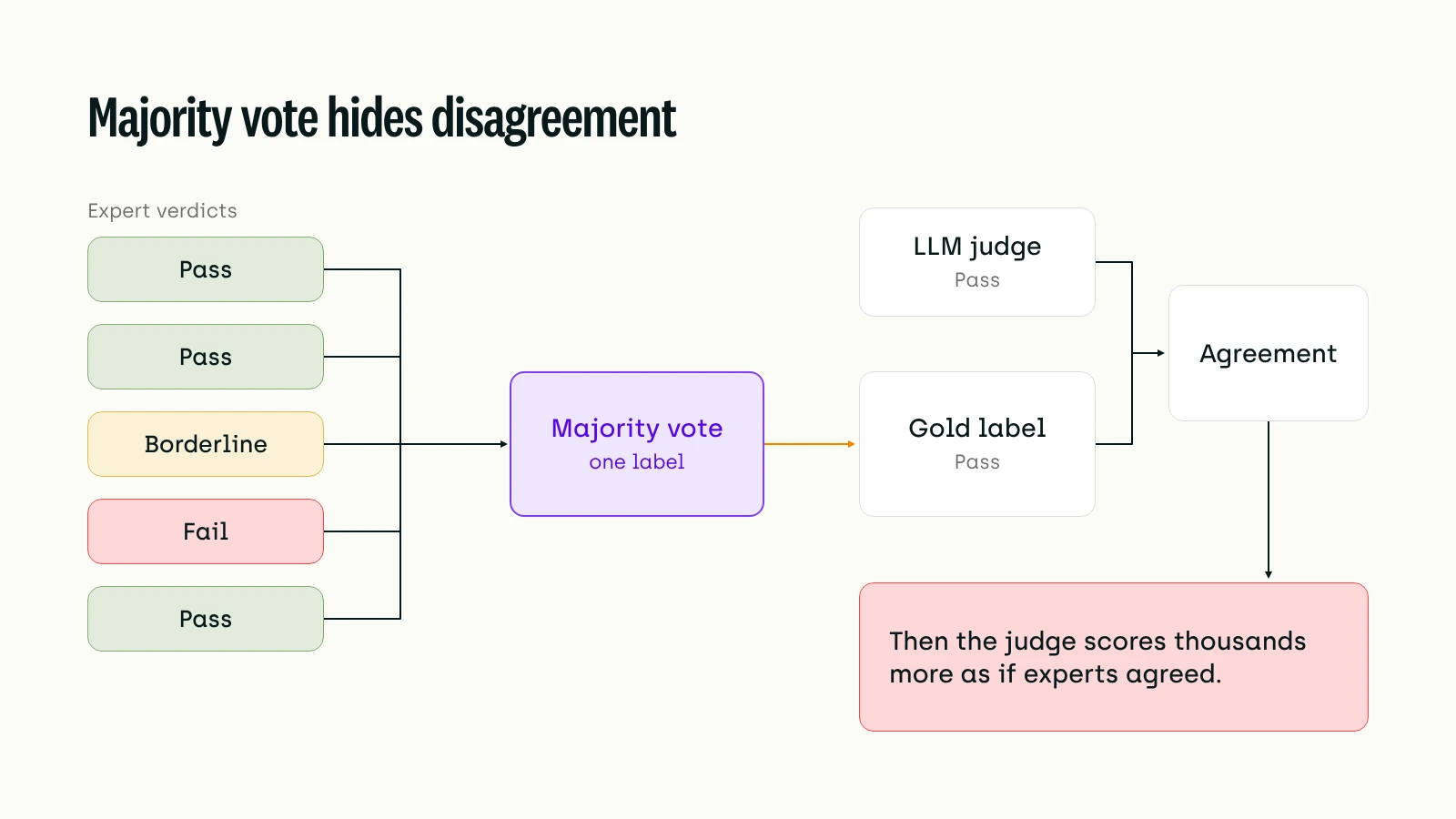
First, most "majorities" were one person. Outside those 36 items, the paper states that "The remaining 126 items had one reviewer each". For most of the audit, "agreement with the majority expert" means agreement with a single expert.
Second, the expert-to-expert figures come from a different run. The Table 4 caption notes "These evaluations used the earlier model set", so they are not agreement estimates for the production evaluation.
Third, experts and judge answered different questions. Experts could rate a conversation pass, borderline or fail; the judge could only say present or absent. The paper doesn't report how borderline ratings, or ties between reviewers, were mapped onto the judge's binary verdict.
The literature calls this rating indeterminacy. A NeurIPS 2025 paper on validating LLM-as-a-judge systems under rating indeterminacy, which ImpactBench itself cites, looks at cases where "rating criteria may admit multiple valid interpretations". There, forcing human annotators to pick one label, then voting them into a single gold label, biases the validation. In their experiments, judges chosen that way performed up to 31% worse than judges chosen with multi-label ratings.
The ImpactBench authors draw a similar conclusion. They note that between-human reliability tracks human-machine reliability, which suggests "some metrics may be inherently contentious". They add: "agreement on a score does not settle whether a metric captures the intended construct."
The expert reviews bear that out. Of 33 metric-level assessments, reviewers judged the test conversations adequate in 20, were uncertain in 10 and found 3 inadequate. Ten recommended renaming the metric. Reviewers questioned whether online contact should count as "real-world" social connection, and whether perceived intimacy with an AI is always harmful. Those are disagreements about what the metric means, and no amount of judge tuning resolves them.
Clinical experts show the same pattern. In a 2026 study of mental health AI safety testing, three psychiatrists used a calibrated rubric. Their intraclass correlations, a reliability score for ratings, were only 0.087 to 0.295. The authors traced this to "coherent but incompatible individual clinical frameworks" (Jafari et al., 2026). Experts disagreeing is normal. Hiding it inside a majority vote is the problem.
Why Does It Matter That the LLM Judge Is Also a Contestant?
GPT-5.6 Luna judged all 48,540 conversations. It was also one of the ten models evaluated, and it finished second, behind its sibling GPT-5.6 Terra.
Research on self-preference shows why this deserves a check. LLM evaluators can score their own outputs higher than other models' outputs that humans rate as equal. The bias is linked to the model recognising its own text (Panickssery, Bowman and Feng, NeurIPS 2024). The risk arises from "the same LLM acting as both the evaluator and the evaluatee." It isn't new. The G-Eval authors flagged that LLM-based evaluators may be biased towards LLM generations. The MT-Bench study listed self-enhancement bias next to position bias, where a judge in a pairwise comparison favours an answer because of where it appears.
ImpactBench doesn't report a self-preference analysis, and nothing in the paper shows that Luna favoured itself or Terra. The ranking may be entirely fair. The audit can't tell us either way. Its expert sample wasn't designed to compare the judge's accuracy on its own conversations with its accuracy on everyone else's.
The same overlap applies, less directly, to the simulated user: Claude Sonnet 5 played the user in every conversation and was also one of the ten models tested.
Choosing a more capable model as judge doesn't settle this on its own if that model is also in the contest. Two design choices would close the gap. HumaneBench, one of the benchmarks ImpactBench adapted, took a different approach to mitigating biases. It validated its judges against human ratings, then scored with an ensemble of three judges from different providers (TechCrunch, 2025). An ensemble isn't a guarantee either. But a judge drawn from outside the contestant pool, or an expert sample stratified by model family, would answer the question directly.
What Should an LLM Judge Audit Record?
ImpactBench is better documented than most. A 2025 review of 445 LLM benchmarks found that only 16.0% used uncertainty estimates or statistical tests to compare results. Meanwhile, 17.1% relied at least partly on LLM-as-a-judge scoring (Bean et al., NeurIPS 2025). ImpactBench reports test-retest reliability, two expert reviews, inter-reviewer agreement and its own limitations. Its authors even flag that a zero pass rate on one planning-related criterion "requires further rubric and judgment audit" before it is blamed on the models.
Meta-evaluation, meaning how to evaluate the judges themselves, is one of five core questions in a comprehensive survey of LLM-based evaluation methods (Li et al., 2024). ImpactBench's candour makes it a useful template for AI evaluation more broadly. Before LLM scores feed a leaderboard or a release decision, any team evaluating LLM applications with custom judges should be able to show the following.
Name the experts and the standard
Who reviewed, with what expertise, against which written criteria. ImpactBench does this well: disciplines are listed, and each metric carries a justification and pass and fail examples.
Put several experts on the contested metrics
Single-reviewer items can't reveal disagreement. Overlap doesn't need to cover everything. It should cover the metrics where the stakes or the ambiguity are highest. In ImpactBench, those were the learning and dependence criteria.
Keep every expert's label
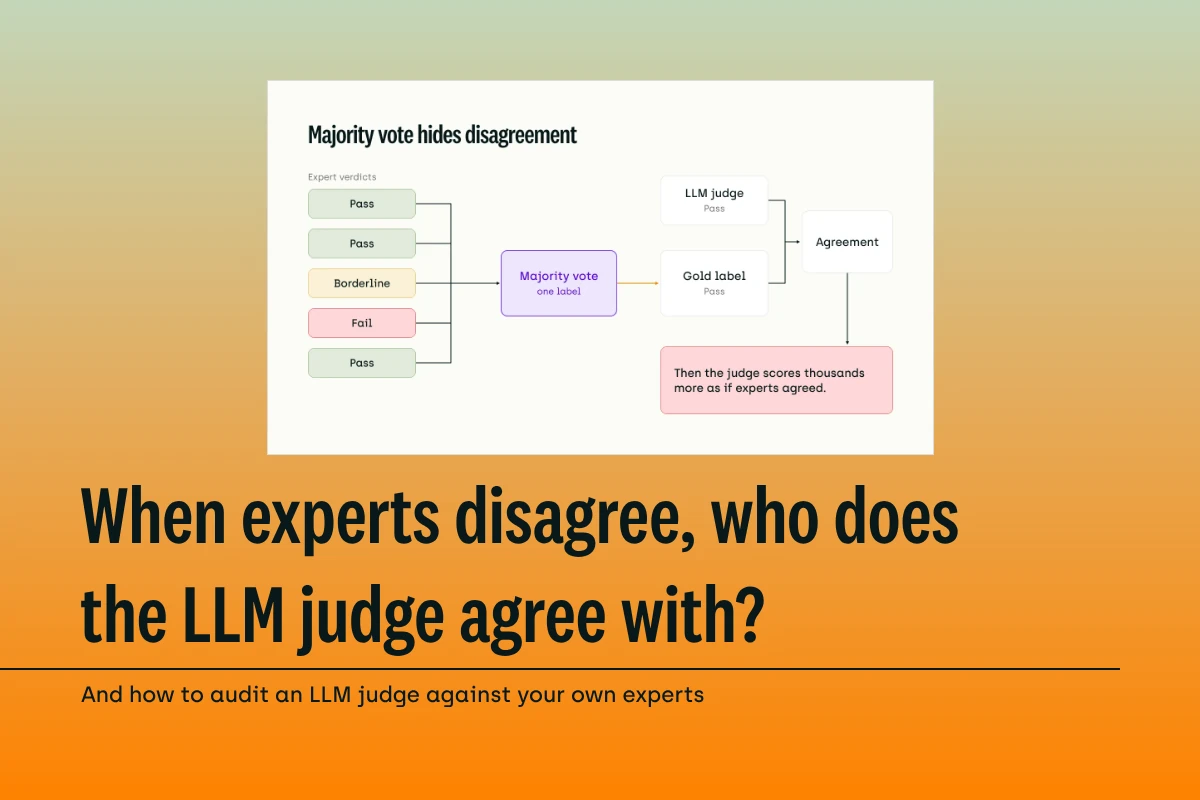
Human annotation takes time, so it's tempting to collapse it into one label per item. Relying solely on a majority vote throws away the disagreement that tells you a metric is contested. Keep per-expert labels so agreement can be computed per metric and revisited when the rubric changes.
Treat "unsure" and "borderline" as data
The 12.6% unsure rate in the internal review is a finding about the rubric. Record it, and route those items to an adjudication step rather than forcing them into pass or fail.
Report coverage and chance-corrected agreement
State how many metrics and items the audit covered, and report kappa or alpha next to raw agreement. Our custom AI benchmark guide suggests at least 75% agreement between judge and experts on a gold set; read that floor alongside a chance-corrected figure.
Keep the judge out of the contest
Use a judge from outside the model pool, or sample enough of the judge's own conversations to test for self-preference.
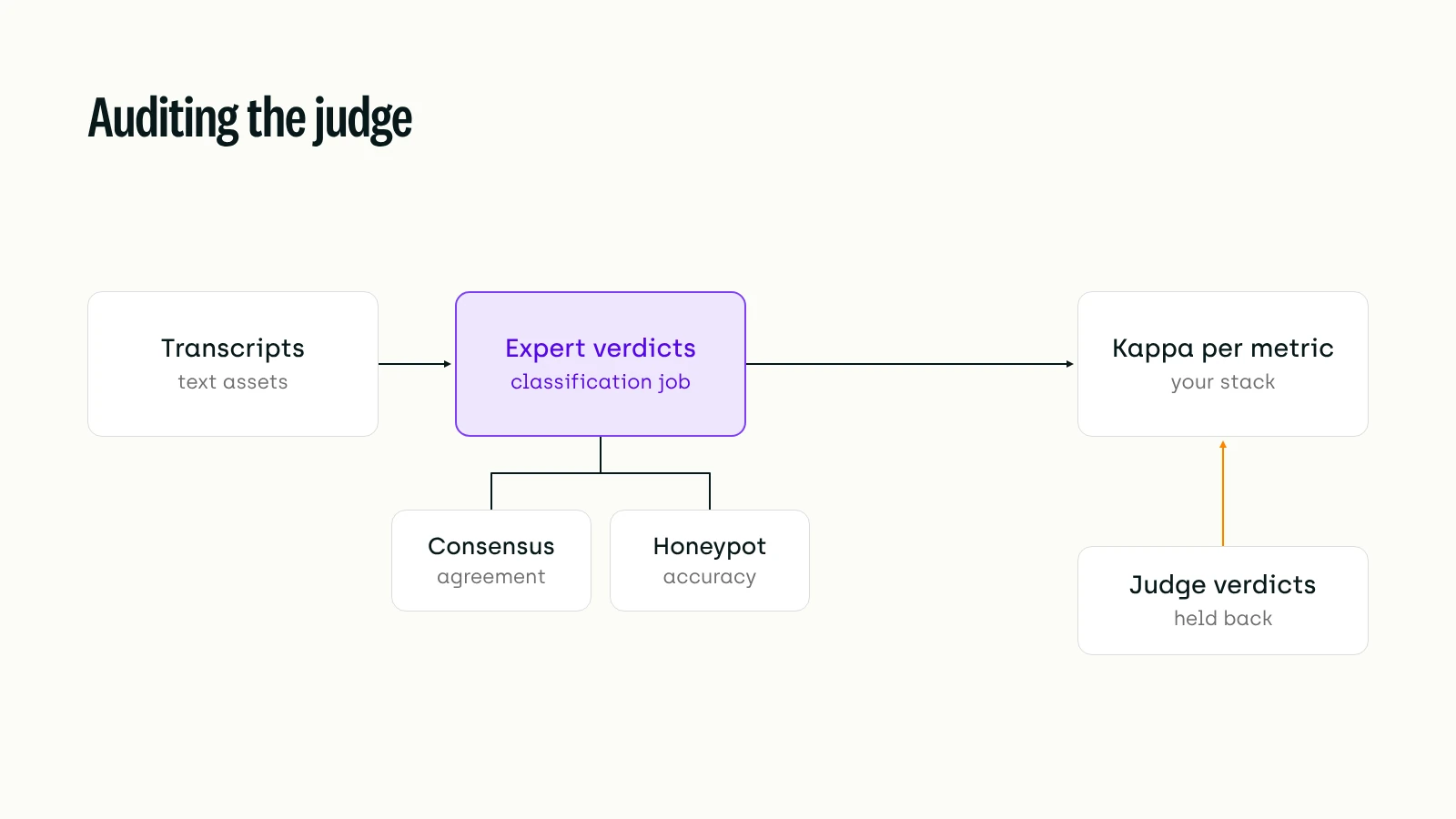
This is the workflow Kili is built around. In a Kili project, the conversations go in as text assets. Each expert rates them in a classification job, with pass, borderline and fail as options. The judge's verdicts can be uploaded as predictions for experts to confirm or correct. If you want each expert's verdict to be independent of the judge's, hold the verdicts back and compare afterwards. Consensus sends the same asset to several experts, blind, and scores how far they agree. Exporting the latest label from each author keeps every expert's verdict, so kappa or alpha can be computed per metric. Honeypots score each expert's work against a trusted ground-truth reference, and Enforce Step Separation means no one reviews their own work. The set of conversations your experts agree on becomes the golden dataset the next judge is validated against.
Conclusion
ImpactBench's most quoted numbers are about models: 53.1% harm avoidance, a 15.6-point gap between doing good and avoiding harm, and wide spreads between providers. Its most transferable lesson is about measurement. The 83.3% figure is honest. The paper also gives readers everything needed to see its limits: a majority that was usually one person, experts who disagreed most on the metric models failed most, and a judge drawn from the contestants.
The authors call ImpactBench "evolving infrastructure for independent, transparent evaluation". Juliana Schroeder of UC Berkeley Haas described the launch as a first step: "we're asking the field to help us get it right" (Haas News, 2026). The same applies to every team putting an LLM judge into production. The judge can carry the volume. Experts have to define what the judge is checking for. Then someone has to measure, item by item and metric by metric, whether those experts agree with each other. Only then should their majority become the answer key.
Resources
The ImpactBench study
- Open Benchmark of AI Impact on Humans (ImpactBench) – Archiwaranguprok et al., arXiv preprint (2026); methods, results, expert review and Appendix C
- About ImpactBench – MIT Media Lab project page and public results platform
- Researchers launch new tool measuring AI's impact on human wellbeing – Haas News, UC Berkeley Haas (2026); launch announcement and AI Nutrition Labels
Validating LLM judges
- Validating LLM-as-a-Judge Systems under Rating Indeterminacy – Guerdan et al., NeurIPS 2025
- LLM Evaluators Recognize and Favor Their Own Generations – Panickssery, Bowman and Feng, NeurIPS 2024
- Measuring What Matters: Construct Validity in Large Language Model Benchmarks – Bean et al., NeurIPS 2025 Datasets and Benchmarks Track
LLM-as-a-judge foundations
- G-Eval: NLG Evaluation using GPT-4 with Better Human Alignment – Liu et al., EMNLP 2023
- Judging LLM-as-a-Judge with MT-Bench and Chatbot Arena – Zheng et al., NeurIPS 2023 Datasets and Benchmarks Track
- LLMs-as-Judges: A Comprehensive Survey on LLM-based Evaluation Methods – Li et al., arXiv preprint (2024)
Expert agreement
- Interrater Reliability: The Kappa Statistic – McHugh, Biochemia Medica (2012)
- Expert Evaluation and the Limits of Human Feedback in Mental Health AI Safety Testing – Jafari et al., arXiv preprint (2026)
Related benchmarks
- A new AI benchmark tests whether chatbots protect human wellbeing – Rebecca Bellan, TechCrunch (2025); HumaneBench and its three-judge ensemble
From Kili
- Who Judges the Judge? – data story on LLM-judge reliability, validity and whose labels count as gold
- How to Build a Custom AI Benchmark – gold sets and agreement thresholds
- How to Build Golden Datasets – expert-checked reference sets for testing, fine-tuning and evaluation
- Contact Kili Technology
Ready to Audit Your LLM Judge Against Your Own Experts?
Kili gives your domain experts a review interface with consensus, honeypots and multi-step review configured in each project's workflow. That lets you measure whether your experts agree before their labels become the answer key. Talk to the Kili team about setting up your first audit.