


AI Summary
- ReVeR's rubric-writer RL lifted preference accuracy from 68.1 to 69.1 while expert-rubric F1 fell from 32.1 to 27.0 (chat).
- Hard rules shrank from 48.2% to 37.8% of chat criteria.
- On LegalRewardBench, reference answers helped every judge; model-written rubrics didn't.
- Measure rubric fidelity separately from accuracy.
Introduction
Rubric based evaluation is only as good as the rubric, and two preprints posted on 13 October 2026 measure that weak point from opposite ends. The first, ReVeR, builds a 4-billion-parameter rubric reward model, then trains its rubric writer with reinforcement learning (RL). Average preference accuracy went from 68.1 to 69.1. Over the same step, its rubrics matched expert-written rubrics less well. Agreement, measured as F1 (a score that combines precision and recall), fell from 32.1 to 27.0 on chat prompts. On instruction following it fell from 46.3 to 38.1. The share of hard rules, the non-negotiable criteria, fell too.
The second, LegalRewardBench, tests reward models on legal questions. When the authors let a model write the rubric for the judge, one strong judge dropped from 80.65% to 71.83% accuracy. When they gave every judge the benchmark's reference answer instead, every judge improved.
The two papers describe one problem. A rubric is the interface between a domain expert and a reinforcement learning loop. It is how "a good answer" gets written down in a form a model can score. Optimise the rubric writer against preference labels and it gets better at separating responses while writing criteria that experts didn't write. In legal and insurance document review, the expert's criteria are the standard the work is held to. There, the drift is the failure.
Below, we define rubric based evaluation and walk through the numbers behind the drift. Then we look at who the "experts" in these benchmarks are, the case for letting rubrics drift, and how to keep a rubric reward anchored to the people who own the standard. If you want the background on reward models and rubric rewards first, start with our Reward Models Explained guide.
What Is Rubric Based Evaluation?
Rubric based evaluation scores a model's response against a written list of evaluation criteria, one criterion at a time, instead of asking a judge for a single score. Each criterion states something a good answer should do, or must not do. The rubric scores then combine into a final score, usually as weighted criteria. HealthBench (OpenAI) is a well-documented case. Each criterion carries between −10 and 10 points. A model-based grader, validated against physicians, marks each one as met or not met. The points earned are then divided by the maximum possible. Negative points let the rubric penalise harmful content, and the benchmark's overall score is clipped to between 0 and 1.
Rubrics exist because most expert work has no single correct answer. In verifiable domains, a program can check the right answer: unit tests for code, an exact match for maths. That is where reinforcement learning with verifiable rewards works, rewarding final answer correctness against known correct answers. A coverage opinion, a contract summary, a clinical reply or a piece of creative writing has no final answer to check. A survey of rubric-guided reinforcement learning (Shan and Shao, August 2026) puts rubrics where criteria "are not externally decidable." Rubric methods help most, it says, where "tasks require partial credit, explanation quality, safety, pedagogy." For open ended tasks, a rubric is how human judgment gets written down in a form a model can score.
Rubrics also differ in scope. Instance specific rubrics are written for one prompt; HealthBench and RubricBench both work this way. Domain specific rubrics apply one set of criteria to a whole task type, such as every claims summary. General rubrics ("is it helpful?") sit at the far end, with the least context.
Compared with a single score for response quality, rubric based LLM evaluation (where a large language model, or LLM, applies the rubric) has three key advantages:
- It allows fine grained analysis. A single score is a black box. Rubric scores show which specific criterion failed, so you can read model performance criterion by criterion as well as overall performance.
- It gives partial credit. A response that meets most criteria earns most of the points.
- It can narrow inter judge variance. The RubricEval benchmark (Pan et al., Fudan University, Donghua University and Ant Group, March 2026) shows this, below.
RubricEval was built because existing judge benchmarks "rely on relatively simple instructions with narrow type diversity." It has 3,486 quality-controlled instances, split into easy and hard subsets of 2,034 and 1,452. The authors compared two ways of applying the same rubric: checking every criterion in one judge call (checklist-level) or checking each criterion in its own call (rubric-level). The metric is balanced accuracy: accuracy averaged across classes, so a lopsided test set can't inflate it. With explicit reasoning, rubric-level judging reached 77.38% for Qwen2.5-32B-Instruct and 82.17% for GPT-4.1, against 69.90% and 70.44% at checklist level. Under the checklist approach, judges from more than one model family scored the same responses anywhere from about 55% to 80%. Rubric-level judging with reasoning narrowed that to 62% to 74%. On the hard subset, o3, one of OpenAI's reasoning models, reached 84.81%, against 55.97% for GPT-4o.
Rubrics don't remove the common failure modes of LLM judges. Zheng et al. named position bias, verbosity bias and self-enhancement bias in LLM judges. The survey adds that rubric rewards correlated with length or style "can favor well-formatted or verbose outputs." Vague criteria are a second weak point. A criterion such as helpfulness depends on what the user needed, which the judge can't see. The survey finds such criteria reach "only moderate alignment with human consensus."
In training, the same rubric scores become reward signals. Rubrics as rewards are one answer to a limit of human feedback in preference form: a preference label says which response won, not why. The survey describes the move as a "paradigm shift from implicit, scalar reward optimization to explicit, structured, and interpretable alignment." Even so, many methods still sum the criteria into one number before the policy (the model being trained) sees it. For LLM alignment in expert domains, that makes the rubric the specification, and a specification that can move.
What Did ReVeR Find When It Trained the Rubric Writer?
ReVeR (Liu and Wang) splits a rubric reward model into two parts. A generator reads only the instruction and writes a rubric with two kinds of criteria. Hard rules are scored 0 or 1. Graded principles are scored from 0 to 100. A judge then scores one response at a time against that rubric, running small programs to check mechanical criteria such as word counts or banned terms. When scores are combined, hard rules take priority; principles only break ties between responses that satisfy the same number of hard rules.
The base model is Qwen3.5-4B. Both parts were first trained by distillation (learning from a larger teacher model's outputs), with DeepSeek-V4-Flash as the teacher. The training data was 30,310 rubric-reasoning traces and 60,620 judging trajectories, built from 41,388 preference triples (a prompt with a preferred and a rejected response). The authors call this distillation "label-blind": neither the preference label nor the competing response is in context when a rubric is written.
Next, the authors ran reinforcement learning on the generator alone ("generator RL"), rewarding it for rubrics that separate the preferred response from the rejected one. To see what that did to the rubrics, they compared the generated criteria with expert-written rubrics from RubricBench. RubricBench is an ACL 2026 benchmark whose rubrics were written from the instruction alone.
Source: Liu and Wang, ReVeR, arXiv 2610.18766, §4.3.
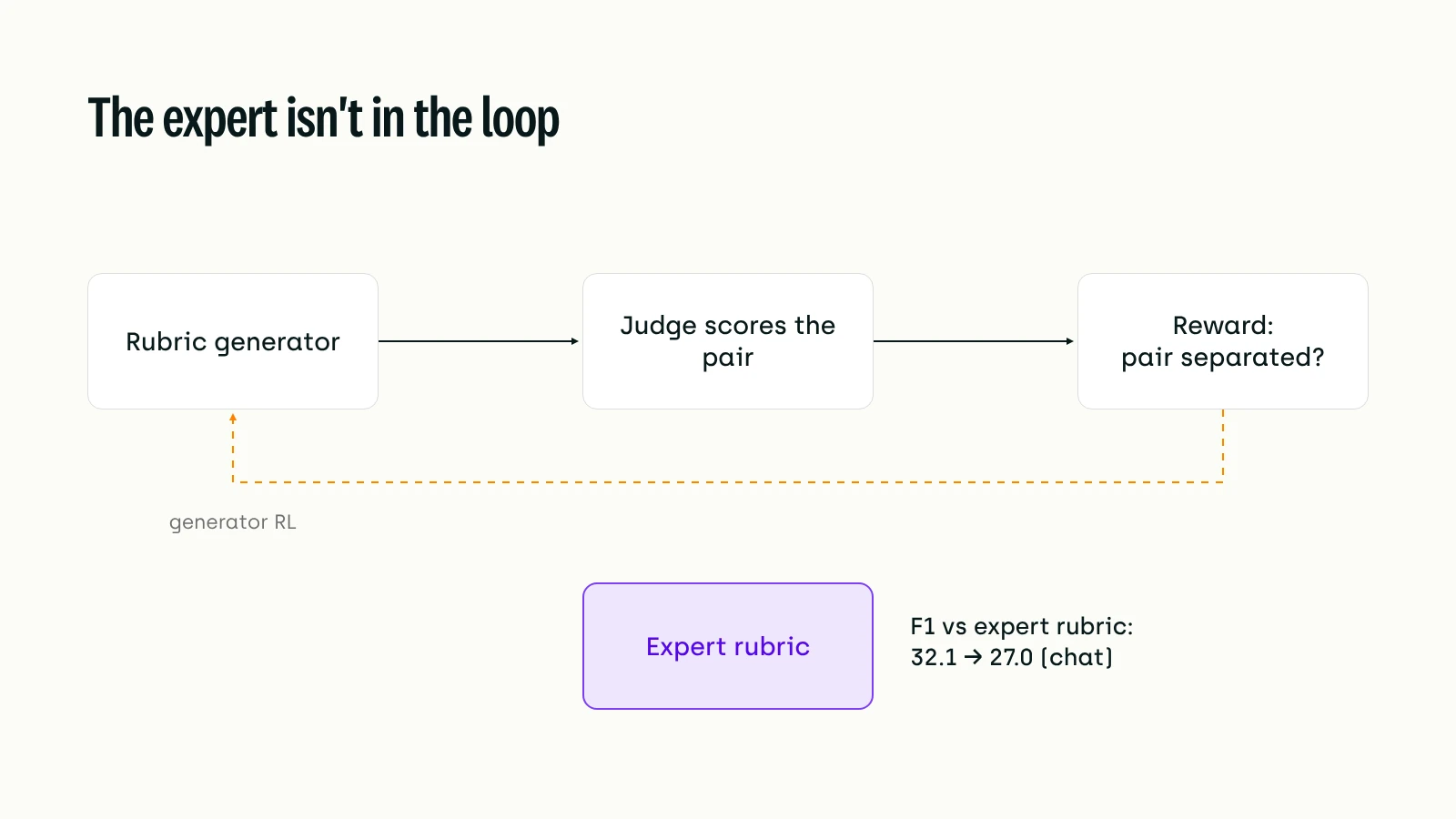
The authors trace the drop to the reward itself, which measures whether two responses get pulled apart. Nothing in it measures whether the rubric matches what an expert would write, so fidelity isn't optimised and can slide. After generator RL, graded principles became more numerous and matched expert criteria less often. Hard rules matched about as often as before; there were just fewer of them.
Did the extra accuracy buy a better downstream model? Not clearly. Trained against the generator-RL rubrics with DPO and GRPO (two common post-training methods), the policy averaged 57.4 under each. With the distilled rubrics, it averaged 57.9 under DPO and 56.6 under GRPO. Both beat the untrained policy's 53.9. Neither result shows that the extra point of preference accuracy was worth the lost fidelity.
The authors' own conclusion is that rubric fidelity, preference accuracy and downstream utility are "distinct properties of a reward and have to be measured separately."
Why Do Hard Rules Disappear First from Rubric Rewards?
ReVeR defines a hard rule as "an explicit, non-negotiable requirement whose violation makes a response unacceptable." It is binary, and when the judge can't find evidence that the rule is met, it scores 0.
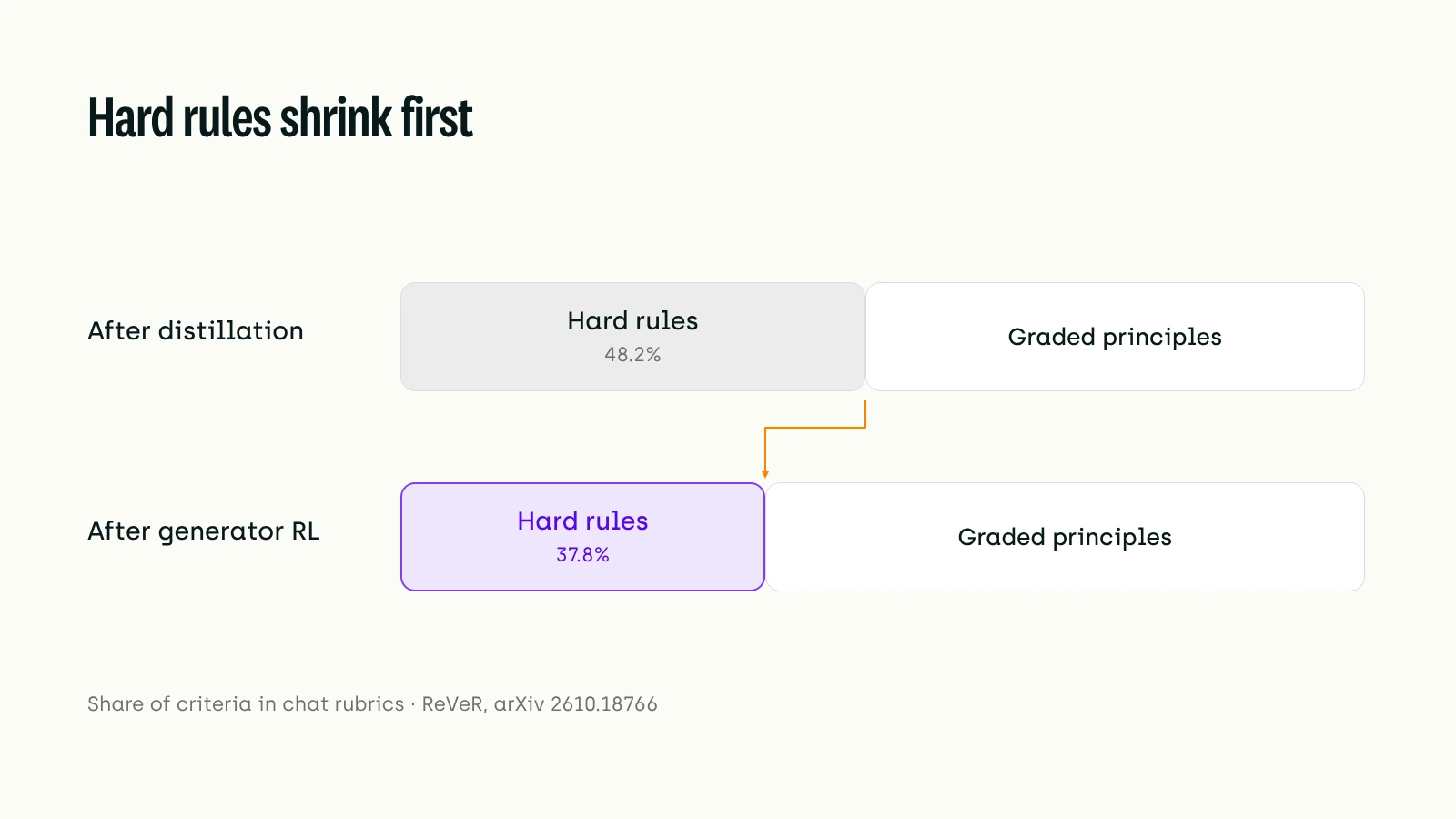
Under a discrimination reward, that design works against hard rules. Two good responses often satisfy the same hard rules, so the rules leave them tied. A graded principle can still tell them apart. The authors say principles help because they "separate responses that binary hard rules leave tied." If the reward is "pull the pair apart", the cheapest move is to write more principles.
On a preference benchmark, that trade is reasonable. In regulated document work, it isn't. Consider what the hard rules of a rubric for an insurance claims assistant might look like (our illustration, not from the papers):
- The answer names the policy clause it relies on.
- A coverage denial cites the specific exclusion.
- No figure appears that isn't in the claim file.
None of these separates two competent answers, because both will usually pass. Each one is the line a claims expert would refuse to cross. A rubric writer rewarded for separation has no reason to keep writing them, and ReVeR's numbers show it writing fewer.
This is a different failure from reward hacking, where a policy learns to satisfy a rubric without doing the task. Our RLVR guide covers that one. Here the policy hasn't done anything yet. The rubric itself has moved. It is closer to the pattern Gao, Schulman and Hilton measured for reward models. There, pushing a proxy too hard means "optimizing its value too much can hinder ground truth performance." The proxy in ReVeR's case is the preference label set; the ground truth that gets left behind is the expert rubric.
Who Writes the Rubrics in Rubric Based LLM Evaluation?
"Expert rubric" sounds like one thing, and rubric design starts with who writes it. In the benchmarks that measure rubric fidelity, it covers people with different backgrounds, and the drift can only be measured against whoever wrote the reference.
RubricBench (Zhang et al., ACL 2026) is the reference ReVeR used. Nine annotators in three groups wrote its rubrics. They were domain practitioners and PhD candidates in computer science or related fields, with experience evaluating NLP (natural language processing) systems, covering STEM, coding and safety. Two annotators wrote each rubric independently, then a senior reviewer reconciled them. The paper states that "Rubrics are derived solely from the instruction, without access to candidate responses." The 1,147 pairs are mostly general chat (36.5%), coding (23.9%) and STEM reasoning (23.8%), with instruction following at 8.8% and safety at 7.0%.
LegalRewardBench (Huang et al.) calls itself "the first human-verified benchmark for evaluating reward models in the legal domain." It has 1,331 preference pairs across 41 task types and five levels: knowledge, understanding, analysis, decision and writing. Legal-domain annotators wrote the rubrics from the reference answer, the task requirements and legal background; the paper doesn't say how many. A model (Gemini-3.1-Pro-Preview) scored responses against those rubrics. Then five law master's students spent 560 hours checking the pairs, keeping one only when their own judgment matched the automatic preference. Their double-blind agreement on a 5% sample was about 80%. The tasks are Chinese and follow the Chinese legal system.
HealthBench sits at the other end: 262 physicians from 60 countries, 5,000 conversations and 48,562 unique criteria, the "vast majority" of them "written specifically by a physician" for one conversation.
Sources: each paper's methods section and appendix.
ReVeR's fidelity drop is measured on chat and instruction following, against rubrics written by NLP-literate annotators. Nobody has yet measured rubric drift against lawyers, claims handlers or underwriters. The legal and insurance case in this article is an inference from the mechanism. It is the test we'd ask any team in those domains to run.
"Expert" is also a claim about a person, and benchmarks rarely let you check it. LegalRewardBench is specific (law master's students, hours logged, agreement reported). RubricBench reports who its annotators were but no agreement figure between them. Our Who Judges the Judge? Data Story makes the case that the reference labels need auditing as much as the judge does. The same holds for reference rubrics.
What Happens When a Model Writes the Rubric for a Legal Judge?
LegalRewardBench ran its judges three ways: with no extra input, with rubrics written by a model, and with the benchmark's reference answer.
Model-written rubrics did not help consistently. Kimi-K2.5 fell from 80.65% to 71.83% with them. GPT-4o rose slightly, from 74.61% to 75.88%.
The reference answer helped every judge the authors tested:
Source: Huang et al., LegalRewardBench, arXiv 2610.18299, §3.3.1.
The gains were largest on knowledge, understanding and decision tasks. On the decision level, Claude-Opus-4.7 went from 87.50 to 96.11. Each item ships with its reference answer, the same one the legal annotators used to write their rubrics. That makes it the closest thing in the benchmark to an expert's worked answer.
Training a legal reward model on more data did less. On about 39,000 legal preference pairs, a Qwen3-8B generative reward model reached 78.96, against 75.69 for the same model simply prompted. A discriminative reward model trained on the same data scored 72.95, below the prompted baseline. Prompting Qwen3-8B with the reference answer reached 82.26, ahead of both trained versions. The authors conclude that reward model training gives limited and inconsistent gains here.
The pattern holds outside law. With self-generated rubrics, the best judge setup reached 58.1% (OpenRubric with Gemini-3-Flash). With the human rubrics, setups reached 84.9% (OpenRubric with DeepSeek-v3.2). The authors' summary is that "rubric mis-specification emerges as the dominant bottleneck." In a 100-instance study, people judging with human rubrics were right 92.0% of the time; with Gemini-generated rubrics, 61.0%. A worse rubric made the humans worse too.
Drift also shows up in where the points go. A July 2026 meta-evaluation, Can LLMs Write Reliable Rubrics? (Hong et al., University of Manchester and A*STAR), asked models to write grading rubrics for reproducing research papers. The best setting came close to the human baseline on correlation (Pearson 0.78 against 0.83). But across every category of paper, those model-written rubrics put more than 60% of the score on code development and less than 21% on whether the results match. In the human rubrics for reinforcement learning papers, result match alone carried 48.8%. The authors found model rubrics "often overly fine-grained, biased toward high scores." A rubric can track the expert's overall ranking and still weight the work differently, which changes model behavior once that rubric becomes a reward.
Is Drifting from Experts Always a Failure?
Not always, and the counter-argument has data behind it.
EvoRubric (Guan et al., Alibaba Tongyi Lab) lets the policy evolve its own rubrics during reinforcement learning. The authors argue that expert rubrics follow human reasoning, which "may not perfectly align with the language model's internal optimization landscape." Their HealthBench result supports the point. Starting from rubrics generated by its own 8B model, EvoRubric scored 53.97. Starting from expert rubrics, it scored 52.84, and a static expert-rubric baseline scored 51.83. HealthBench is graded against physician-written criteria, so rubrics the model wrote for itself trained a policy that scored slightly higher on the physicians' test.
EvoRubric belongs to a wider family of dynamic rubrics. The survey notes that rubrics "can be generated, refined, and co-evolved with the policy", proposing new criteria as training goes. It lists self-evolving rubrics as one route to mitigating reward hacking. It presents that as a proposed defence, not a proven one. It also warns that coupled rubric and policy updates "risk feedback loops, criterion drift, and evaluator dependence."
EvoRubric doesn't report a fidelity measure, so we can't say how far its rubrics moved. But the result points at the right distinction. A rubric does two jobs:
- As a training signal, it only has to separate better responses from worse ones in a way that moves the policy in the right direction. If a drifted rubric does that, drift is a cost worth paying.
- As an evaluation standard, it defines what "correct" means for the people accountable for the output. Drift here changes the test.
In open-ended chat, the two jobs blur. In regulated document review, they don't. The National Association of Insurance Commissioners (NAIC) adopted a model bulletin on insurers' use of AI in December 2023. It asks insurers' AI programs to cover "validating, testing, and retesting as necessary to assess the generalization of AI System outputs." It also asks them to consider "the extent to which humans are involved in the final decision-making process." A claims team answering that bulletin needs a test written by its own experts, held fixed between retests. A rubric that has drifted toward whatever separates preference pairs is a different test.
The practical answer is to let training rubrics evolve if they help, and freeze an expert-owned rubric for evaluation. Then measure the distance between the two.
How Do You Keep Rubric Based Evaluation Anchored to Your Experts?
The papers above point to a short protocol for any rubric-based evaluation framework. It is our synthesis, built from their methods.
1. Have experts write the hard rules before they see any responses
RubricBench and ReVeR both derive rubrics from the instruction alone. For experts, this matters even more: criteria written after reading model output tend to describe that output. Hard rules (cite the clause, name the exclusion, invent no figures) are the part of the rubric that should stay expert-owned.
2. Freeze a reference rubric set and track fidelity against it
Keep a fixed set of expert-written rubrics, versioned. Every time the rubric generator changes, report what ReVeR reported: criterion-level F1 against the reference and the share of hard rules. That gives you a number directly aligned with what your experts wrote. A rise in preference accuracy alongside a fall in either is the drift signal.
3. Give the judge the expert's reference answer
LegalRewardBench's clearest result is that a reference answer helped every judge, while model-written rubrics helped some and hurt others. Where your experts already produce worked answers (claim decisions, contract reviews, coverage opinions), feed them to the judge.
4. Check the judge against your experts, not only against preference labels
Score a gold set of responses with your experts and with the judge, and compare, one criterion at a time where you can (RubricEval's rubric-level result). Our Who Judges the Judge? piece sets out the protocol: 50 to 100 items to start, and a 75% raw agreement floor read alongside a chance-corrected figure.
5. Report the three numbers separately
Follow ReVeR's advice literally: rubric fidelity, preference accuracy and the downstream policy result, each on its own line. A reward that improves one while the others fall is a finding.
6. Retest when anything upstream changes
New base model, new rubric generator, new product line, new regulation. The NAIC bulletin's "retesting as necessary" is a reasonable trigger list for any regulated team.
Where Kili fits
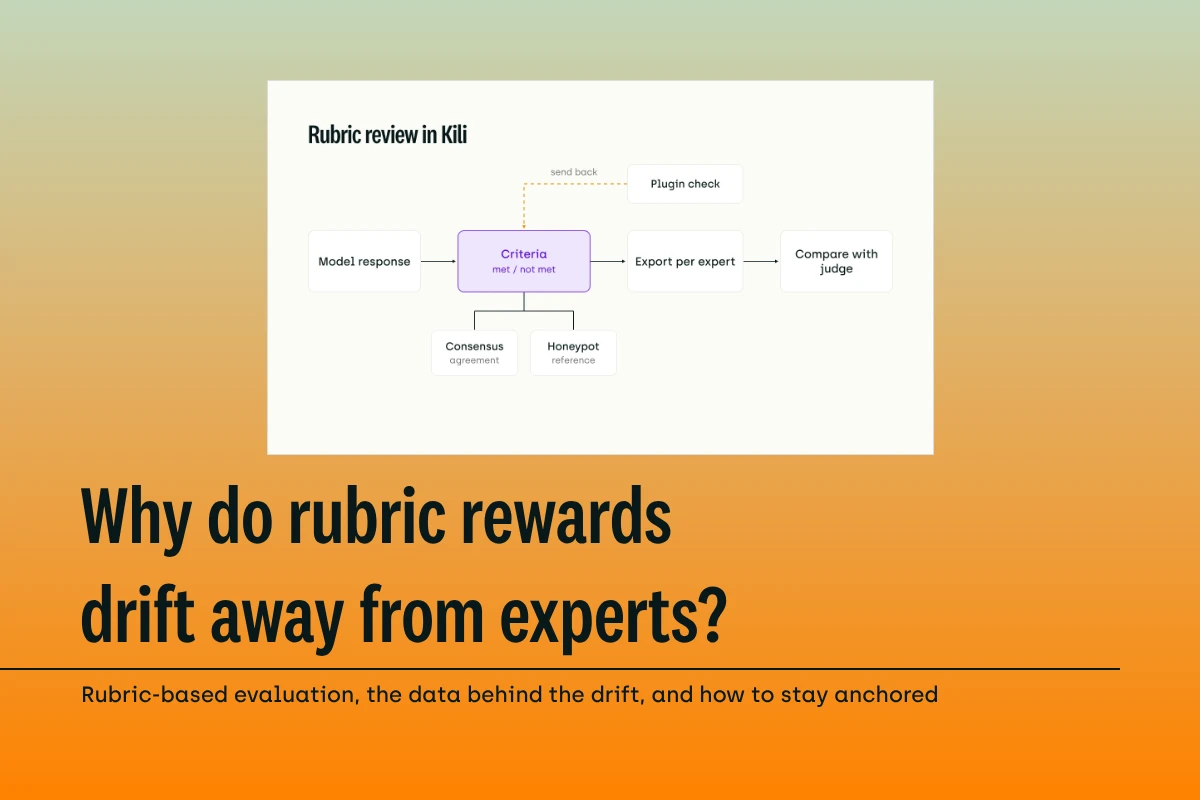
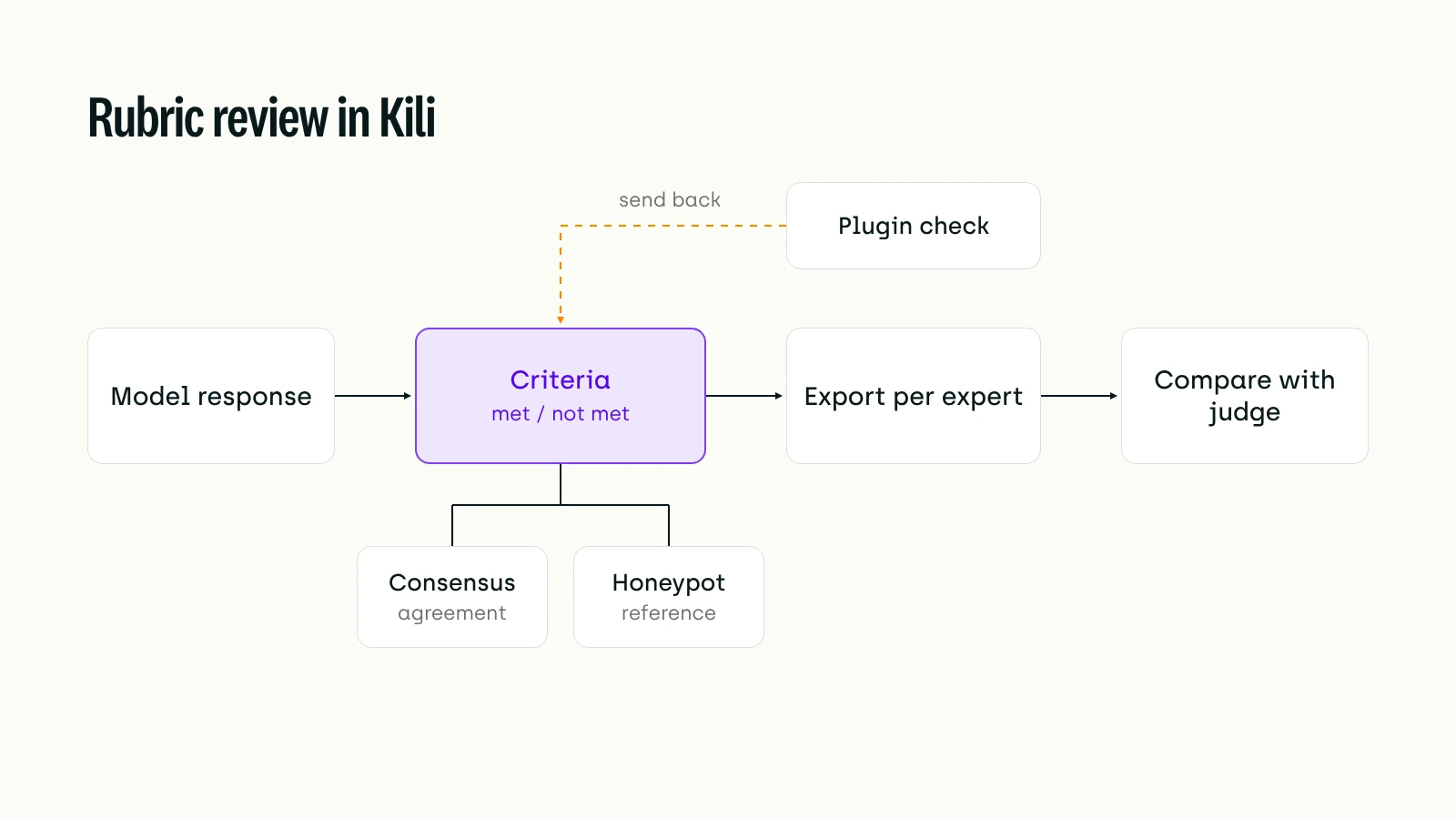
Kili covers the expert side of this loop. Each rubric criterion becomes a single-choice classification job (met or not met) on a text or PDF asset that holds the model's response. A project admin can import the rubric reward model's verdicts as predictions, from the project's Imports settings in Kili format or with the Python SDK. Predictions are matched to responses by external ID. Kili stores predictions, expert labels and reviews as separate label types, each with its author and date. Consensus has several experts score the same responses blind and measures how often they agree. A honeypot, enabled on one workflow step, scores each expert against a trusted reference. Plugins can add an issue or send an asset back when a hard rule comes back "not met." Exporting the latest label from each author gives you the expert verdicts to compare with the judge's. Kili runs as SaaS or in your own environment, and the RL training stays in your stack.
Conclusion: The Rubric Is the Specification
Teams are handing more of the rubric-writing to models, as ReVeR and EvoRubric show. The reasons are good: experts are expensive, and a model can write criteria for millions of prompts. ReVeR, RubricBench and LegalRewardBench don't argue against that. They show what it costs when nobody checks. A generator rewarded for separating responses writes fewer hard rules and drifts from expert criteria while its accuracy rises. Judges handed model-written rubrics can get worse, and judges handed an expert's reference answer get better.
The implication for regulated teams is a change in what the expert's job is. The expert no longer needs to write every rubric. The expert does need to own the reference rubric, write the hard rules, and sign off on a fidelity number every time the generator changes. In legal and insurance work, that number is the evidence that the model is still being tested against the standard the business is held to.
Resources
The papers behind this Data Story
- Rubrics from the Task, Verdicts from Evidence: Pointwise Rubric Rewards with Tool-Augmented Judges (ReVeR) – Liu and Wang, arXiv preprint, 13 October 2026
- LegalRewardBench: Benchmarking Reward Models for Legal Preference Evaluation – Huang et al., arXiv preprint, 13 October 2026
- RubricBench: Aligning Model-Generated Rubrics with Human Standards – Zhang et al., ACL 2026
Rubric-based evaluation and rubric quality
- RubricEval: A Rubric-Level Meta-Evaluation Benchmark for LLM Judges in Instruction Following – Pan et al. (Fudan University, Donghua University, Ant Group), arXiv preprint, March 2026
- A Survey on Rubric-Guided Reinforcement Learning for Language Models – Shan and Shao, arXiv preprint, August 2026
- Judging LLM-as-a-Judge with MT-Bench and Chatbot Arena – Zheng et al., NeurIPS 2023 Datasets and Benchmarks Track
- Can LLMs Write Reliable Rubrics? A Meta-Evaluation for Experiment Reproduction – Hong et al., arXiv preprint, July 2026
- EvoRubric: Self-Evolving Rubric-Driven RL for Open-Ended Generation – Guan et al. (Alibaba Tongyi Lab), arXiv preprint, May 2026
- Scaling Laws for Reward Model Overoptimization – Gao, Schulman and Hilton, ICML 2023
Expert-written criteria and regulation
- HealthBench: Evaluating Large Language Models Towards Improved Human Health – Arora et al. (OpenAI), arXiv preprint, May 2025; self-reported by OpenAI
- NAIC Model Bulletin: Use of Artificial Intelligence Systems by Insurers – National Association of Insurance Commissioners, adopted 4 December 2023
From Kili Technology
- Reward Models Explained: Preference Data, Rubric Rewards and How They Fail – background on reward models and rubric rewards
- RLVR Explained: Reinforcement Learning with Verifiable Rewards – reward hacking and verifier gaming
- Who Judges the Judge? – auditing LLM judges and their reference labels
- Contact Kili Technology
Ready to Anchor Your Rubric Rewards to Your Own Experts?
Does your team train or evaluate models against rubrics in legal, insurance or financial document work? Talk to the Kili team about setting up expert rubric review, with the expert verdicts exported for your own judge-agreement checks.