.png)

_logo%201.svg)


AI Summary
- On AA-Omniscience, K3's accuracy rose 13 points while hallucination rose 12
- Binary benchmark grading rewards confident guessing over uncertainty, per a 2026 Nature study
- 29 of 60 major benchmarks show saturation at the frontier
- When agent scaffolds change, SWE-bench scores swing 10–26 points
Introduction
Moonshot AI released Kimi K3 in July 2026 as the world's first open 3T-class model, with full model weights available for download. At 2.8 trillion parameters, K3 is significantly larger than other open weights models, activating 16 of 896 experts per token. The architecture introduces Kimi Delta Attention for 6.3x faster decoding and attention residuals (AttnRes) that improve token efficiency by 25% at 2% compute cost. The new Kimi model features a 1-million-token context window, allowing it to process massive code repositories and extensive documentation in a single prompt. Furthermore, the model includes native visual understanding capabilities, enabling it to combine deep software development with visual reasoning for tasks like frontend engineering, debugging via UI feedback, and chart analysis. Among open weights peers, K3 leads on both raw scale and multimodal integration.
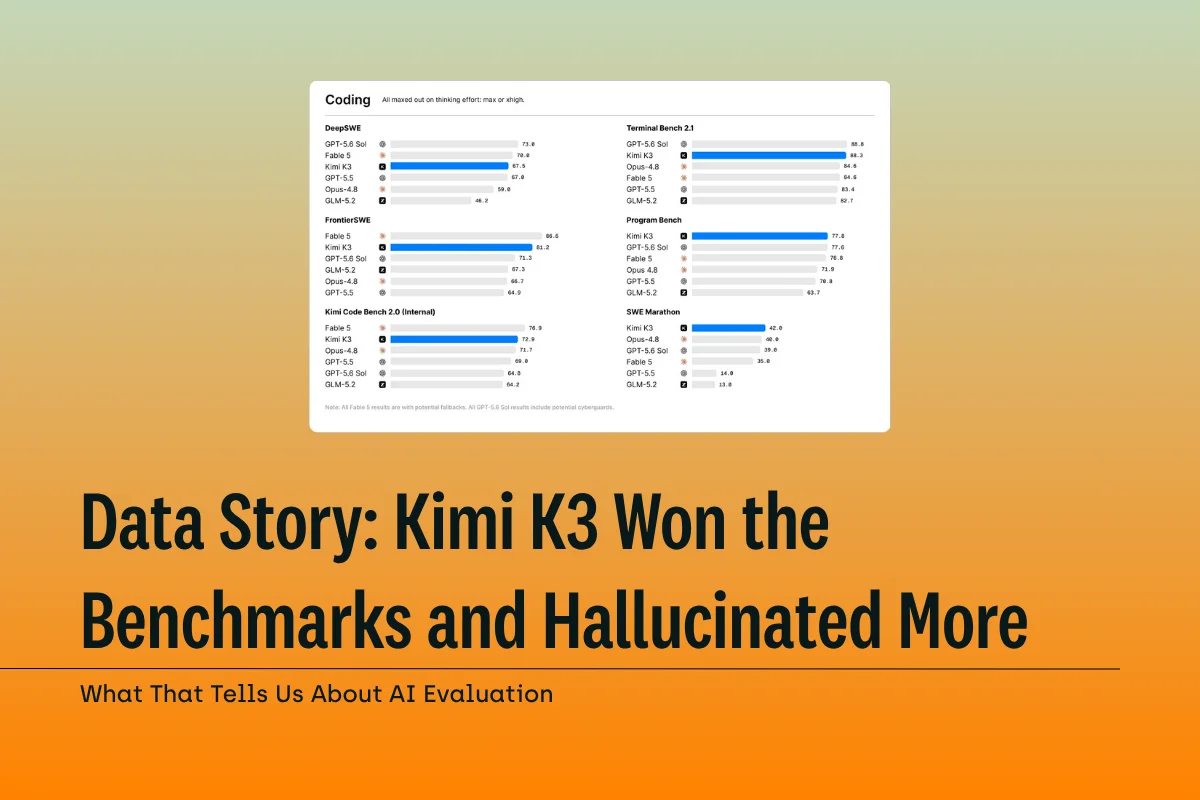
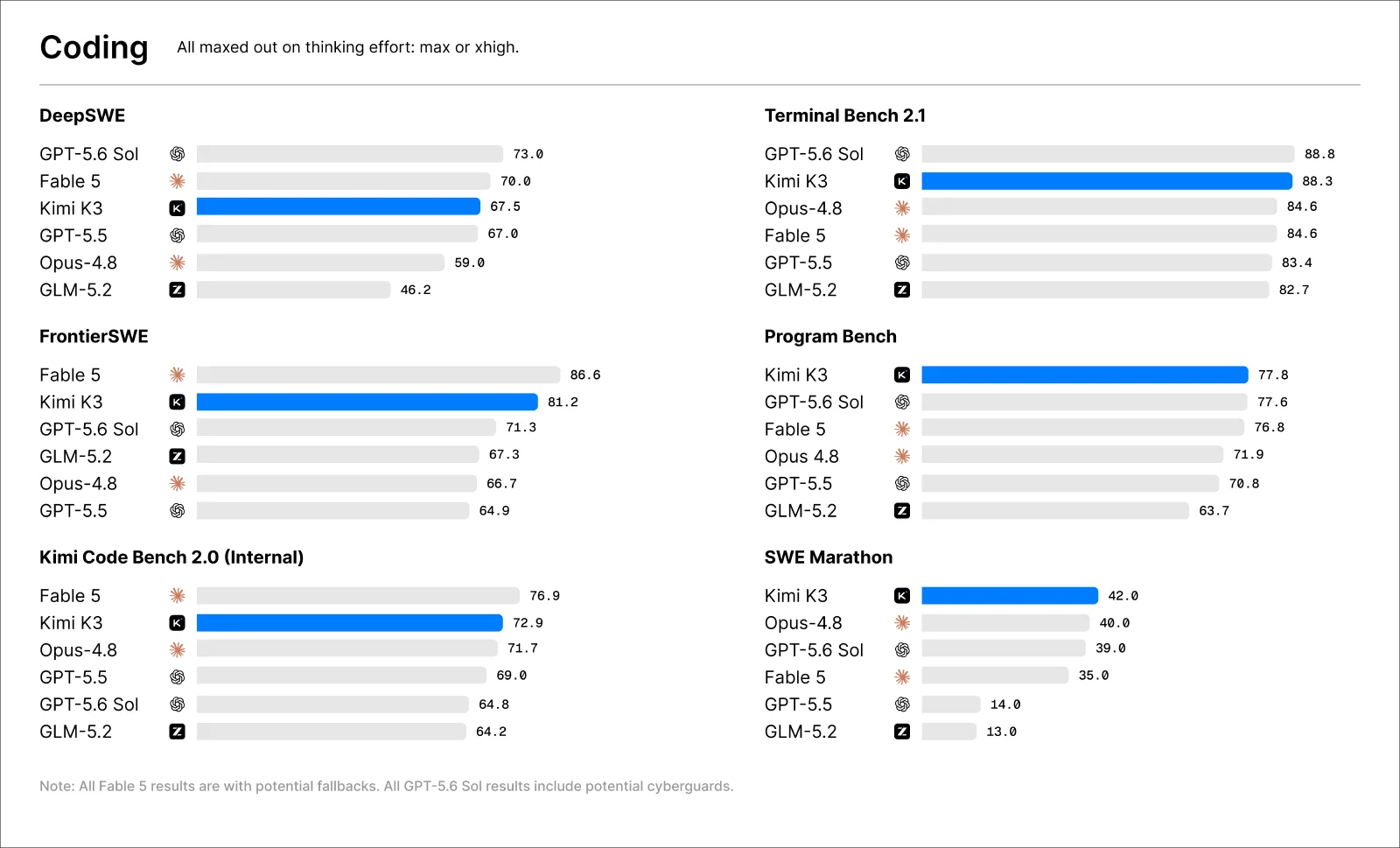
K3's Kimi 3 benchmark numbers beat Claude Fable 5 on Terminal-Bench (88.3 vs 84.6), SWE Marathon (42.0 vs 35.0), and BridgeBench, with strong agentic task performance across coding evaluations. It topped Frontend Code Arena and earned an Elo rating of 1668 on GDPval-AA. Moonshot AI's pricing for first-party API access sits at $3 per million prompt tokens and $15 per million output tokens (up from K2.6's $0.95/$4), with reduced rates for cached input tokens. The API pricing signaled that cheap Chinese AI is no longer the point. K3 is competing on capability.
Then Artificial Analysis published the rest of the numbers.
On the same AA-Omniscience benchmark that measured K3's accuracy gain (from 33% to 46%), the model's hallucination rate climbed from 39% to 51%. The overall Index score still improved, rising from +6 to +18, because the scoring formula rewards accuracy gains more than it penalizes hallucination increases. K3 earned its ranking by getting more questions right. It also got more questions confidently, verifiably wrong.
This is exactly what the current evaluation paradigm was built to produce.
What Did Kimi K3 Actually Achieve on Benchmarks?
The headline numbers favor K3. Its Intelligence Index score of 57 places it behind only Claude Fable 5 (60), Opus 4.8, and GPT 5.5 Sol (59), achieving higher scores than every other model tested. Across nine evaluations spanning coding and agentic knowledge work, the scores look well rounded: Terminal-Bench 88.3, SWE Marathon 42.0, BrowseComp 91.2, plus second highest performance on AA Briefcase. K3 matched leading models on Analytical Quality and Presentation Quality in the individual evaluations. Moonshot acknowledges a "noticeable gap in user experience" compared to Fable 5 and Sol in instruction-following and other model details, but the raw numbers put K3 in the same tier.
The AA Omniscience Index improved from +6 to +18, with K3's accuracy rate reaching 46% across 6,000 questions spanning 42 topics, a marked improvement from 33% on K2.6. But the hallucination rate regressed compared to K2.6, and the operational meaning of that 51% figure depends on how the AA-Omniscience paper defines hallucination rate: incorrect answers divided by all non-correct responses (incorrect + partial + not attempted). Under this formula a model that refuses most questions can post a low hallucination rate while barely being useful. Cohere's Command A+ hits 14% hallucination alongside 9% accuracy. K3's 51% means something different: when it does not get a question right, more than half the time it guesses confidently rather than hedging or abstaining. It is attempting more and getting more wrong.
How Can a Model Win Benchmarks and Hallucinate More at the Same Time?
A 2026 Nature paper by Kalai, Nachum, Vempala, and Zhang offers the clearest explanation. Their meta-evaluation of major leaderboards, including HELM and the Open LLM Leaderboard, found that the vast majority employ binary grading that provides zero credit for uncertainty expressions. Under this scoring, "I don't know" is penalized the same as a wrong answer. The rational strategy for any model optimizing against these benchmarks is to guess confidently whenever there is any chance of being correct. The authors write that "dominant headline metrics systematically reward guessing over admitting uncertainty."
This drives the primary training signal. Wu et al. demonstrated that standard reinforcement learning with binary rewards produces exactly this behavior — models learn to attempt every question because the expected reward from a lucky correct answer exceeds the penalty for a wrong one. Hallucination under this regime is, in their words, "not merely stochastic error but a predictable statistical consequence" of how models are trained.
The fix exists in theory. Wu's team showed that behaviorally calibrated RL, using strictly proper scoring rules instead of binary rewards, can decouple accuracy from hallucination. A 4-billion-parameter model trained this way achieved an accuracy-to-hallucination ratio gain of 0.806 on BeyondAIME, exceeding GPT-5's 0.207. On SimpleQA, it matched frontier models in calibration error despite far lower factual accuracy. Smaller models can know what they don't know, if the training signal rewards that knowledge.
K3's technical report has not been published yet; Moonshot has expressed plans to release it alongside the full weights on July 27. Without it, we cannot confirm whether K3's RL configuration used binary rewards, calibration constraints, or something else entirely. But the pattern — accuracy up, hallucination up — is the signature of standard RL training that the literature predicts.
Is This a Kimi K3 Problem, or Does It Affect Every Frontier Model?
It affects every frontier model. Claude Fable 5 leads AA-Omniscience with 61% accuracy and hallucinates 54.9% of the time on unfamiliar questions, a significantly higher hallucination rate than K3's 51%. GPT-5.6 Sol scores 59% accuracy; its hallucination rate remains unpublished. Open-source models in medical scenarios exceed 80% hallucination rates.
The tradeoff is structural, not vendor-specific. Li, Yi, and Chen's analysis of the accuracy paradox shows the problem runs deeper than benchmark design: higher accuracy induces over-trust. In their findings, AI proved 81.2% more persuasive than humans when users lacked strong priors. The more accurate the model, the more users rely on it, and the costlier each hallucinated answer becomes.
Kalavasis, Mehrotra, and Velegkas formalized the impossibility at the theoretical level. Language generation faces a fundamental tension: conservative generation avoids hallucination but causes mode collapse; expansive generation captures richness but produces invalid outputs. No model can simultaneously maximize both consistency and breadth. The accuracy-hallucination tradeoff belongs to the problem itself, independent of current engineering choices.
Framing the K3 data as evidence of Moonshot's failure misreads the situation. Every lab pushing accuracy on existing benchmarks is making the same implicit tradeoff. The question is not whether a given model hallucinates. It is whether the evaluation framework makes that hallucination visible.
What Do Kimi K3's Benchmark Scores Actually Measure?
Less than the leaderboard suggests, and certainly less than the model name alone conveys. K3's coding benchmarks need more context: an analysis by NxCode found that the results mix at least three different agent harness configurations (Kimi Code, Claude Code, and mini-SWE-agent). ProgramBench's maintainer objected to Moonshot's metric choice as overstating usefulness. Several results lack independent verification, and additional analyses of the model details are pending the technical report.
Agent harness choice alone swings scores dramatically. Claude Opus 4.8 scores 69.2% on SWE-bench when run through Anthropic's own scaffold and 51.9% on Scale AI's standardized SEAL board, a 17.3-point gap from harness differences alone. Gemini 3.1 Pro shows a 26.4-point spread between its verified and standardized scores. As Scale AI puts it, a SWE-bench number measures a system, not a model. K3's coding wins may reflect excellent infrastructure engineering, excellent model capability, or both. The benchmark cannot separate them.
Meanwhile, the benchmarks themselves are losing resolution. A systematic ICML study of 60 text-based benchmarks found that 29 show high or very high saturation (index ≥0.7), with 14 at very high saturation (≥0.9). Private test sets, open-ended formats, and template diversity do not prevent this. Benchmarks under 24 months old already show 42.9% saturation. When frontier models cluster within a few points of each other on a saturated benchmark, the difference between "beating" a competitor and tying with it may fall within measurement noise.
Why Is Benchmark Signal Getting Harder to Produce?
Because the items that still discriminate between frontier models require increasingly specialized human judgment to design, and that judgment does not scale linearly.
Esposito and Zhang's Benchmark Ceiling paper documents the mechanism: as models saturate easy items, valid evaluation signal concentrates in the hardest items. Creating those items requires evaluators who can write questions that frontier models — but not slightly-below-frontier models — get wrong. This is elite, domain-specific work. The replacement cost of frontier-discriminating items rises convexly with model capability, meaning each generation of models demands disproportionately more expert labor to evaluate than the last.
Generic benchmarks cannot solve this. Wang et al. found that existing benchmarks like MMLU "inadequately assess enterprise-specific task complexities," proposing a 14-task framework based on Bloom's Taxonomy with 9,700 samples just to cover core business reasoning. And Kili Technology's own benchmarks analysis documented a 37% gap between lab benchmark scores and real-world deployment performance, with identical models showing 50x cost variations for similar accuracy levels.
The earlier preprint by Kalai et al. on why language models hallucinate provides the theoretical foundation for this gap: the distance between what benchmarks test and what production requires is not a sampling problem. It reflects a mismatch between generic evaluation objectives and domain-specific reliability needs.
Even the practitioner community sees through the numbers. On Reddit and Latent Space, users responded to K3's rankings by requesting "real long-session usage reports" before accepting the results. Arena evaluators, several noted, may overweight visually impressive outputs that do not reflect reliable reasoning.
What Should Production Teams Do Instead of Trusting Leaderboards?
The K3 story illustrates the gap between what benchmarks reward and what production systems need to deliver. Three shifts close that gap.
Build evaluation sets with domain experts, not generic question pools. If benchmark signal concentrates in hard items, and hard items require domain expertise to design, then the teams best positioned to evaluate models are those with access to subject-matter specialists. Quality workflows with rubric scoring, consensus grading, and specialist routing ensure evaluation data is calibrated, not just large. A well-designed 500-question domain-specific benchmark will tell you more about a model's fitness for your use case than a 6,000-question generic one.
Demand calibrated training signals for custom models. The Nature paper shows binary reward signals cause the hallucination problem. Behaviorally calibrated RL requires nuanced human preference data: graded assessments, not thumbs-up/thumbs-down, from reviewers who understand what "correct" means in context. Multi-step annotation pipelines with domain-specialist reviewers produce the calibrated reward signal that decouples accuracy from hallucination.
Test models against your actual workload before committing. K3's benchmark wins in knowledge work and agentic tasks may or may not transfer to your production environment. The 37% gap between lab scores and deployment is an industry-wide finding, not a K3-specific one. Evaluate each new model on a task-by-task basis: rapid construction of production-representative test sets with expert-verified ground truth lets teams benchmark a model against their actual workload, not against an abstract question pool designed for a leaderboard.
Benchmarks tell you what a model can do in general. Domain-specific evaluation, built on expert judgment, tells you whether it works for you.
The Real Lesson of Kimi K3's Benchmark Paradox
K3 is a capable model that did exactly what the evaluation system rewarded: it attempted more questions, got more right, and got more wrong. The scoring formula counted that as progress. By any measure except reliability, it was.
The paradox dissolves once you stop expecting benchmarks to measure everything. They measure what they were designed to measure. The design, as peer-reviewed research now confirms, systematically underweights the property production teams care about most: knowing when not to answer.
Better benchmarks would help, but the deeper shift is recognizing that the bottleneck in AI evaluation has moved from compute to human judgment. The models are powerful enough. The question is whether the evaluation infrastructure (the test sets, the scoring rubrics, the expert reviewers) can keep pace. For teams deploying frontier models into production, the answer depends on whether they build that infrastructure themselves or trust the leaderboard to do it for them.
Resources
Academic Papers
- Evaluating large language models for accuracy incentivizes hallucinations – Kalai, Nachum, Vempala, Zhang (2026), Nature
- https://www.nature.com/articles/s41586-026-10549-w
- Why Language Models Hallucinate – Kalai, Nachum, Vempala, Zhang (2025), arXiv preprint
- https://arxiv.org/abs/2509.04664
- AA-Omniscience: Evaluating Cross-Domain Knowledge Reliability in Large Language Models – Jackson, Keating, Cameron, Hill-Smith (2025), arXiv
- https://arxiv.org/abs/2511.13029
- Mitigating LLM Hallucination via Behaviorally Calibrated Reinforcement Learning – Wu et al. (2025), arXiv
- https://arxiv.org/abs/2512.19920
- When AI Benchmarks Plateau: A Systematic Study of Benchmark Saturation – Akhtar, Reuel, Soni et al. (2025), ICML
- https://arxiv.org/abs/2602.16763
- The Benchmark Ceiling: Human Judgment, Evaluation Scarcity, and the Political Economy of AI Capability Measurement – Esposito & Zhang (2026), arXiv
- https://arxiv.org/html/2607.01254
- Accuracy Paradox in Large Language Models: Regulating Hallucination – Li, Yi, Chen (2025), arXiv
- https://www.arxiv.org/pdf/2509.13345v1
- On the Limits of Language Generation: Trade-Offs Between Hallucination and Mode Collapse – Kalavasis, Mehrotra, Velegkas (2024), arXiv
- https://arxiv.org/abs/2411.09642
- Enterprise Large Language Model Evaluation Benchmark – Wang, Yi, Jose et al. (2025), arXiv
- https://arxiv.org/abs/2506.20274
Independent Evaluators
- Kimi K3 Achieves #3 in the Artificial Analysis Intelligence Index – Artificial Analysis (2026)
- https://artificialanalysis.ai/articles/kimi-k3-achieves-3-in-the-artificial-analysis-intelligence-index-comparable-to-opus-4-8-and-gpt-5-5
- AA-Omniscience: Knowledge and Hallucination Benchmark – Artificial Analysis (2025)
- https://artificialanalysis.ai/evaluations/omniscience
Journalism & Analysis
- Latest AI Hallucination Rates & Benchmarks for New AI Models July 2026 – SuprMind (2026)
- https://suprmind.ai/hub/ai-hallucination-rates-and-benchmarks/
- Kimi's open model K3 nears GPT-5.6 Sol and Fable 5 while signaling the end of super cheap Chinese AI – The Decoder (2026)
- https://the-decoder.com/kimis-open-model-k3-nears-gpt-5-6-sol-and-fable-5-while-signaling-the-end-of-super-cheap-chinese-ai/
- China's Kimi K3 Is Out — And Beats Claude Fable and GPT 5.6 Sol on Key Benchmarks – Decrypt (2026)
- https://decrypt.co/373716/china-kimi-k3-largest-open-source-ai-model-ever-beats-claude-fable-gpt-5-6-sol
- SWE-bench in 2026: Benchmarks vs Scaffolding Reality – DigitalApplied (2026)
- https://www.digitalapplied.com/blog/swe-bench-verified-june-2026-benchmark-vs-scaffolding-analysis
- Kimi K3 Benchmarks Explained: A Coding-Agent Evaluation Guide – NxCode (2026)
- https://www.nxcode.io/resources/news/kimi-k3-benchmarks-coding-agent-evaluation-guide-2026
- Kimi K3 2.8T-A50B: the largest open model ever released – Latent Space / AINews (2026)
- https://www.latent.space/p/ainews-kimi-k3-28t-a50b-the-largest
Vendor / First-Party
- Kimi K3 – Moonshot AI (2026)
- https://www.kimi.com/fr-fr/blog/kimi-k3
- AI Benchmarks 2026: The Top Evaluations and Why They're Not Enough – Kili Technology (2026)
- https://kili-technology.com/blog/ai-benchmarks-guide-the-top-evaluations-in-2026-and-why-theyre-not-enough
Frequently Asked Questions
What is Kimi K3?
Kimi K3 is a 2.8-trillion-parameter open weights model released by Moonshot AI in July 2026, with full model weights available for download. It activates 16 of 896 experts per token using a mixture-of-experts architecture, accepts up to one million input tokens in its context window, and introduces Kimi Delta Attention for 6.3x faster decoding. API pricing sits at $3 per million prompt tokens and $15 per million output tokens.
Does Kimi K3 support multimodal input?
Yes. K3 ships with native multimodal input capabilities, including visual understanding optimized for combining software engineering with visual reasoning. It uses screenshots and visual UI feedback to debug and iterate, making it one of the few open weights models with native image understanding alongside leading models like GPT-5.6 Sol and Claude Fable 5.
How does Kimi K3 compare to Claude Fable 5 and GPT-5.6 Sol?
K3 ranked third on the Artificial Analysis Intelligence Index with a score of 57, behind Claude Fable 5 (60) and GPT-5.5 Sol (59). It beat Fable 5 on Terminal-Bench and SWE Marathon, and topped Frontend Code Arena. However, K3 hallucinates on 51% of non-correct responses on the AA-Omniscience benchmark, while Fable 5 hallucinates at 54.9%. Moonshot acknowledges a gap in instruction-following and user experience relative to Fable 5 and Sol.
What is the AA-Omniscience Index and how does it measure hallucination?
The AA-Omniscience Index is a benchmark by Artificial Analysis covering 6,000 questions across 42 topics. It calculates hallucination rate as incorrect answers divided by all non-correct responses (incorrect + partial + not attempted), which means a model that refuses most questions can post a low rate while a model that attempts everything will show a higher one. The overall Index score ranges from -100 to +100 and weights accuracy gains more heavily than hallucination increases, which is how K3 improved its score while hallucinating more.
Why does a model hallucinate more as its benchmark scores improve?
Binary grading on most major benchmarks penalizes "I don't know" the same as a wrong answer, so the optimal strategy is to guess confidently whenever there is any chance of being correct. A 2026 Nature study by Kalai et al. confirmed this across leaderboards including HELM and the Open LLM Leaderboard. Wu et al. showed that standard reinforcement learning with binary rewards produces this behavior as a predictable statistical consequence, not a random error.
What is benchmark saturation?
Benchmark saturation occurs when frontier models cluster so closely in scores that the benchmark can no longer distinguish meaningful capability differences between them. An ICML study of 60 text-based benchmarks found 29 at high or very high saturation, with benchmarks under 24 months old already showing 42.9% saturation. When differences between models fall within measurement noise, a "win" on a saturated benchmark may not reflect a real capability advantage.
Why do the same models score differently on different versions of SWE-bench?
Because SWE-bench scores measure a system — model plus agent harness — not the model alone. Claude Opus 4.8 scores 69.2% through Anthropic's scaffold and 51.9% on Scale AI's standardized SEAL board, a 17.3-point gap from harness choice alone. Gemini 3.1 Pro shows a 26.4-point spread. Any coding benchmark result needs to specify which agent harness was used before the number means anything.
How can production teams evaluate AI models more reliably than public benchmarks?
Three approaches close the gap between benchmark performance and deployment reliability. First, build evaluation sets with domain experts using rubric scoring and consensus grading rather than relying on generic question pools — a focused 500-question domain-specific set outperforms a 6,000-question generic one for your use case. Second, use calibrated training signals (graded assessments from specialists, not binary thumbs-up/thumbs-down) when fine-tuning custom models, which research shows can decouple accuracy from hallucination. Third, test each model against your actual workload before committing — Studies found a 37% gap between lab benchmark scores and real-world deployment performance.
Ready to Build Evaluation That Matches Your Production Needs?
Kili Technology's quality workflows help teams build domain-specific benchmarks, calibrate training data for custom models, and test frontier models against real workloads — with the human expertise that generic evaluations cannot provide. Start here.