



Comparisons

The Dataloop Alternative Built for High Quality Data at Scale

Whether you're labeling training data, building supervised fine-tuning (SFT) datasets, or evaluating model outputs, the question that decides your model's fate is the same: can you trust the human judgments feeding it? Kili is built to make that quality measurable, provable, and scalable.

Built-in end-to-end data quality system
Built to run multiple high volume projects in parallel
Full healthcare-grade compliance coverage (SOC 2 Type II, ISO 27001, HIPAA, GDPR)

Trusted by the world leaders

Volume Is Easy. Trustworthy Data Is the Hard Part.

Features

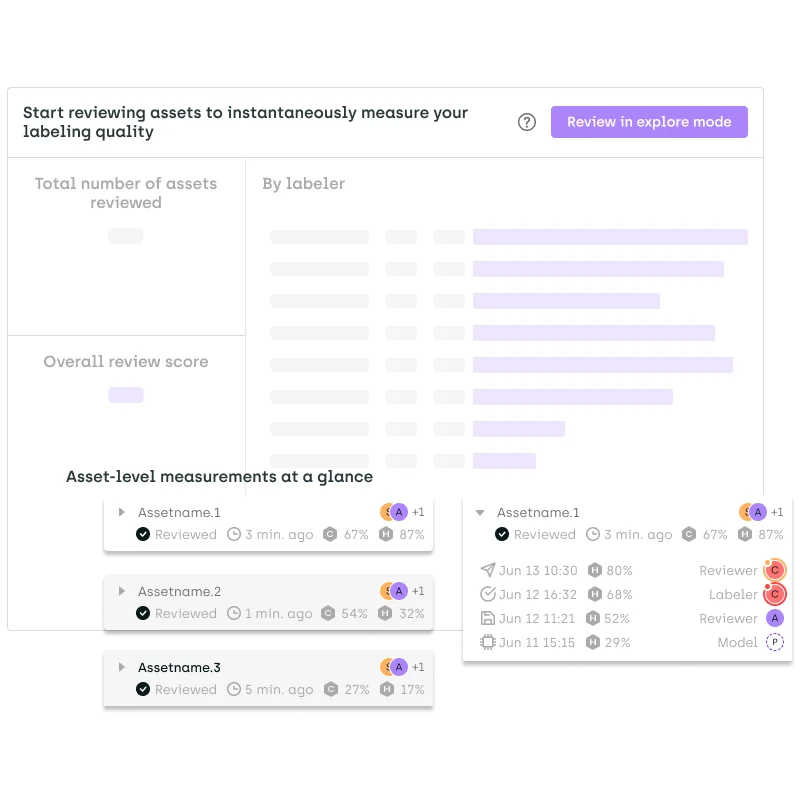
Quality you can measure and prove

Across labeling, SFT, RLHF, and evaluation, it's the same job: producing human judgments you can trust.

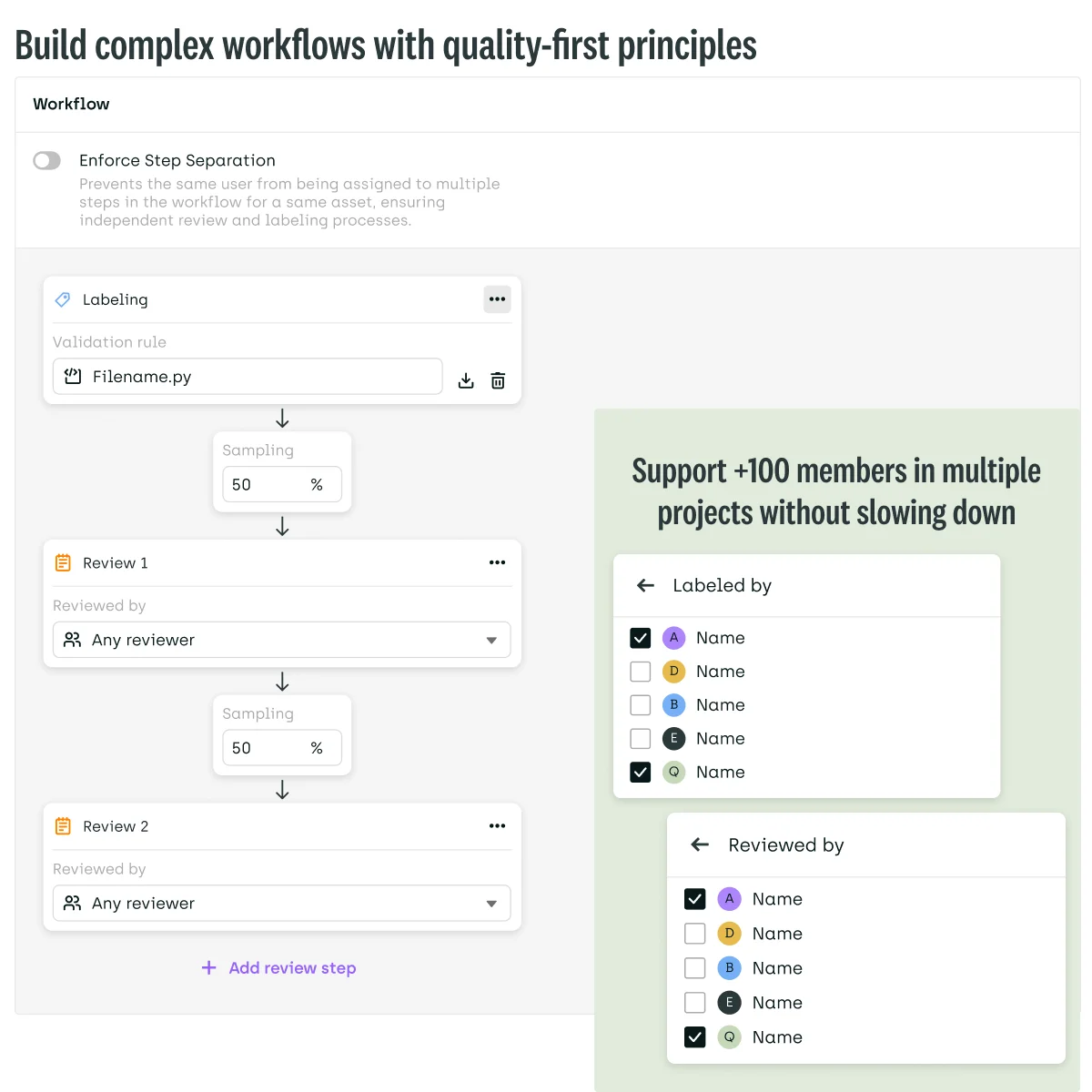
Configure multi-stage review with named steps, set the sampling rate between each step, and enforce step separation so no one reviews their own work. Then measure quality several independent ways — gold-standard testing catches accuracy drift, consensus measures agreement on subjective judgments (critical for RLHF and evaluation), review scoring captures human QA, and human-model agreement benchmarks labels against model predictions.

Learn More
Features

Built to scale, built to hold up

Operations grow from a handful of experts to hundreds of contributors across dozens of concurrent projects.

Kili is built for that: an organization-level user pool deployed across projects with role-based access, automatic workload distribution so no one collides, asset locking to prevent conflicts, queue prioritization, and per-contributor and per-project analytics so managers can see who's fast, who's accurate, and who needs coaching — without the platform slowing down as volume climbs.

Learn More
Features

Run it where your data has to live

Choose the deployment model per project and per contract: managed SaaS to start; Azure Marketplace as a private managed app in your own subscription; a hybrid "On-Premise Data" mode where the platform runs in the cloud but raw data never leaves your storage; or full on-premise on your own Kubernetes/Docker with no internet or root access required after install.

Each tier is contractually defined, so legal and security teams get clear data-residency boundaries in writing — and the same quality and scale capabilities travel with you wherever it runs.

Learn More

Why switch to Kili?

Kili vs Dataloop — both cover core annotation well. The differences are in how quality is enforced, what the data actually is, and where the platform can run.

Kili Dataloop
Data types Image, video, text, PDF, geospatial, audio Image, video, text, PDF, geospatial, audio
Geospatial & sensor imagery NITF, JP2, GeoTIFF, multispectral & hyperspectral multi-layer, RPC affine transformation, resampling, CRS control, GeoJSON export COG, GeoTIFF, OSM, XYZ tiles; lat/long annotations with EPSG:4326 export. Sensor-imagery formats not documented
Compliance SOC 2 Type II, ISO 27001:2022, HIPAA, GDPR SOC 2 Type II, ISO 27001, ISO 27701, GDPR — HIPAA not listed
Jurisdiction European company with a US subsidiary. SaaS hosting choice in Europe or the US US / Israel
Multi-stage review Named review stages, sampling rate set between each stage, enforced step separation so no one reviews their own work, per-step send-back rules Labeling tasks chained to QA tasks with issue/note loops
Quality signals Gold standard, consensus, review scoring, at item / contributor / project level Consensus, honeypot and qualification tasks
What a labeler can see Assigned assets only, or queue mode with no visibility into the dataset; labeler identities can be anonymised Pulling and distribution allocation methods; labeler anonymisation not documented
Deployment SaaS, hybrid mode where raw data never leaves your storage, and full on-premise SaaS, hybrid mode where raw data never leaves your storage, and full on-premise
Air-gapped operation No internet or root access required after install Not publicly documented
Version stability LTS releases twice a year with a one-year support window, so accredited environments stay on a fixed, patched version Continuous release; LTS track not documented
Customer data Contractual zero-data-retention: no customer data is ever used to train models Not publicly documented

Last verified against Dataloop's public documentation, July 2026. Something out of date? Let us know.

Migration Assistance

We're here to get things moving

Switching platforms usually stalls on one question: what happens to the data we've already labeled? We'll walk your existing projects, ontologies, and labels with you, map them onto Kili, and give you a written migration plan before any commitment. Most teams find the annotations transfer intact and only the review configuration needs rebuilding.

Use Cases

Where Kili Technology Excels

Kili Technology is trusted in highly-demanding industries where security and quality of data cannot be compromised

Large-scale work where expert judgment sets the quality bar

When expert-driven work has to scale. The judgments come from specialists — radiologists reading scans, linguists judging model outputs, domain experts ranking responses — and the challenge is holding that same rigor across a large, growing workforce instead of letting standards drift. Kili's infrastructure lets expert-grade quality scale with the operation.

Multi-project operations under mixed compliance regimes

When one organization runs many projects at once. Dozens of parallel workstreams, each with its own team, data type, and security requirements — some far stricter than others — and every project needs to stay cleanly separated rather than sharing data by default. Kili keeps each workstream isolated and lets deployment adapt project by project.

High-stakes data where quality must be provable, not assumed

For medical-imaging labels, physical AI data, or safety-critical evaluation, "the pipeline ran" isn't good enough — you need a defensible record of how each judgment was checked. Kili produces auditable quality evidence per contributor and per project.

Data-sovereign work for defense, government, and regulated enterprises

When data cannot touch third-party servers, full on-premise with no post-install internet dependency, a hybrid mode where raw data never leaves your storage, and three contractually-defined hosting tiers give legal teams what they need in writing.

Tools

Build structured datasets from all data types

Kili Technology is a complete data suite that supports all data types and handles specialized formats for domain-specific requirements.

Geospatial Imagery

Drive reliable mapping and monitoring through high-quality geospatial annotations.

OCR & Document Layout Analysis

Turn unstructured documents into usable data with accurate text extraction and streamlined review workflows.

Natural Language Processing

Annotate text for NER, classification, and sentiment analysis with collaborative workflows.

Image Annotation

Annotate images 10x faster with SAM 2 integration and automated quality controls.

Video Annotation

Annotate long videos seamlessly and boost productivity with advanced automation.

LLM & RAG Evaluation

Build quality-focused RLHF workflows and evaluate RAG systems with dynamic and static support.  

FAQ

Need help?

Whether you’re a small startup, a growing mid-sized business, or a large enterprise, we’re here to make things simple and support you at every step.

How does Kili measure data quality?
Can I keep my data on-premise with Kili?
Kili vs Dataloop for SFT, RLHF, or model evaluation?
Can Kili run air-gapped?
Testimonials

Trusted by teams around the world

We listen closely to our users — and build with their feedback in mind. Their success is what drives us forward.

I have been using Kili for 6 months now on a wide range of labeling use cases (both in computer vision and natural language processing). The stability offered by the tool is essential when you have tight deadlines and large volumes of data to annotate. Our team of over 1000 workers is accustomed to the tool, we were able to easily integrate our workforce management tool with Kili with the SSO functionality.
Kili is a powerful and easy-to-use tool for data labeling and annotation. The interface is user-friendly and offers several interesting features. The customer support team is also responsive and helpful.
Software to engage both labelers and business lines in the necessary but tedious task of labeling and annotation, served by a dedicated team to listen to your problems.
Thanks to the fact that our AI infrastructure now includes Kili Technology, we can use the tool for all kinds of projects... LCL teams can accelerate drastically the creation of their training datasets, which means a significant improvement for all the parties involved.
With the choice of Kili, we are much more confident about the future. We decided to eliminate a large part of the technical debt by choosing a solution that will be perfectly mastered across a whole range of data science and AI projects.
I have been using Kili for 6 months now on a wide range of labeling use cases (both in computer vision and natural language processing). The stability offered by the tool is essential when you have tight deadlines and large volumes of data to annotate. Our team of over 1000 workers is accustomed to the tool, we were able to easily integrate our workforce management tool with Kili with the SSO functionality.
Kili is a powerful and easy-to-use tool for data labeling and annotation. The interface is user-friendly and offers several interesting features. The customer support team is also responsive and helpful.
Software to engage both labelers and business lines in the necessary but tedious task of labeling and annotation, served by a dedicated team to listen to your problems.
Thanks to the fact that our AI infrastructure now includes Kili Technology, we can use the tool for all kinds of projects... LCL teams can accelerate drastically the creation of their training datasets, which means a significant improvement for all the parties involved.
With the choice of Kili, we are much more confident about the future. We decided to eliminate a large part of the technical debt by choosing a solution that will be perfectly mastered across a whole range of data science and AI projects.