Learn best practices for combining LLM-as-a-judge and HITL workflows for reliable AI.

Download the Report →
Product

Coordinate hundreds of annotators across dozens of projects — without losing control

Manage annotation workflows that scale from agile expert teams to large-scale operations with defined roles. Kili's collaboration architecture gives operations leaders the structure to scale teams from a handful of experts to hundreds of annotators — with role-based access, automatic task distribution, performance tracking per annotator, and quality gates that hold across every project.

*No credit card required. Risk-free evaluation.

Trusted by the world leaders

Features

Workflow orchestration for complex annotation operations

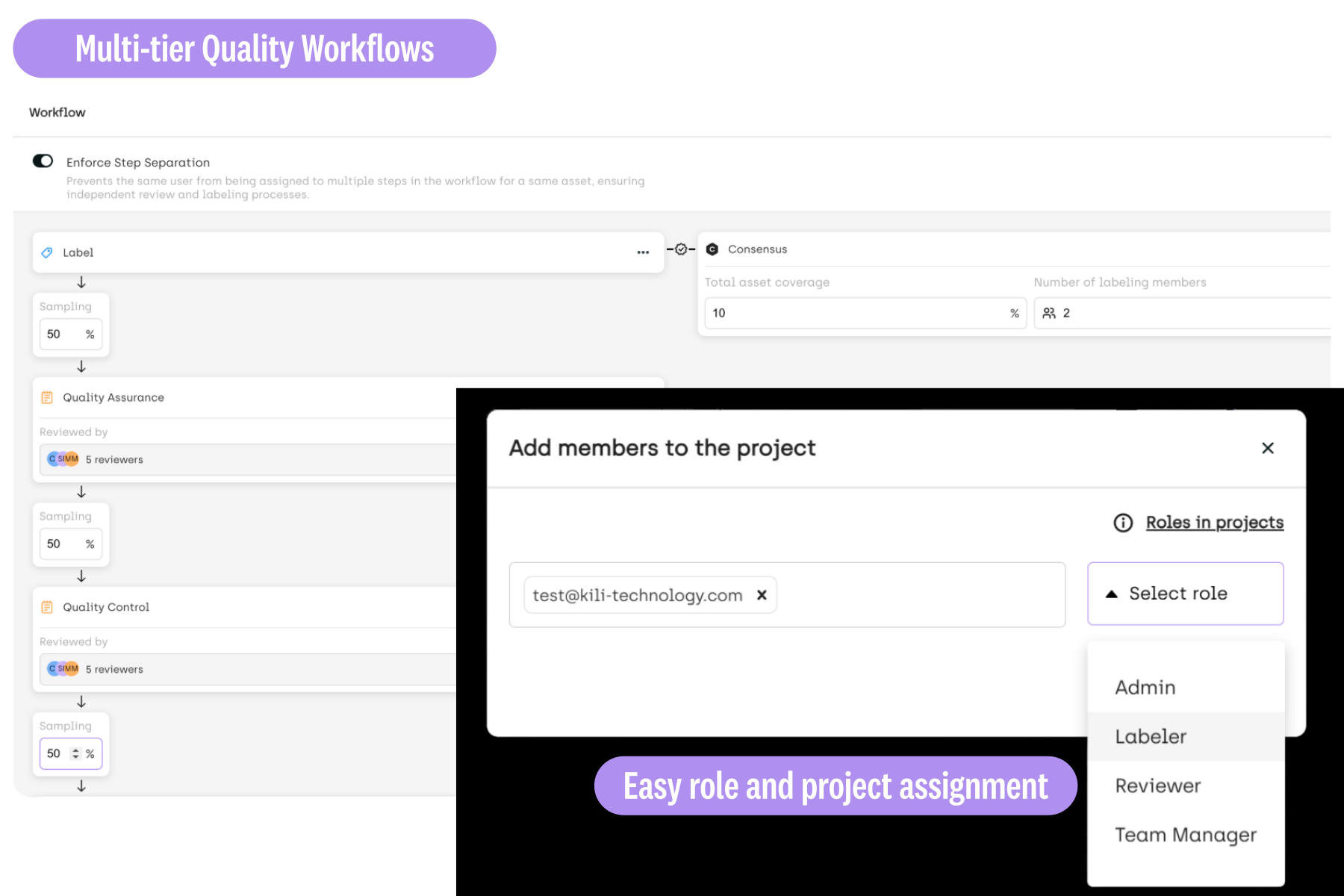
Define multi-step annotation and review workflows where each step is assigned to a specific group. Set sampling rates between steps — send 100% of assets to the first review, then sample 20% for a senior review pass. Enforce step separation so no annotator reviews their own work. Kili automatically distributes assets to annotators so each person processes unique data, with asset locking to prevent edit conflicts. When your operation has 200 annotators across 30 projects, this kind of structured orchestration is what keeps quality consistent and throughput predictable.

Book a Demo
Features

Know where label quality is holding back model performance — across every project.

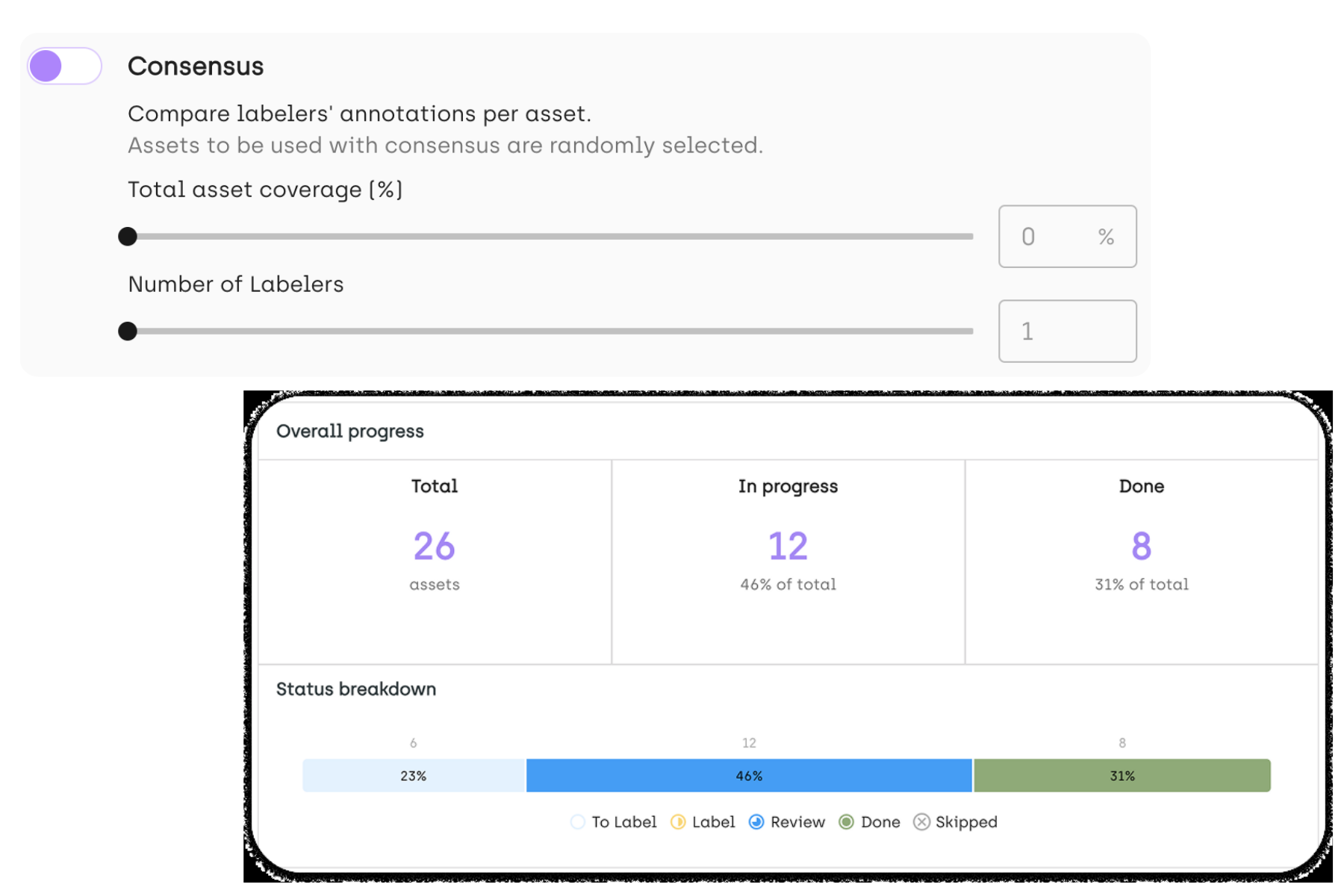
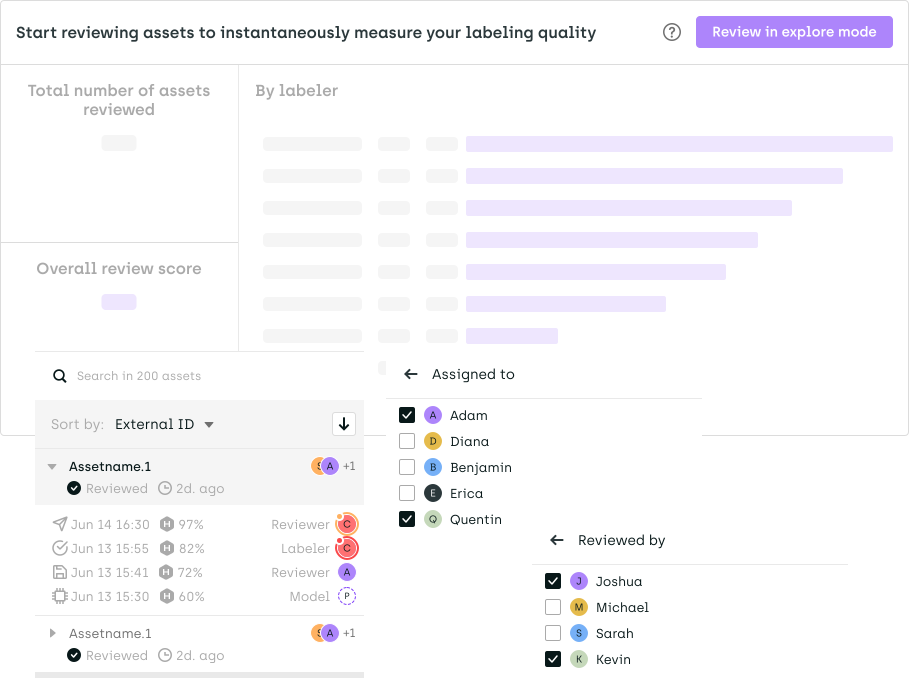
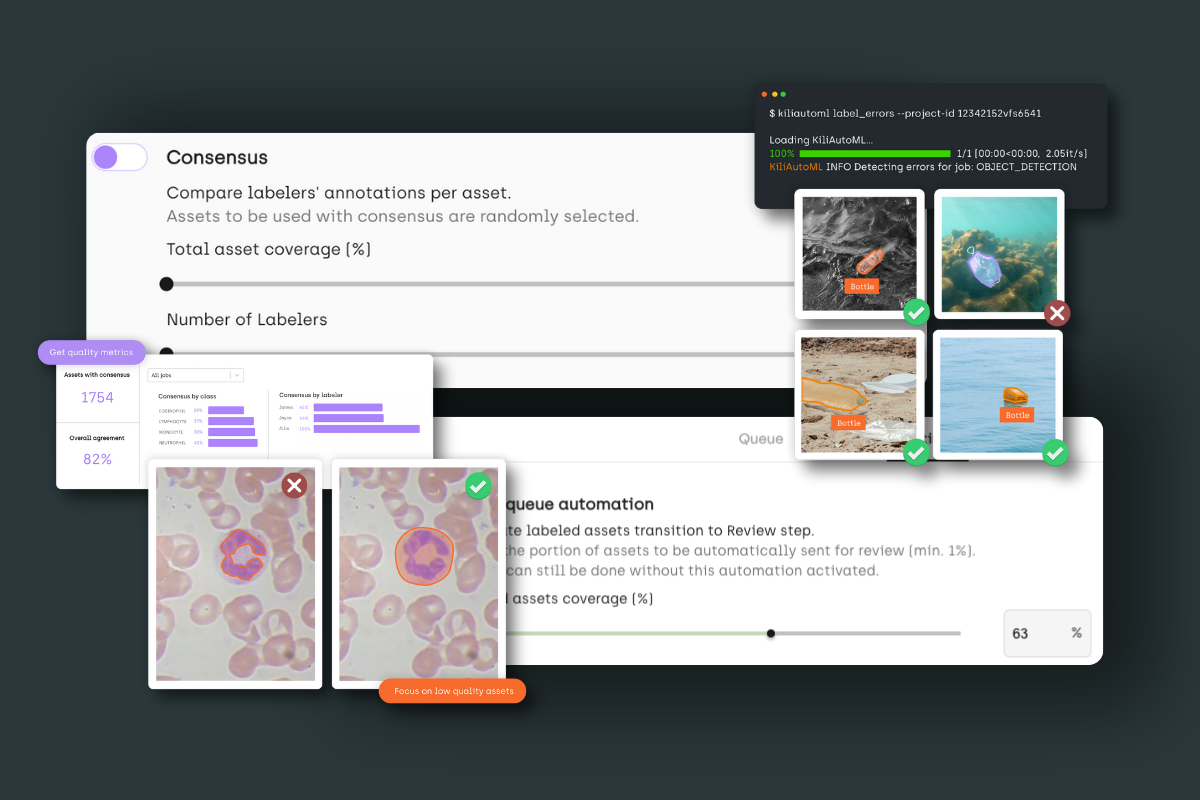
Kili measures quality through four distinct mechanisms: Honeypot testing (ground-truth assets embedded in the queue to measure individual accuracy), Consensus scoring (inter-annotator agreement), Review scores (original label vs. reviewed version), and Human-model IoU (annotations vs. model predictions). All four are computed per annotator, per asset, and per project.

Book a Demo
Features

Built-in feedback loops that keep distributed teams aligned

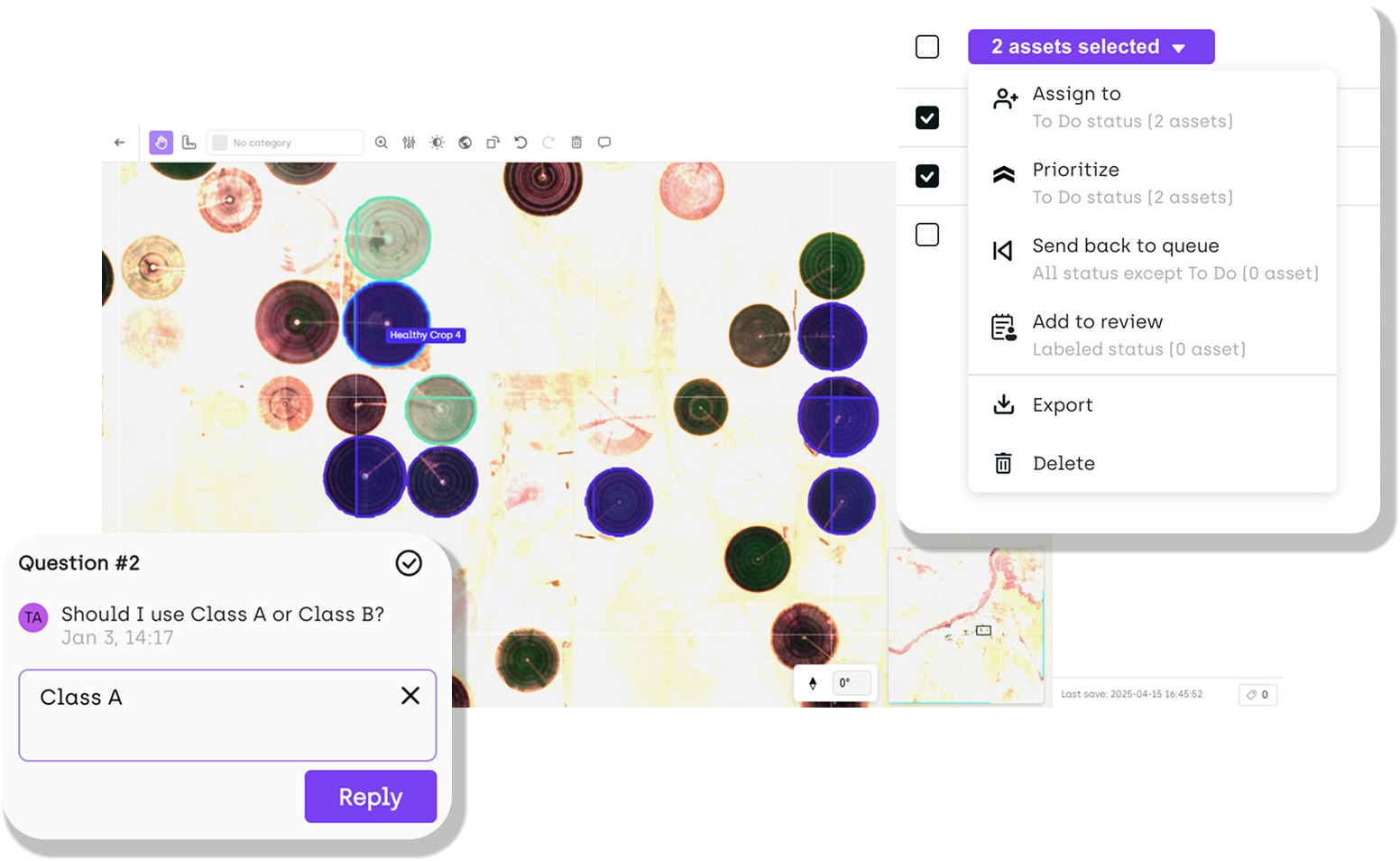
When reviewers find a problem, they flag the specific annotation — not just the whole asset — with context on what went wrong. Labelers see open issues when they return to the asset and can correct in place. For edge cases that need discussion, the conversation happens inside the platform, attached to the object in question. No email chains, no spreadsheet trackers, no ambiguity about which annotation in which project someone means. When your team is distributed across time zones, contextual communication like this is what keeps the operation running.

Book a Demo
Tools

Build structured datasets from all data types

Kili Technology is a complete data suite that supports all data types and handles specialized formats for domain-specific requirements.

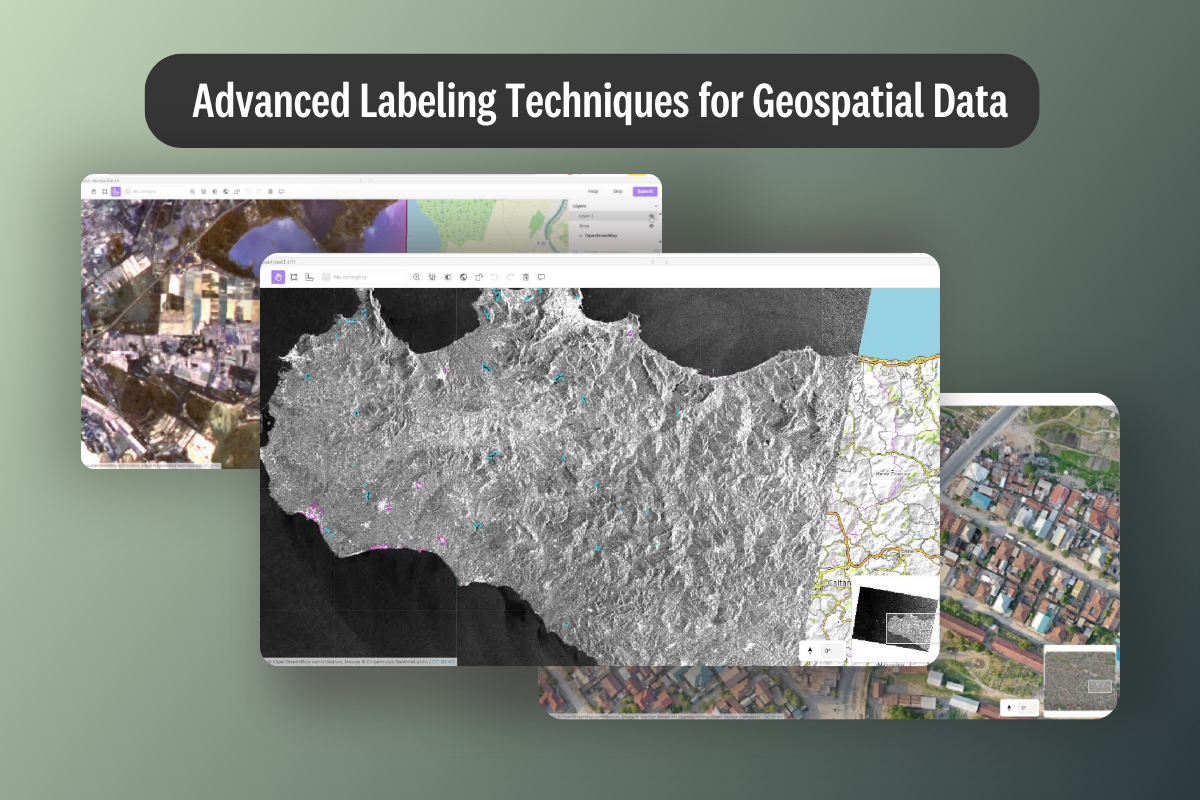
Geospatial Imagery

Drive reliable mapping and monitoring through high-quality geospatial annotations.

OCR & Document Layout Analysis

Turn unstructured documents into usable data with accurate text extraction and streamlined review workflows.

Natural Language Processing

Annotate text for NER, classification, and sentiment analysis with collaborative workflows.

Image Annotation

Annotate images 10x faster with SAM 2 integration and automated quality controls.

Video Annotation

Annotate long videos seamlessly and boost productivity with advanced automation.

LLM & RAG Evaluation

Build quality-focused RLHF workflows and evaluate RAG systems with dynamic and static support.  

Performance visibility across your entire operation

Product photo of breast cell segmentation on Kili Technology's platform
  • Per-annotator productivity tracking

    See how long each annotator spends per asset, their throughput rate, and how their speed trends over time. Identify bottlenecks before they become backlogs.
  • Quality scores that mean something

    Honeypot accuracy, Consensus agreement, and Review score — tracked per person, per project. Weighted averages handle complex ontologies with multiple labeling jobs.
  • Project-level analytics that scale with your operation.

    Track quality and productivity per annotator within each project. Filter and sort your full project list by progress, tags, and status. Export metrics via the API for cross-project reporting.
Use Cases

High-precision labeling built for large datasets

Where large teams and complex workflows meet consistent quality

Distributed Annotation Workforces

Coordinate hundreds of annotators across locations and time zones on concurrent projects. Automatic task distribution ensures each person processes unique data, asset locking prevents conflicts, and role-based permissions give every team member exactly the access they need — nothing more.

Multi-Stage Quality Programs

Configure review workflows where every annotation passes through multiple checkpoints — with sampling rates, step separation enforcement, and consensus scoring between annotators. Track quality per person and per class to catch drift early and keep output consistent across high-volume workstreams.

Annotation Team Onboarding & Performance Management

Onboard new annotators into active projects without disrupting production. Use Honeypot testing to measure accuracy from day one, track per-annotator productivity over time, and identify who's ready for complex tasks — and who needs additional guidance — using data from the Analytics dashboard.

Cross-Functional AI Projects

Bring together data scientists configuring ontologies, domain experts validating edge cases, and annotation teams executing at volume — all within the same project. Four project-level roles (Labeler, Reviewer, Team Manager, Admin) keep responsibilities clear so each group contributes without stepping on the others' work.
Ready to Start?

Test out the tool now or go for a deeper evaluation

You can also check out our documentation to learn more about our features. We're ready when you are.

Plans

Free Trial

Test out our platform for your use cases, no credit card required.

$0
/month
  • 1 team seat
  • 100 asset limit for text, documents, and images
  • 5 asset limit for video and satellite imagery
  • AI-assisted labeling
  • * For evaluating more advanced use cases, speak with our team
Sign-Up

Enterprise

For organizations requiring advanced security and customization

Custom Contract
All Grow features
including:
  • Custom seat allocation
  • Custom terms
  • SSO integration
  • Advanced security features
Get Started
FAQ

Need help?

Got questions about Kili Technology? Check out our FAQ. If you can't find it in this list, drop a question for our team.

How many annotators can work simultaneously on Kili Technology?
What collaboration features does Kili provide for large teams?
How does Kili handle workflow orchestration at scale?
Can Kili integrate with our existing ML infrastructure?
What API capabilities does Kili offer for automation?
Testimonials

Trusted by teams around the world

Learn how Kili Technology has changed the way these teams train, fine-tune, and evaluate their models.

No items found.
I have been using Kili for 6 months now on a wide range of labeling use cases (both in computer vision and natural language processing). The stability offered by the tool is essential when you have tight deadlines and large volumes of data to annotate. Our team of over 1000 workers is accustomed to the tool, we were able to easily integrate our workforce management tool with Kili with the SSO functionality.
Kili is a powerful and easy-to-use tool for data labeling and annotation. The interface is user-friendly and offers several interesting features. The customer support team is also responsive and helpful.
Software to engage both labelers and business lines in the necessary but tedious task of labeling and annotation, served by a dedicated team to listen to your problems.
Thanks to the fact that our AI infrastructure now includes Kili Technology, we can use the tool for all kinds of projects... LCL teams can accelerate drastically the creation of their training datasets, which means a significant improvement for all the parties involved.
With the choice of Kili, we are much more confident about the future. We decided to eliminate a large part of the technical debt by choosing a solution that will be perfectly mastered across a whole range of data science and AI projects.