.png)

_logo%201.svg)


AI Summary
- K2.6's published spec matches K2.5's 1T-parameter / 32B-active MoE architecture; weights can swap in-place.
- Independent evaluation (Artificial Analysis) ranks K2.6 #4 across all AI models tested and #1 among open-weight models.
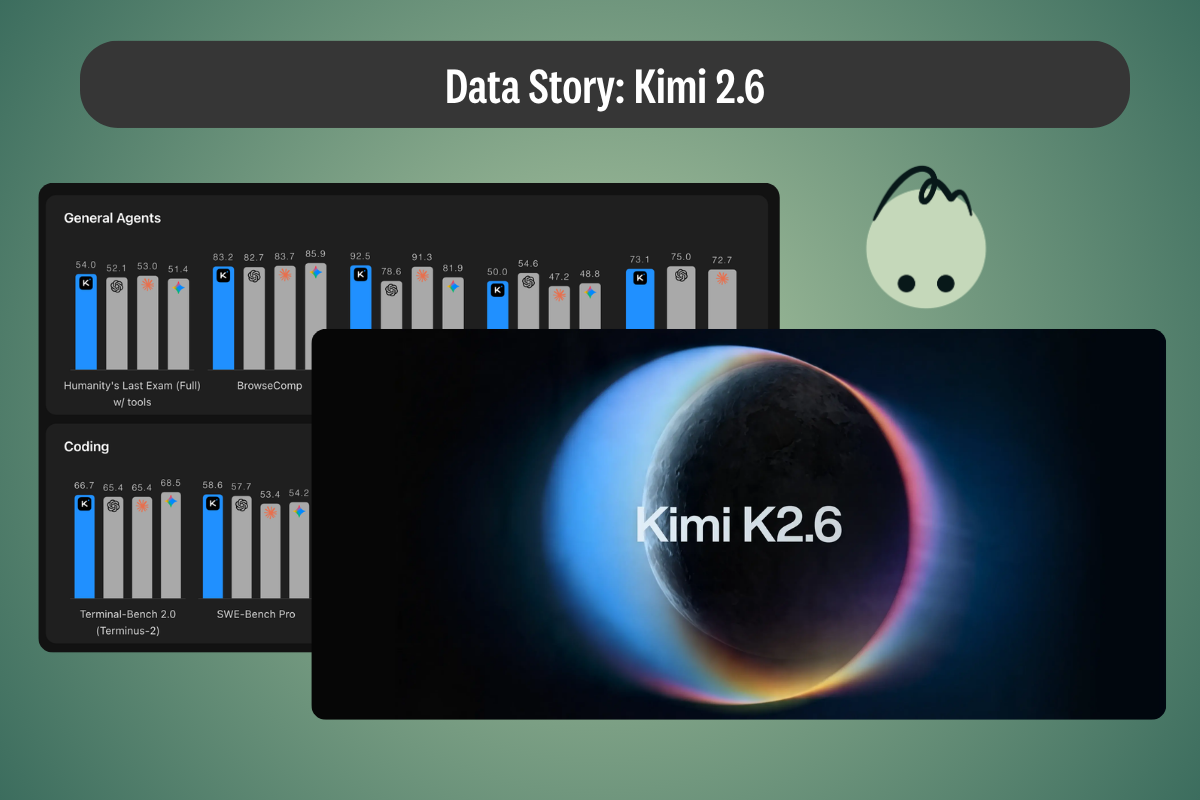
- On SWE-Bench Pro, K2.6 scores 58.6 — ahead of GPT-5.4 (57.7), Claude Opus 4.6 (53.4), and Gemini 3.1 Pro (54.2) on one of the hardest coding tasks in current AI benchmarks.
- Hallucination rate on AA-Omniscience fell from 65% (K2.5) to 39% (K2.6), approaching Claude Opus 4.7.
- Native INT4 quantization via QAT cuts the footprint to ~594 GB with ~2× generation speedup.
- Kili Technology helps teams close the gap between open-weight capability and production agent reliability with expert-labeled trajectories, calibration-focused evaluation sets, and tool-use grading by 2,000+ verified domain specialists.
Introduction
Kimi K2.6 dropped on April 21, 2026. Per Moonshot's model card, the architecture is identical to K2.5 down to the parameter count — a re-trained model with a revised post-training pipeline rather than a new topology. Artificial Analysis now ranks this 1T-parameter Mixture-of-Experts system #4 across 346 models and #1 among open-weight releases.
On SWE-Bench Pro, K2.6 edges past GPT-5.4 by 0.9 points and clears Claude Opus 4.6 by five. The hallucination rate on AA-Omniscience fell from 65% on K2.5 to 39% on K2.6 — a calibration jump that matters more for production deployment than most top-line benchmark gains.
The gains concentrate in agentic coding and tool use. On pure reasoning tasks — HLE without tools, GPQA-Diamond — K2.6 trails Gemini 3.1 Pro by eight to ten points. The model was trained for a specific class of work, and it shows.
How Does K2.6 Differ from K2.5 Architecturally?
Per Moonshot's own documentation, it doesn't. The Kimi-K2.6 model card lists the same 61 layers, the same 7,168-dimension hidden state, the same 384 experts (8 routed + 1 shared per token), the same Multi-head Latent Attention (MLA), and the same 400M-parameter MoonViT vision encoder. The context window is still 256K tokens. The vocabulary is still 160K. The model card is a vendor spec sheet rather than a peer-reviewed paper — no dedicated K2.6 technical report has been published as of April 22, 2026 — but the published parameter count, layer count, and expert configuration all match K2.5.
A deployment running K2.5 can swap in K2.6 model weights without re-provisioning hardware or rewriting inference code. Cloudflare, Baseten, Fireworks, OpenRouter, Novita, Parasail, and Ollama — all model providers that host open-weight releases — had K2.6 live on day zero, partly because the Workers AI integration only needed a weight update.
Moonshot appears to have settled on MLA's KV-cache compression — the attention optimization choice SiliconANGLE flagged — and left it alone for this release. If a K2.6 technical report later surfaces changes beyond the parameter count, this framing will need revising; until then, the model card is the primary source.
What Was K2.6 Trained On, and Why Does MuonClip Matter?
The full training data breakdown for K2.6 specifically is undisclosed. What we do have is the Kimi K2 foundation paper, which documents the base model that K2.6 is still built on. That base was pretrained on 15.5 trillion tokens across four domains: Web Text, Code, Mathematics, and Knowledge. The global batch size was 67 million tokens. Learning rate followed a cosine decay from 2e-4 to 2e-5. Pretraining context was a conservative 4,096 tokens; long-context extension happened later.
Moonshot used MuonClip for training — an extension of the Muon optimizer with a technique they call QK-Clip, a per-head clipping rule applied to query and key projections with threshold τ=100. The paper reports that the full 15.5T-token run completed without a single loss spike, a falsifiable claim that few vendor reports at this scale have been willing to make.
The agentic specialization is built in post-training. The pipeline, as described in the foundation paper, runs in three stages: supervised fine-tuning, large-scale agentic trajectory synthesis, then reinforcement learning that combines Reinforcement Learning with Verifiable Rewards (RLVR) with a self-critique rubric mechanism. In the trajectory synthesis stage, Moonshot simulates thousands of Model Context Protocol (MCP) tools and synthetic tools, generates tool-use trajectories against them, and filters through multi-agent review. The paper's t-SNE visualization shows synthetic tools spanning the same embedding space as real MCP tools — meaning the synthetic distribution isn't degenerate.
A pattern keeps appearing across frontier model reports: the models that perform best at agentic work aren't the ones with the most data; they're the ones with the most carefully curated tool-use trajectories. Training recipes matter more than scale at this point, and synthetic data pipelines only work if the filtering is done by people who understand what "correct agent behavior" means in context.
What Do the Benchmarks Actually Show?
Start with independent evaluation, because self-reported numbers from any vendor's official reports need cross-checking against publicly available scores. Artificial Analysis places K2.6 at 54 on its Intelligence Index v4.0. Claude Opus 4.7, Gemini 3.1 Pro, and GPT-5.4 all sit at 57. The index aggregates ten evaluations covering agentic, coding, reasoning, and knowledge tasks. On τ²-Bench Telecom, an agentic evaluation, K2.6 hits 96%. On GDPval-AA Elo — a head-to-head comparative eval — K2.6 scores 1520, up from K2.5's 1309.
Moonshot's own numbers, published on the Kimi K2.6 blog post, are averaged over 10 independent runs per coding task — a level of disclosure most vendor benchmarks skip. All top models in the table below were evaluated at their vendors' maximum reasoning configuration (xhigh reasoning effort for GPT-5.4, max effort for Claude Opus 4.6, high thinking mode for Gemini 3.1 Pro), so the report scores obtained reflect the same conditions across vendors:
| Benchmark | Kimi K2.6 | GPT-5.4 (xhigh) | Claude Opus 4.6 (max) | Gemini 3.1 Pro (high) |
|---|---|---|---|---|
| SWE-Bench Pro | 58.6 | 57.7 | 53.4 | 54.2 |
| SWE-Bench Verified | 80.2 | — | 80.8 | 80.6 |
| SWE-Bench Multilingual | 76.7 | — | — | — |
| Terminal-Bench 2.0 | 66.7 | 65.4 | 65.4 | 68.5 |
| HLE-Full (no tools) | 34.7 | 39.8 | 40.0 | 44.4 |
| HLE with tools | 54.0 | 52.1 | 53.0 | 51.4 |
| AIME 2026 | 96.4 | 99.2 | 96.7 | 98.3 |
| GPQA-Diamond | 90.5 | 92.8 | 91.3 | 94.3 |
| AA Intelligence Index | 54 | 57 | 57 | 57 |
K2.6's SWE-Bench Pro lead over GPT-5.4 is 0.9 points — inside the noise of any benchmark that isn't averaged over hundreds of runs. The five-point gap over Claude Opus 4.6 is more durable. On SWE-Bench Verified, K2.6 is within a point of Claude and Gemini — call it a tie.
K2.6 has reached parity with frontier closed models in agentic coding and tool-augmented reasoning, while trailing meaningfully on reasoning without tools. HLE without tools shows K2.6 at 34.7 versus Gemini 3.1 Pro at 44.4 — a ten-point gap, not a rounding error. The training recipe is optimized for a specific class of work. That gap between headline scores and task-specific strength is exactly why domain-specific benchmarks have become the more useful lens than general leaderboards.
What Is the Agent Swarm, and Is the 300-Agent Claim Meaningful?
Agent Swarm is K2.6's default agent framework. Given a complex task, K2.6 spawns specialized sub-agents that run in parallel, each handling a slice of the work, then aggregates results — coordinating many independent agents that execute code and call tools across a session. The capacity has scaled: 300 sub-agents running 4,000 coordinated steps in K2.6, up from 100 agents and 1,500 steps in K2.5. On BrowseComp with Agent Swarm enabled, K2.6 scores 86.3 against K2.5's 78.4 — a jump that reflects both better instruction following and better task decomposition.
Moonshot published two showcase runs with the release, both emphasizing long-horizon performance optimization. In one, K2.6 spent 12 hours optimizing a Zig-based LLM inference engine, making 4,000+ tool calls and pushing Qwen3.5-0.8B throughput on a Mac from ~15 to ~193 tokens/second — roughly 20% faster than LM Studio. In another, K2.6 spent 13 hours overhauling an exchange-core matching engine, making 1,000+ tool calls across 4,000+ lines of modified code and achieving a 185% median throughput gain.
These are Moonshot's internal demonstrations. No academic or third-party replication of the 300-agent swarm claim has been published as of April 2026. Launch-partner testimonials from Baseten, Vercel, Blackbox.ai, and CodeBuddy (which reports 96.6% tool-call success) are vendor-incentivized — useful as existence claims that these companies shipped K2.6 integrations on day zero, less useful as capability assessments.
K2.6's architecture rewards long-horizon, tool-heavy workloads. If your production use case is "an agent that runs for hours across many tools," the benchmarks suggest K2.6 is worth piloting. If your workload is closer to pure knowledge retrieval or multi-step reasoning against hard questions, the top reasoning models from closed vendors — Gemini 3.1 Pro or Claude Opus 4.7 — still hold the advantage.
Why Does Native INT4 Quantization Change the Deployment Math?
K2.6 inherits the INT4 quantization scheme introduced in Kimi K2 Thinking. The technique is Quantization-Aware Training (QAT), which simulates low-precision arithmetic during post-training while maintaining full-precision weights — so by the time quantization is applied to MoE components, the model has already adapted to the accuracy loss. DeepLearning.AI's coverage of K2 Thinking described the outcome: roughly 2× generation speedup versus FP8, with the full model footprint landing near 594 GB — down from ~1 TB at FP16. All benchmarks Moonshot reports for K2.6 are run at INT4.
Minimum viable hardware sits at 4× H100 with INT4 at reduced context. Full deployment with the 256K context window is recommended on 8× H200 or H20 configurations. A well-resourced team can realistically self-host the model.
That matters for data sovereignty. For enterprises handling regulated data — healthcare, finance, defense, public sector — the ability to run a frontier-class model on owned infrastructure without sending inference traffic to a closed-API vendor is a substantive capability. The Modified MIT license (full terms on GitHub) allows commercial use below 100M MAU or $20M MRR without attribution. Above that threshold, a "Kimi K2" UI attribution is required.
There's a geopolitical subtext too. INT4-native inference means K2.6 runs well on less-advanced accelerators — including the H20s currently available in China. South China Morning Post's coverage situates the release within a broader pattern: Alibaba, ByteDance, and Tencent have been signaling open-source support, with Alibaba Cloud and Zhipu adopting hybrid approaches. K2.6 fits that positioning.
Has K2.6 Actually Become More Reliable, or Just Better at Benchmarks?
On AA-Omniscience — a benchmark designed to measure whether a model abstains when uncertain rather than fabricating answers — K2.6 posts a 39% hallucination rate, down from 65% on K2.5. That's close to Claude Opus 4.7's 36% and MiniMax-M2.7's 34%.
A 26-point calibration drop inside one iteration, with no architecture change, is the kind of result that gets hard to explain as benchmark hacking. Moonshot's post-training improvements taught the model when to say "I don't know." Models that won't abstain look better on accuracy benchmarks that don't penalize confident wrong answers, and worse on benchmarks like AA-Omniscience that explicitly measure refusal calibration.
Hallucination calibration is the difference between a model you can put behind a customer-facing agent and one you can't. For most production deployments, calibration outranks a 0.9-point SWE-Bench Pro lead.
The caveat is that no independent safety or red-team evaluation has been published for K2.6. There is no system card describing jailbreak resistance, refusal policy details, or agentic misuse evaluations — the areas where human oversight during deployment is usually the backstop. The hallucination improvement is real, but it's one narrow slice of reliability.
What Are the Honest Limits of K2.6?
First, no K2.6-specific technical report exists yet. The Hugging Face model card references the K2.5 paper (arXiv 2602.02276), not a new one. What changed in training between K2.5 and K2.6 is vendor-described, not documented in a preprint.
Second, training-data composition for K2.6 specifically is undisclosed. The 15.5T-token figure comes from the K2 foundation paper. What additional tokens, filtering choices, or synthetic data went into K2.6 is not public. Knowledge cutoff is reported as "around April 2025," unverified.
Third, independent benchmarking is thin. Artificial Analysis is the primary external evaluator to date. Epoch AI, METR, and Stanford CRFM HELM have not yet published K2.6 analyses.
Fourth, K2.6 is more compute-intensive than GPT-5.4 at full thinking depth. Running the complete Artificial Analysis Intelligence Index required roughly 160M reasoning tokens — between Claude Sonnet 4.6 (190M) and GPT-5.4 (110M). Moonshot's official API lists input pricing at $0.60/M, which keeps K2.6 among the cheapest models in its capability tier, but the per-token gap against closed-model alternatives isn't as wide as it looks once thinking-depth consumption is factored in.
Where K2.6 Leaves the Open-Weight Landscape
K2.6 is proof that frontier capabilities in agentic coding are no longer structurally locked behind closed APIs. An open-weight model, running on owned infrastructure at INT4, can match or exceed GPT-5.4 on SWE-Bench Pro. Enterprises building long-horizon coding agents now have leverage they didn't have six months ago. The same open-weight shift is visible on the training-data side of another frontier release, which we cover in our deep dive into DeepSeek V4.
What K2.6 isn't is a general-purpose replacement for frontier closed models. It was trained to be exceptional at agentic tool use, and it is. On raw reasoning without tools, it trails by a substantial margin. The right question for any team evaluating K2.6 isn't "is this as good as GPT-5.4?" — it's "does our workload look more like SWE-Bench Pro or more like HLE?"
Where the remaining differentiation lives is worth thinking about. On the published spec, architecture is the same between K2.5 and K2.6. The gap Moonshot points to sits entirely in training data and post-training technique: the MCP tool simulation, the RLVR pipeline, the self-critique mechanism, the calibration work that halved the hallucination rate. Teams building production agents over the next eighteen months will need to take tool-use data curation and trajectory quality as seriously as Moonshot appears to have.
What Frontier Agentic Performance Actually Requires
K2.6's most interesting result isn't the SWE-Bench Pro lead — it's the 26-point drop in hallucination rate from a training pipeline change alone. The gains at the frontier are coming from curated tool-use trajectories, careful evaluation, and post-training signal quality. Data engineering work, done by people who understand what "correct behavior" looks like in the specific domain.
That's where Kili Technology operates. The work of labeling agentic trajectories, building evaluation sets that catch calibration failures (the discipline laid out in our guide on how to build a custom AI benchmark), and grading tool-use correctness in specialized domains — from Lean 4 theorem proving to practicing-attorney review to 40+ language coverage — is done by Kili's 2,000+ verified domain specialists rather than crowdworkers. For teams building long-horizon agents where the gap between K2.6-class capability and production reliability is the training data, that specialization is the differentiator.
Resources
Primary Sources — Moonshot AI
- Kimi-K2.6 Model Card — architecture and deployment specifications
- Kimi K2.6: Advancing Open-Source Coding — Moonshot's release blog, benchmarks, showcases
- Kimi K2 Modified MIT License — full licensing terms
- Kimi-K2-Thinking Model Card — predecessor release documenting INT4 / QAT methodology
Technical Papers
- Kimi K2: Open Agentic Intelligence (arXiv preprint) — foundation model paper covering MuonClip, pretraining, and post-training pipeline
Independent Evaluation
- Artificial Analysis: Kimi K2.6 — The New Leading Open Weights Model — Intelligence Index v4.0 ranking
- Artificial Analysis: Kimi K2.6 Model Page — intelligence, performance, and price analysis
Deployment & Infrastructure
- Cloudflare Workers AI: Kimi K2.6 — day-zero inference integration
Journalism & Analysis
- DeepLearning.AI: Kimi K2 Thinking Outperforms Proprietary Models — coverage of INT4 / QAT methodology and reported training economics
- South China Morning Post: Moonshot AI Releases Flagship Model — geopolitical and open-source market context
- SiliconANGLE: Moonshot AI Releases Kimi-K2.6 — attention optimization details
- The Decoder: Open-weight Kimi K2.6 Takes On GPT-5.4 and Claude Opus 4.6 — comparative analysis
- Yicai Global: China's Moonshot AI Releases Kimi K2.6 — Chinese market perspective
- Latent Space (AINews): Moonshot Kimi K2.6 — technical community coverage
Reference
- Wikipedia: Kimi (chatbot) — release timeline reference
Frequently Asked Questions
What is Kimi K2.6?
Kimi K2.6 is an open-weight large language model from Moonshot AI, released in April 2026. It is a 1-trillion-parameter Mixture-of-Experts system with 32 billion parameters active per token, supporting a 256K-token context window. Artificial Analysis ranks it #1 among open-weight models.
How does K2.6 differ from K2.5 architecturally?
Per Moonshot's model card, it doesn't. K2.6 lists the same 61 layers, 7,168-dimension hidden state, 384 experts, Multi-head Latent Attention, and MoonViT vision encoder as K2.5. All gains come from a revised post-training pipeline rather than a new architecture.
What training data was Kimi K2.6 trained on?
The full K2.6-specific training data breakdown is undisclosed. The K2 foundation paper documents a base model pre-trained on 15.5 trillion tokens across Web Text, Code, Mathematics, and Knowledge domains. What additional tokens or filtering went into K2.6 specifically is not public.
How does K2.6 perform on coding benchmarks?
On SWE-Bench Pro, K2.6 scores 58.6 — ahead of GPT-5.4 (57.7) and Claude Opus 4.6 (53.4). On SWE-Bench Verified it scores 80.2, within a point of Claude and Gemini. However, on reasoning without tools (HLE-Full), K2.6 trails Gemini 3.1 Pro by nearly ten points.
What is Agent Swarm?
Agent Swarm is K2.6's default agent framework that spawns specialized sub-agents running in parallel to handle complex tasks. K2.6 can coordinate up to 300 sub-agents across 4,000 steps — up from 100 agents and 1,500 steps in K2.5. On BrowseComp with Agent Swarm enabled, K2.6 scores 86.3 versus K2.5's 78.4.
Can I self-host Kimi K2.6?
Yes. Native INT4 quantization via Quantization-Aware Training reduces the footprint to roughly 594 GB with approximately 2× generation speedup versus FP8. Minimum viable hardware is 4× H100 at reduced context, with 8× H200 or H20 recommended for the full 256K context window. The Modified MIT license allows commercial use below 100M MAU or $20M MRR without attribution.
Has K2.6 improved on hallucination rates?
Yes. On AA-Omniscience, K2.6 posts a 39% hallucination rate, down from 65% on K2.5 — a 26-point improvement with no architecture change. That rate approaches Claude Opus 4.7's 36%. The improvement came entirely from post-training calibration work that taught the model when to abstain rather than fabricate.
Building Production Agents? Start with the Right Evaluation Data.
Kili Technology helps enterprise teams close the gap between open-weight model capability and production agent reliability. From expert-labeled tool-use trajectories to calibration-focused evaluation sets graded by 2,000+ verified domain specialists, Kili provides the data infrastructure that agentic AI systems need to perform in the real world — not just on benchmarks.